


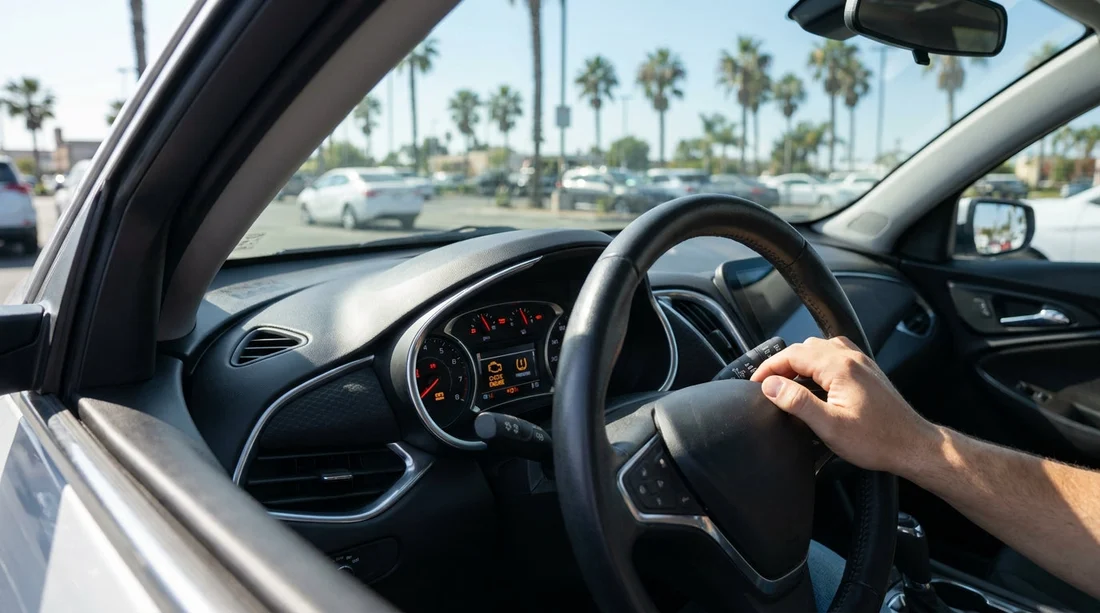
Quick Summary:
- Turn ignition on, confirm red warning lights go out after start-up.
- Photograph any persistent icons and note mileage, fuel level, and time.
- Flag brake, oil, temperature, and airbag lights before leaving the bay.
- Verify tyre pressure warning, then inspect tyres for obvious damage.
Picking up a car hire in California often means bright sun, busy bays, and a quick handover. That is exactly when it pays to pause for a 60 second dashboard scan. Modern cars run a brief self-check, many icons illuminate, then most should turn off once the engine is running. The goal is not to diagnose the vehicle yourself, it is to spot anything that should be raised at the counter before you merge onto the freeway.
Do this check while you are still parked in the bay: start the engine, keep your foot on the brake, and look for any red lights that stay on or any amber lights that indicate a fault. If something remains illuminated, take a clear photo of the instrument cluster and the odometer. Then speak to staff straight away so the issue is documented, or the vehicle is swapped if needed.
If you are collecting at a major hub like Los Angeles LAX or San Francisco SFO, you may be driving straight into dense traffic. A warning light that could be manageable around town can become stressful on an interchange. A quick check reduces the risk of delays, disputes, or a roadside callout later.
How to run a fast warning light check in the rental bay
Use a simple sequence so you do not miss anything:
1) Ignition on, engine off: Many lights will illuminate briefly. This is normal and confirms the bulbs or display work.
2) Start the engine: Within a few seconds, most icons should extinguish. Some amber reminders may remain, such as low washer fluid or a service due notice.
3) Check the centre display messages: Some cars show “check system” text rather than a classic symbol.
4) Test basics: Press the brake pedal, check the parking brake releases, and ensure the gear indicator behaves normally.
5) Record evidence: If a light stays on, photograph it, then report it before driving off.
Red warning lights to flag immediately
Red typically means stop, or do not continue until the problem is understood. In a car hire, that translates to “flag at the counter”.
Oil pressure (oil can icon): If this stays on after start-up, do not drive. Low oil pressure can cause severe engine damage quickly. Ask for another vehicle or assistance.
Engine temperature (thermometer or heat waves): A red temperature warning can indicate overheating or low coolant. In California heat, especially in slow-moving traffic, this is not something to ignore.
Brake system (circle with exclamation, or “BRAKE”): This could mean the parking brake is still engaged, low brake fluid, or a brake system fault. First, confirm the parking brake is fully released. If it remains lit, flag it.
Battery/charging (battery icon): A charging system warning may lead to a dead battery mid-journey. It is best handled before you leave the facility.
Airbag/SRS: If the airbag light stays on, the restraint system may not function as designed. This should be noted and typically warrants a swap for peace of mind.
Power steering (steering wheel icon): Electric power steering faults can make the car heavy to steer at low speed. If it persists, do not accept the vehicle as-is.
Amber warning lights that still matter before you set off
Amber usually indicates a non-immediate issue, but it can still affect drivability, safety, or your trip timing.
Check engine (engine outline, MIL): A steady amber check engine light may represent a stored fault. The car might drive normally, but it can also enter reduced-power mode. In a car hire, it is sensible to report it at pick-up so it is documented, and request another car if you prefer certainty.
ABS warning: ABS helps maintain steering control under heavy braking. If the ABS light stays on, standard braking remains, but the anti-lock function may be disabled. That is worth flagging before you face stop-start freeway traffic.
Traction control or stability control (car with skid marks): If this is illuminated steadily, the system may be off or faulted. In a coastal fog bank, sudden rain, or mountain routes, you may miss the support these systems provide.
Tyre pressure monitoring (TPMS, horseshoe with exclamation): This is common and sometimes triggered by temperature changes. Before driving off, inspect each tyre for visible damage or a very low tyre, then confirm pressures at the first safe opportunity. If a tyre looks low in the bay, report it immediately.
Low fuel: Not a defect, but it matters for your first leg. Confirm the fuel policy on your agreement and match it to the gauge. If the gauge seems inconsistent with what you were told, ask staff to note it.
Warning lights that can be normal, depending on timing
Some icons are expected during start-up and should disappear shortly after:
Seat belt reminder: Will stay on until buckled. Confirm it turns off once you click in.
Parking brake indicator: Should extinguish when you release the brake fully.
Door or boot open: Check that all doors, including the tailgate, are properly latched. In some SUVs and minivans, a slightly ajar sliding door can trigger repeated alerts.
Headlights and high beam indicators: These are status lights, not faults. Still, confirm you understand the light controls before pulling out at dusk.
If you are hiring a larger vehicle, such as a people carrier for luggage and family, you may see extra system messages. If you are comparing options like minivan hire at LAX, it is worth spending an extra minute learning the dashboard layout, because warning icons can appear in multiple places.
Documenting issues clearly at the counter
If you spot a persistent warning light, keep the process simple and factual:
Take a photo showing the warning icon and the odometer in the same frame, if possible.
Note the conditions, for example engine just started, air conditioning on, or parking brake released.
Ask for it to be logged on your agreement or the condition report.
Request guidance on whether the vehicle should be swapped or inspected.
This is particularly useful when collecting from busy desks where multiple brands operate. If you are picking up through a provider page like Budget at SFO or Hertz in San Diego, you still follow the same principle: verify the car is in a condition you are comfortable driving before you leave the lot.
Why this matters for California driving
California routes can be demanding in ways visitors do not always anticipate. Long freeway merges, steep grades, and high temperatures increase the importance of cooling, tyres, and braking systems. A light that signals overheating risk, low oil pressure, or a brake fault is not something to “see how it goes” with on I-5 or the 405. Even amber warnings can turn into a delay if the car later limits performance on a hill or refuses a smog-related readiness check message. Catching issues while you are still at the bay is the least disruptive moment to resolve them.
FAQ
Q: Should any warning lights stay on after I start the engine?
A: Most should turn off within a few seconds. Seat belt and parking brake indicators can remain until you buckle up or release the brake. Persistent red or amber fault lights should be reported before you drive away.
Q: If the tyre pressure light is on, can I still drive?
A: First inspect tyres for obvious low pressure or damage. If a tyre looks low, report it immediately. If tyres look fine, you can usually drive carefully to the nearest safe place to check pressures, but it is best to have it noted at pick-up.
Q: What if the check engine light is on but the car feels normal?
A: A steady check engine light can still indicate a stored fault that may worsen or trigger reduced power later. Photograph it and ask staff to log it, and consider requesting another vehicle for certainty.
Q: What is the single most serious light to watch for at pick-up?
A: The oil pressure warning is one of the most critical. If it remains illuminated after start-up, do not drive, report it at the counter, and ask for a replacement vehicle.
Q: How long should I spend on this check before leaving the rental bay?
A: Around one minute is enough: start the car, watch the self-check, scan for any persistent red or amber icons, take a photo if needed, then report it before exiting.





























































































