


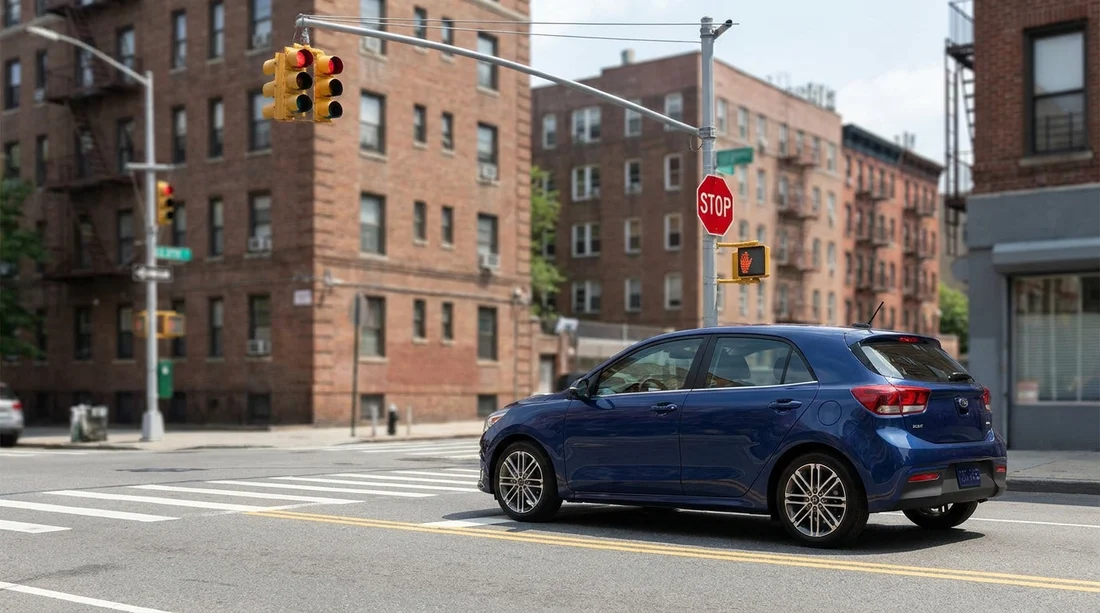
Quick Summary:
- Come to a complete stop before the line, not a rolling stop.
- Right turn on red is usually allowed unless signs prohibit it.
- After stopping, yield to pedestrians, cyclists, and crossing traffic first.
- At four-way stops, follow arrival order, then yield to the right.
If you are collecting a car hire vehicle in New York, the first few junctions can feel intense. The good news is that most of the rules are straightforward once you know two US staples that catch UK visitors out: STOP signs and right turn on red. Add in different lane discipline, turning rules, and how Americans treat intersections, and you will feel much more confident leaving the pick-up area.
If you are picking up at JFK, it helps to know in advance where the exits feed into multi-lane roads. Hola Car Rentals has practical pick-up information for car hire at New York JFK, and if you need extra space there is also van hire at New York JFK.
STOP signs, what “complete stop” really means
In New York State, a STOP sign means you must come to a full stop, not a slow roll. Your wheels should stop turning. Police can and do ticket “rolling stops”, especially near busy junctions and around school areas. Treat it like a UK stop sign but expect them far more frequently, including at smaller residential junctions.
Where do you stop? First, stop at the thick white stop line if there is one. If there is no line, stop before the crosswalk. If there is no crosswalk marking, stop before entering the intersection. If you stop too far forward, you can block pedestrians, and in New York pedestrians often step into the crossing the moment the signal changes.
After you stop, you still have a duty to yield. Look left, right, and left again. Watch for cyclists filtering along the kerb line and for pedestrians starting late. If visibility is limited, you may “creep” forward after the initial stop to improve your view, but the key is that you have already fully stopped first.
Four-way stop intersections, the arrival-order rule
Many junctions in the US use “all-way stop” control, usually shown by small plaques reading ALL WAY or 4 WAY beneath the STOP sign. The rule is simple: the first vehicle to arrive and stop goes first. The second goes next, and so on. If two vehicles arrive at the same time, the vehicle on the right goes first. If you are turning left and an oncoming vehicle is going straight, the vehicle going straight normally has priority.
UK drivers sometimes hesitate, expecting a more formal priority layout. In New York, being predictable helps more than being polite. Stop fully, establish who arrived first, then go decisively when it is your turn. Use your indicator early, as other drivers rely on it to work out the sequence.
If you are driving a rental from New Jersey into New York, you may meet these intersections almost immediately. Details for arrivals near Newark are covered on Hola Car Rentals pages such as car rental at Newark EWR and car hire at New Jersey EWR.
Right turn on red, allowed unless banned
This is the rule that causes most uncertainty for UK visitors. In New York, you may usually turn right at a red light after you come to a complete stop, check it is safe, and yield to pedestrians and other traffic. However, you must not turn if there is a sign saying “NO TURN ON RED”, which is common in Manhattan and near busy crossings.
Think of right on red as similar to giving way at a junction, not as a free pass to keep moving. The correct sequence is: stop behind the line, scan for signs that prohibit the turn, check for pedestrians in both the near and far crosswalks, check for cyclists, then turn only when there is a clear gap. If the view is blocked or traffic is heavy, it is acceptable to wait for green.
Also note that right turn on red may be restricted in special situations, for example where a protected pedestrian phase is used or where the junction geometry makes it dangerous. If other cars behind you beep, do not let that pressure you into an unsafe turn. A beep is often just “I am here”, not necessarily aggression, but you should still turn only when legal and safe.
Turning lanes, lane choice, and what to watch at signals
New York roads are often wide and marked with dedicated turning lanes. Get into the correct lane early, because late lane changes in fast traffic are stressful. Unlike the UK, you can sometimes turn from a lane that looks like a through lane if the road markings allow it, so always follow the arrows painted on the road and any overhead signs.
Watch for right-turn lanes that bypass a traffic light, sometimes controlled by a separate yield sign. In those cases you may not be facing a red light at all, you may instead be joining a slip lane where you yield to pedestrians and to traffic already on the main road.
Another difference: on some junctions there can be a green light for through traffic while a red arrow prohibits turning. If you see a red arrow, do not turn, even if the main light is green.
Pedestrians, crosswalks, and why “yield” matters more
New York is pedestrian-heavy. At STOP signs and when turning on red or green, you must yield to people in the crosswalk. Many crossings are “unmarked” in the legal sense, meaning the intersection itself forms a crosswalk even if paint is worn. Practically, assume pedestrians have priority whenever they are stepping off the kerb at a junction.
Cyclists are another factor, especially in New York City where cycle lanes can run alongside the kerb. When turning right, check your passenger-side mirror and blind spot for a cyclist continuing straight, as they can appear quickly. If there is a bike lane, yield before crossing it to turn.
Common UK-to-US trip-ups right after car hire pick-up
Driving position and lane discipline: You will be on the right side of the road, sitting on the left side of the car. The most common early mistake is drifting left in the lane, especially on wide roads. Use the centre line or lane markings as your reference and keep your body aligned with the lane centre.
Speed limits and units: Signs are in miles per hour, which is familiar in the UK, but typical limits differ. Urban limits can be lower than you expect, and highways may vary by road. Keep an eye out for frequent changes, especially near exits and work zones.
School buses: If a school bus stops with red lights flashing and a stop arm extended, you must stop, typically in both directions unless there is a physical median. This is heavily enforced and carries serious penalties.
Emergency vehicles: If an emergency vehicle approaches with lights or sirens, pull over safely to the right and stop. Do not continue through an intersection just because your light is green if the emergency vehicle is entering.
Mobile phone use: Handheld phone use while driving is restricted. Use hands-free only, and set navigation before moving off from the pick-up area.
Leaving the airport or depot calmly
Your first 10 minutes are about simplifying decisions. Set your navigation before you put the car in drive. If you miss a turn, take the next safe exit rather than cutting across lanes. In New York, rerouting is normal.
If you are comparing suppliers, you can also review options such as Dollar car rental at New York JFK when planning your car hire approach, timings, and pick-up location.
FAQ
Do I have to stop fully at every STOP sign in New York? Yes. You must make a complete stop before the stop line or crosswalk, then proceed only when safe.
Can I always turn right on a red light in New York? No. It is generally allowed after a full stop, but it is forbidden where you see a “NO TURN ON RED” sign or a red turn arrow.
At a four-way stop, who goes first if we stop together? If two vehicles stop at the same time, the vehicle on the right has priority. If you are turning left, yield to oncoming traffic going straight.
What if pedestrians start crossing while I am waiting to turn right on red? You must wait. Yield to pedestrians in the crosswalk and only turn when the crossing is clear and it is safe.
Will other drivers expect me to turn right on red if it is legal? Some may, but you are not required to turn if you cannot do so safely. Waiting for green is acceptable when visibility or gaps are poor.





























































































