


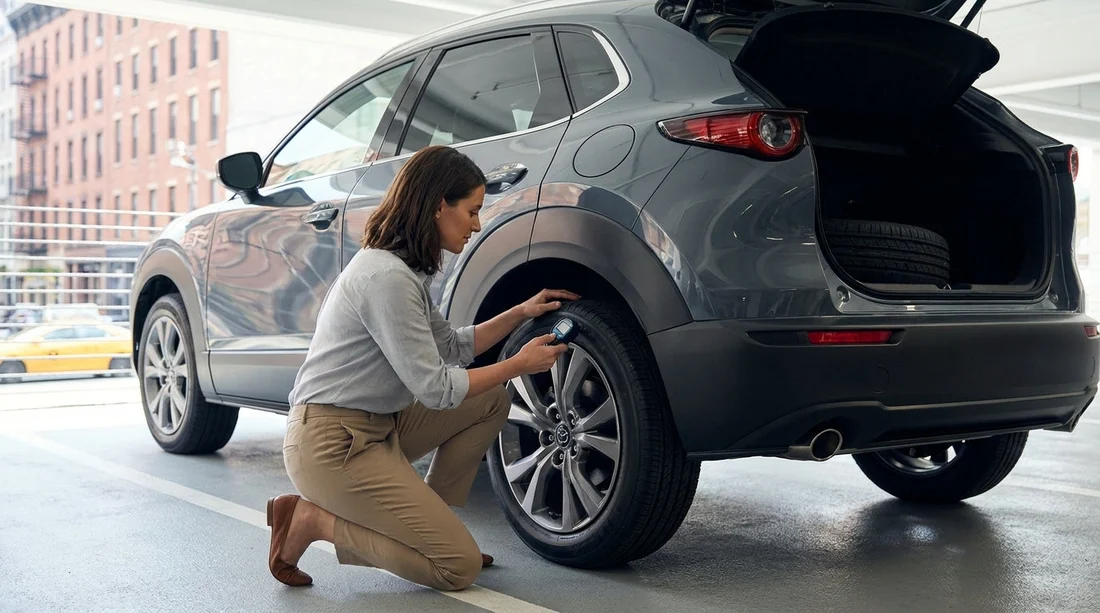
Quick Summary:
- Inspect all tyres for safe tread depth and even wear patterns.
- Check sidewalls for cuts, bulges, cracking, or exposed cords.
- Confirm tyre pressures match the door-jamb sticker before leaving.
- Locate the spare or inflator kit, and confirm tools are present.
Tyres are easy to overlook when you are keen to get moving, but they are the only contact point between your rental and the road. Before you start car hire in New York, a two minute walkaround focused on tread, sidewall condition, and pressures can help you avoid vibrations, longer stopping distances, and an awkward roadside stop. The goal is not to become a mechanic, it is to confirm the vehicle is roadworthy and that you know what you would do if you picked up a nail or hit a pothole.
If you are collecting near major hubs, build this check into your pick-up routine, alongside confirming fuel policy and noting existing marks. It is just as relevant whether you are collecting from car rental New York JFK or heading out from car rental Newark EWR. New York and New Jersey roads can include bridge joints, construction plates, and seasonal potholes, all of which are hard on tyres.
1) Start with a full tyre walkaround
Begin at the front left tyre and go clockwise so you do not miss one. Look at the tyre face and then crouch slightly to view the inner sidewall as well. You are checking for three things: tread depth, wear pattern, and visible damage. Do not rely on a quick glance from standing height, because bulges and cuts hide low down.
Also confirm the tyre size and type match across an axle. Mismatched tyres on the same axle can affect handling and braking, especially in wet conditions. If something looks inconsistent, ask the agent to note it and provide an alternative vehicle.
2) Tread depth, wear bars, and “odd” wear patterns
Tread depth is your grip reserve for rain and standing water. Modern tyres have wear bars in the grooves, when the tread is level with those bars, the tyre is worn out. You do not need a gauge to spot this, but a quick check of multiple grooves across the tyre is important because wear is not always even.
Look for these common patterns:
Centre worn more than edges: can indicate over-inflation, the tyre rides on the middle and loses wet grip.
Both edges worn more than centre: can indicate under-inflation, which increases heat and can lead to failure.
One edge worn: may suggest alignment issues, which can pull the car to one side and chew through tread quickly.
Cupping or scalloped dips: may indicate suspension issues and often causes droning noise at speed.
None of these are things you need to fix at the desk, but they are strong reasons to request a different car.
3) Sidewall safety: cuts, bulges, cracking, and embedded objects
Sidewalls do not have thick tread rubber, so damage here is more serious. Check for:
Bulges or bubbles: often caused by an internal cord break from a pothole impact. A bulge can fail without warning.
Cracks: fine surface cracking may be age related. Deep cracking is a concern, especially if you can see fabric or cords.
Cuts and tears: particularly around the rim area, which can happen after kerb contact.
Objects: nails or screws can sit in the tread without immediate pressure loss. If you see something embedded, do not pull it out, report it before you depart.
While you are there, look at the wheels too. A heavily scuffed rim can hint at recent kerb strikes, which may also have damaged the tyre bead. If you spot anything questionable, it is better to swap vehicles at the counter than debate responsibility later.
4) Tyre pressure: where to find the correct numbers
Pressure affects grip, stopping distance, comfort, and fuel use. You do not need to measure it perfectly at the desk, but you should confirm it is not obviously low. A visibly squashed tyre is a no-go.
For the correct pressures, check the driver’s door jamb sticker (sometimes inside the fuel flap). That sticker lists recommended PSI for front and rear tyres and often a higher “full load” setting. Do not use the number moulded on the tyre sidewall, that is a maximum rating, not the recommended setting.
If the car shows a tyre pressure warning light on the dash, flag it immediately. It might be a simple low pressure situation, but it could also indicate a slow puncture or a sensor issue. Either way, you want it resolved before you drive away, particularly if you are heading onto faster roads around Newark or the turnpike corridors common after car hire at Newark Airport (EWR).
5) Valve caps, stems, and slow-leak clues
Valve caps seem minor, but they keep dirt and moisture out of the valve core. Ensure each tyre has a cap fitted. If a cap is missing, request one. Also glance at the valve stem for cracks, especially on older rubber stems. Slow leaks often show up as one tyre that repeatedly drops pressure compared with the others.
Another quick clue is the presence of tyre shine or wet-looking residue around the bead, which can sometimes mask small issues. You are not policing cosmetic products, you are checking whether something looks like it is being hidden or hurriedly cleaned up.
6) Confirm what “spare” you actually have
Not every rental comes with a full size spare. Many vehicles have a space-saver spare, and some have no spare at all, only an inflator kit with sealant. Before you leave, open the boot and confirm what is provided, because your plan depends on it.
Full size spare: best option, can be driven like a normal tyre.
Space-saver spare: smaller and usually limited by speed and distance. It is for getting to a repair facility, not for continuing a road trip.
Inflator and sealant kit: can temporarily seal small tread punctures, but it will not help with sidewall damage or a blowout.
This matters in New York because kerb impacts and potholes are more likely to cause sidewall damage, which sealant cannot fix. If you are hiring a larger vehicle, such as through minivan rental Newark EWR, confirm whether the spare is accessible and whether tools are included, as storage layouts vary.
7) If there is a spare wheel, check its condition and tools
Lift the boot floor and inspect the spare. You are looking for visible cracks, damage, or obvious under-inflation. Space-saver spares are frequently neglected, so they can be flat when you need them most. If there is a pressure printed on the spare, note it.
If you notice low tread, a bulge, a warning light, or a missing spare kit, raise it immediately and ask for a replacement vehicle or documented acknowledgement. Take clear photos of any damage you are concerned about, including the tyre label if visible. This is particularly helpful after a busy airport collection, such as with Thrifty car rental New York JFK, when vehicles turn around quickly and small issues can be missed.
Finally, once you start driving, pay attention during the first mile. Any strong vibration, thumping, or a steering pull can indicate tyre or wheel issues. If it does not feel right, return promptly while it is easy to switch cars.
FAQ
Q: How can I quickly judge if tyre tread is too low?
A: Look for the wear bars inside the grooves. If the tread is close to level with those bars in several places, request another vehicle.
Q: Is a small sidewall scuff acceptable?
A: Light cosmetic rubbing is common, but any cut, bulge, deep crack, or visible cord is not. If you cannot tell, ask the desk to inspect and document it.
Q: Should I adjust tyre pressures before leaving the car park?
A: If a tyre looks low or a warning light is on, resolve it before departure. For routine top-ups, use the door-jamb sticker PSI and inflate when tyres are cold.
Q: What if my rental has no spare wheel?
A: Confirm there is an inflator and sealant kit, check the sealant expiry date, and make sure the compressor and instructions are present. This setup will not help with sidewall damage.
Q: Do I need to check the spare’s pressure too?
A: Yes. Spares are often under-inflated from sitting unused. A flat spare is effectively no spare, so ask for it to be inflated or for another car.





























































































