


Quick Summary:
- “Or similar” guarantees the class booked, not the exact model pictured.
- Seats, general size, transmission, and air conditioning are usually consistent.
- Brand, trim, colour, technology, and boot shape can vary.
- Choose a class for luggage and passengers, and add a comfort buffer.
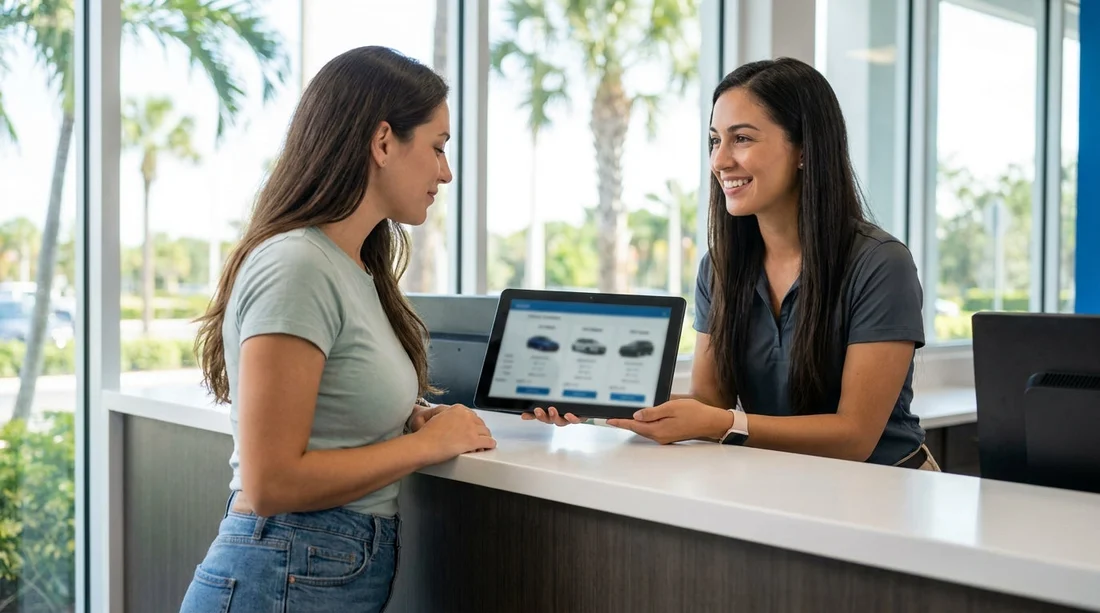
When you search for car hire in Florida, you will often see a vehicle described as “Toyota Corolla or similar”, “Nissan Rogue or similar”, or “Ford Mustang or similar”. The phrase can feel vague, especially if you have a specific model in mind for a road trip, family holiday, or a work visit. In US car rental, that wording usually signals a class-based booking system, where the rental company commits to providing a vehicle that matches the category, not the exact make and model shown in the listing photo.
Understanding what is, and is not, guaranteed helps you choose the right category, budget accurately, and avoid frustration at the counter. Florida is a high-volume market with heavy seasonal demand, so substitutions are common, even when you book well in advance.
What “or similar” actually means in US car hire
In the US, most rentals are sold by vehicle class, sometimes called a category. The example car displayed online is a representative model. “Or similar” means the supplier will provide a car that is comparable in that category, based on their fleet availability when you arrive.
Comparable usually refers to broad characteristics such as size, number of doors, passenger capacity, luggage space, drivetrain type in some categories, and whether the vehicle is automatic. It does not mean you will receive the same brand, the same body style within a category, or the same feature set. Two cars can be “similar” on paper but feel different in real life, especially for boot space and rear legroom.
What is typically guaranteed when you book by class
While policies vary slightly by supplier, these are the elements that tend to be consistent when you book car hire in Florida by class:
Seats and basic size band. Economy, compact, intermediate, full-size, premium, and SUV categories generally indicate a rough cabin size and how many passengers the vehicle is designed to carry.
Transmission type. In Florida, most cars are automatic, and categories are often listed as automatic unless a manual option is explicitly shown.
Air conditioning. Given the climate, air conditioning is effectively standard, but it is still worth confirming on your booking confirmation if it is listed as an included feature.
Four doors versus two doors, when stated. Some categories specify “2/4 doors”. If you require four doors for child seats or easier access, select a category that explicitly supports that.
Comparable luggage capacity. The “bags” icons online are estimates, but they do guide what the supplier considers that class to be for boot space.
If you are arriving at a busy location such as Orlando Airport (MCO), the counter team generally works to keep you within the booked category, because class inventory is managed in blocks. However, within that block, model selection is often down to what has returned, what has been cleaned, and what is ready to go.
What is not guaranteed, even if the photo shows it
The following are commonly misunderstood. Even if they are shown in the listing images, they are usually not guaranteed unless the contract explicitly states them:
Exact make and model. “Corolla or similar” could become a Sentra, Elantra, or Jetta, depending on fleet mix.
Trim level and engine. You might receive a base trim with fewer features than the picture suggests, or a different engine option.
Colour, wheels, interior materials, and sunroof. These are almost never guaranteed.
In-car technology. Apple CarPlay, Android Auto, built-in navigation, USB-C ports, and premium audio may vary car-to-car.
Exact boot shape. Two “intermediate” saloons can fit luggage differently, so plan with margin if you have prams, golf clubs, or large suitcases.
Specific safety or driver aids. Lane keeping assist, blind-spot monitoring, and adaptive cruise can be present on one vehicle but not another in the same class.
This is why “or similar” is best read as “same category”, not “same experience”.
Why substitutions happen so often in Florida
Florida fleets turn over quickly. Late returns, flight delays, unexpected maintenance, and cleaning backlogs can all affect what is available at the exact time you pick up. Add peak holiday traffic, cruise schedules, and major events, and even well-run locations sometimes have to substitute models to keep queues moving.
Downtown branches can be particularly sensitive to limited space and faster same-day turnover. If you are collecting from a central area such as Downtown Miami or nearby business districts like Brickell, the branch may prioritise getting you into an equivalent class quickly rather than searching for a specific model that appeared online.
How to set expectations before you arrive
The goal is to choose the right class so that any “similar” car still works for your trip. A few checks make a big difference:
Choose class based on people and luggage, not the pictured model. If you are four adults with suitcases, an intermediate saloon may be tight, even if the photo looks roomy. Consider moving up a class for comfort on longer drives.
Be honest about Florida driving plans. If you will be doing motorway miles, beach gear, or theme park days with prams and coolers, extra boot space matters more than a particular badge.
Understand that “SUV” is broad. Compact SUVs, midsize SUVs, and full-size SUVs can feel very different. If ground clearance or interior volume is important, select the smallest class that still covers your needs with a buffer.
Know your non-negotiables. If you must have seven seats, a certain fuel type, or a specific drivetrain, look for a class that explicitly states it. Otherwise, assume it may vary.
Check your confirmation, not just the search results. Your paperwork should show the class, transmission, and any included add-ons. That is what staff will use to match your vehicle.
What to do at pick-up if the offered car is not suitable
If the vehicle offered is within the class but does not meet your practical needs, stay specific and polite. Explain the issue in functional terms, for example “we have three large suitcases and this boot will not close”, rather than focusing on the missing model name.
Ask whether another vehicle in the same class is available. Sometimes a different body style in the category fits your luggage better. If nothing suitable exists in the booked class, you can ask what alternatives are available and what the price difference would be to move up. If the supplier cannot provide the booked class at all, they may offer a free upgrade, depending on their policy and inventory.
If you are expecting a larger vehicle for family travel, reviewing SUV options ahead of time can help set a baseline for space. For travellers planning a roomier trip, see the Florida SUV category information on SUV rental in Florida.
Picking the right class for Florida trips
Florida road trips often include long, straight motorway driving, heavy rain bursts, and lots of luggage for beach and theme park days. If you value a quieter ride and easier overtakes, moving up one class can make the “or similar” outcome more consistently comfortable.
If you are comparing suppliers and pick-up points, it can help to review what each location typically serves. For example, travellers flying into Orlando might compare supplier pages such as Alamo at Orlando MCO to understand the type of categories offered at that airport.
FAQ
Does “or similar” mean I might get a better car than the one shown? Yes. You can receive a newer model, a different body style, or a higher trim within the same class. It can also go the other way, where the car is plainer than the photo.
Can I insist on the exact model pictured when I booked car hire in Florida? Usually not. Unless your booking specifically guarantees a make and model, the supplier’s obligation is to provide the booked class or an acceptable substitute.
If the rental company has no cars in my class, what happens? If your class is unavailable, the supplier may offer a free upgrade to a higher category, or present alternatives. Policies vary, so confirm any price change and ask for it to be reflected in the paperwork.
How can I reduce the chance of an unsuitable “similar” car at pick-up? Select a class based on seats and luggage with extra margin, arrive on time, and state non-negotiable needs clearly. If possible, choose a location with strong inventory for your category.





























































































