


Quick Summary:
- Keep going, never reverse, and take the next exit safely.
- Use Texas frontage roads to regroup, then follow signs back.
- Take a signed U-turn or turnaround, not a last-second lane cut.
- Signal early, choose a safer lane, and add time calmly.
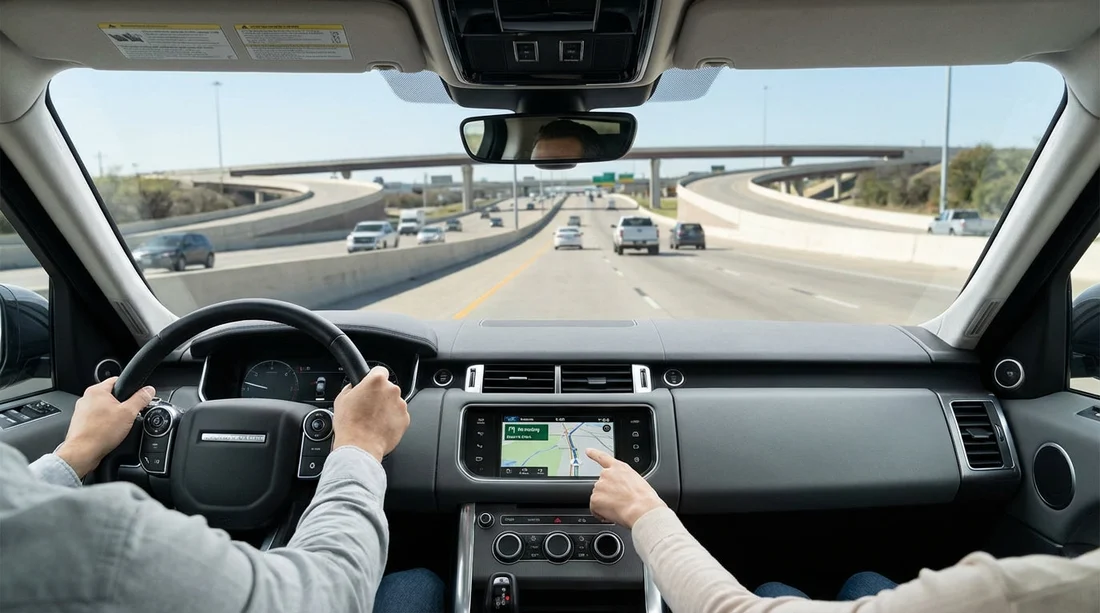
Missing a freeway exit in Texas happens to locals and visitors alike, especially on wide multi-lane interstates with complex interchanges. In a car hire vehicle, the safest legal move is usually the simplest one: stay predictable, continue forward, and use the next exit or the frontage road system to re-route. What turns a minor navigation mistake into a serious crash risk is the panic response, sudden braking, late lane changes, or trying to “save” the exit by cutting across solid lines.
This guide gives you a clear playbook for Texas freeways and service roads, including what you can legally do, what to avoid, and how to re-route with minimal stress. It is written for typical driving conditions around major hubs such as Dallas Fort Worth, Houston, Austin, and San Antonio.
First rule: keep moving forward and stay predictable
If you realise you missed an exit, commit to not attempting a last-second correction. On Texas interstates, exits can appear quickly after an overpass, and the rightmost lanes often split into multiple ramps. The safest legal response is to keep your lane, maintain a steady speed with traffic, and plan for the next decision point.
These actions are almost always illegal or extremely unsafe:
Reversing on a freeway or ramp. Stopping on the main lanes to “wait” for a gap. Cutting across gore areas, the painted triangular sections between lanes and ramps. Crossing a solid white line at the last second to reach an exit lane. Swerving across multiple lanes without time to signal and merge.
In practice, “I missed it” should immediately translate to “I will take the next safe opportunity.” In Texas, that opportunity is often the next exit, or the frontage road system that parallels many highways.
Understand Texas frontage roads (service roads) and why they help
Texas is known for frontage roads, also called service roads or access roads. They run alongside many freeways and let you leave the highway without fully committing to a distant exit. If you miss your intended off-ramp, taking the next exit often puts you onto a frontage road where you can turn around, cross under the freeway, and re-enter in the correct direction.
Frontage roads are designed for exactly this type of correction, but they have their own rules and hazards. Expect traffic lights, lower speeds, right-turn-only segments, and frequent driveways. In busy areas, frontage road traffic can be heavy, and merges back onto the freeway may be short.
If you are arriving from an airport area with dense signage, it can help to know your likely route type in advance. For example, trips starting near Dallas DFW car hire often involve multi-level interchanges with frontage roads, while journeys near Houston IAH car hire frequently use frontage roads to access terminals, hotels, and toll routes.
A simple re-routing playbook for missed exits on big freeways
Use this step-by-step approach whenever you miss an exit on an interstate, tollway, or major expressway in Texas.
1) Hold your lane and scan ahead. Take a breath, keep both hands steady, and look far ahead for the next exit number and distance. Many Texas signs provide one mile and half-mile notice, so you often have time to set up for the next exit.
2) Decide: next exit or frontage road correction. If you are already near the right lanes, taking the next exit is usually easiest. If you are in far-left lanes with heavy traffic, it may be safer to continue until you can move right gradually over a longer distance, even if that adds a couple of miles.
3) Use signals early, merge one lane at a time. Avoid the temptation to dart across. Signal, check mirrors, check blind spots, and move one lane at a time with a clear gap. Texas drivers often move quickly, so being predictable and early helps others accommodate you.
4) Exit calmly and commit to the ramp. Once you are in an exit lane, do not re-enter the freeway at the last second. Ramps can tighten unexpectedly, and sudden changes cause rear-end collisions.
5) On the frontage road, re-orient before you act. After you exit, you may have two directions on the frontage road, and intersections can be closely spaced. If safe, continue straight to a traffic light or a designated turnaround rather than making an abrupt immediate turn.
6) Correct direction using a turnaround, U-turn lane, or cross street. Many frontage road intersections have a signed U-turn lane beneath the overpass, sometimes called a turnaround. Use these where posted, obey yield signs, and watch for pedestrians and cyclists. If no turnaround exists, use a cross street to get to the opposite frontage road, then follow signs to re-enter the freeway in the correct direction.
7) Re-enter with patience. On-ramps may be short. Accelerate to match traffic, use the full merge lane where available, and do not stop at the end of the ramp unless traffic is truly blocked. If you miss the merge, continue on the frontage road to the next on-ramp.
How to use turnarounds legally and safely
Texas frontage road turnarounds are common under overpasses, but they vary by city and highway. Some are signal-controlled, others have yield signs, and some are tight curves that require slower speeds than you might expect.
Key safety points:
Obey signs and lane markings. Some turnarounds are marked “U-turn only”, others share space with left turns. Do not assume you can turn from any lane.
Yield correctly. If you have a yield sign, you must wait for the main frontage road traffic. Watch for fast-moving vehicles exiting the freeway, because they may still be slowing.
Watch vehicle length and turning radius. If you are in a larger hire vehicle, such as a people carrier, you may need a wider path. This comes up often for families collecting a larger vehicle, for instance near Austin minivan rental locations. Take it slow and avoid clipping kerbs or drifting into adjacent lanes.
Do not block intersections. If the turnaround backs up, wait behind the stop line and avoid stopping across crosswalks or junctions.
Lane discipline on Texas freeways: how to avoid risky lane cuts
Most missed-exit problems start earlier, when a driver realises too late that the exit is on the right. On Texas freeways with five or more lanes, the safer strategy is to set up early even if you are not fully sure.
Practical habits that reduce risk:
Stay out of the far-left lane unless passing. The left lane often runs faster, and it can be difficult to cross back to the right safely near interchanges.
When in doubt, choose the lane that keeps options open. A middle-right lane often allows easier movement either to an exit lane or to continue straight.
Follow exit numbers, not just street names. In dense areas, street names repeat or appear on multiple signs. Exit numbers are more consistent, especially when your sat nav recalculates.
Accept that re-routing is normal. Adding five minutes is preferable to forcing a merge. In a car hire vehicle, you may also be unfamiliar with braking response, blind spots, and indicator sensitivity, so give yourself extra space.
What about toll roads and express lanes?
Texas metro areas have toll roads and managed express lanes. If you miss an exit in a toll lane or express lane, you may not be able to leave immediately. The safest legal approach is still to continue to the next authorised exit point. Do not cross double white lines or separated barriers to escape.
If you accidentally enter a toll route, keep driving normally and exit at the next available point. The routing mistake is rarely dangerous, but the attempt to undo it often is. If you are unsure how tolls are handled with your car hire agreement, check the paperwork and the instructions you received at pick-up.
Airport-area complexity: why missed exits are common
Airports concentrate unfamiliar drivers, heavy signage, and last-second lane splits. Around Dallas Fort Worth and Houston, it is common for one lane to become an exit-only lane with little notice, or for an airport entrance to split between terminals.
Two tactics help:
Follow terminal and exit number signs early. If you are approaching an airport complex, move to the appropriate lanes sooner than you think you need.
If you miss the terminal turn, loop safely. Airports are designed for circulation. Continue to the next terminal or loop road, then follow signs back. Do not stop on the shoulder to consult your phone. If you need to recheck navigation, take the next safe parking area or petrol station off the frontage road.
Drivers collecting vehicles through partner brands may be leaving from busy rental areas, such as those linked to Budget car hire at Dallas DFW or Hertz car hire at San Antonio SAT, where getting into the correct lane early can reduce stress.
Safety and legal checklist: what to do immediately after you miss it
Use this quick mental checklist to keep your decisions safe and lawful:
Do: keep a steady speed with traffic, signal early, take the next exit, use frontage roads and marked turnarounds, and pull off the roadway to a safe place if you must check directions.
Do not: reverse, stop in live lanes, cross gore markings, drive over kerbs or painted separators, or make sudden multi-lane moves.
If conditions are bad: in heavy rain, at night, or with aggressive traffic, be even more conservative. Take the next exit, find a calmer frontage road segment, and re-enter when you have a clear plan.
FAQ
Q: Can I reverse on a Texas freeway if I just passed my exit?
A: No. Reversing on a freeway or ramp is illegal and extremely dangerous. Continue forward and take the next exit.
Q: What is the safest way to recover from a missed exit on a Texas interstate?
A: Stay in your lane, maintain a steady speed, then take the next exit and use the frontage road to turn around or re-route.
Q: Are frontage roads the same as service roads in Texas?
A: Yes. People commonly call them frontage roads, service roads, or access roads. They run alongside many freeways and help you re-route safely.
Q: Can I cross the painted triangle between the freeway and the exit ramp?
A: No. That gore area is not a driving lane. Crossing it is unsafe and can be treated as an illegal lane change.
Q: What should I do if my sat nav tells me to make an unsafe lane change?
A: Ignore the unsafe instruction, keep driving, and let it re-route. Take the next exit or frontage road option when you can move safely.





























































































