


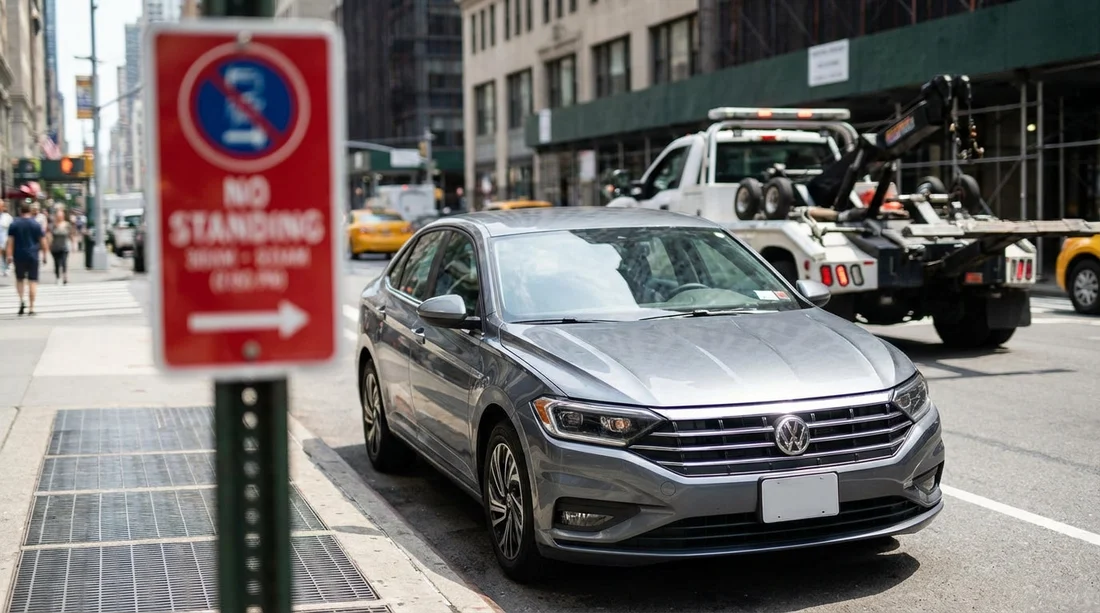
Quick Summary:
- ‘No Standing’ usually means no stopping except quick passenger drop-off.
- At fire hydrants, keep 15 feet clear, even briefly.
- Bus stops and lanes are enforced aggressively, expect rapid tickets or towing.
- Check arrows, times, street-cleaning days, and the nearest sign pair.
In New York, kerbside signs are not decoration, they are active rules with fast enforcement. If you are using a car hire in NYC, understanding the difference between ‘No Standing’ and ‘No Parking’ can save you from an expensive tow, a Penalty Charge style ticket (NYC calls them parking summonses), and the stress of finding your vehicle at an impound lot. The key is to read the sign like a short legal sentence: what action is banned, on which side of the sign, and during which hours.
NYC also layers rules. A single stretch of kerb might have a loading exception, bus-stop restrictions, hydrant clearances, metered parking hours, and street-cleaning schedules. The toughest surprises for visitors are that some restrictions apply even if you stay in the driver’s seat, and that towing can be immediate in certain zones. The sections below break down the wording you will see and give quick checks you can do before switching off the engine.
If you are collecting a car hire from an airport and driving into the city, the first hour of parking can be the riskiest. Many travellers pick up from car hire at New York JFK or arrive via Newark, where car hire near Newark EWR is common, then head straight into Manhattan without realising how strict kerbside rules are. A little sign-reading changes everything.
What ‘No Standing’ means in NYC, in plain English
In NYC, “standing” means stopping your vehicle, even for a short time, whether or not the engine is running. A ‘No Standing’ sign generally prohibits stopping except for a very limited purpose: quickly picking up or dropping off passengers. The idea is that traffic must keep moving. If you stop for anything else, waiting for someone, checking your phone, loading bags, it can be treated as a violation.
Practical rule: with ‘No Standing’, you may be allowed to pause only as long as passengers are actively getting in or out. If you have to wait for them to arrive, you are already in violation. If you step away from the car, you are likely treated as parked, which is worse.
Where you see it most: avenues with heavy traffic, near big attractions, outside hotels, around hospitals, and on corners where visibility matters. Enforcement can be fast because you are visibly obstructing flow.
‘No Parking’ vs ‘No Standing’ vs ‘No Stopping’
NYC uses three similar-looking restrictions, but the differences matter:
No Parking means you may stop temporarily to load or unload passengers or goods. The catch is you must stay with the vehicle and keep the activity continuous. If you stop “to wait”, it is not loading. If you walk into a shop and come back, you were effectively parked.
No Standing is stricter: it typically allows only passenger pick-up and drop-off, not loading goods. Think of it as “no waiting, no loading”, only a brief passenger exchange.
No Stopping is the strictest: you cannot stop at all, even briefly, except if directed by police, avoiding a crash, or obeying a traffic signal. These areas are common near tunnels, bridges, and places with sightline risks.
If you are unsure which one you are in, treat it as the strictest and move on. For a car hire driver unfamiliar with NYC, a safer plan is to use off-street garages for any stop longer than a quick passenger drop.
When towing happens fastest
NYC issues tickets for many parking violations, but towing tends to be used for situations that block safety routes or major traffic movement. While practices vary by borough and time of day, towing risk is highest when you:
Block a hydrant. Fire hydrant clearance is a safety issue, and you can be ticketed quickly even if you are “only a minute”.
Stop in a bus stop or bus lane. Buses need to pull in and out. Stopping there can draw immediate enforcement, sometimes via cameras, and tow trucks may operate on key routes.
Park in a clearway-style ‘No Standing’ zone during restricted hours. Busy corridors, especially in Manhattan, are managed aggressively because a single stopped car creates knock-on congestion.
Ignore street-cleaning restrictions. On alternate side parking days, cars left on the wrong side can be ticketed, and in some locations moved or towed to allow cleaning and resurfacing.
Double park. Even with hazard lights on, double parking is illegal and a common tow trigger if it blocks travel lanes.
Fire hydrants: the 15-foot rule that catches visitors
Hydrants are a classic tow-and-ticket trap. In NYC you must not park within 15 feet (about 4.6 metres) of a fire hydrant. This is measured along the kerb, not “as the crow flies”. If you are unsure of the distance, assume it is too close and find another space.
Important nuance: being in the car does not necessarily save you. If you are stopped by a hydrant and not actively moving, an officer can still issue a summons. Also, a driveway cut-out or a gap between parked cars does not make hydrant proximity legal.
Quick check: look for a hydrant partly hidden by a parked SUV, street furniture, or snowbanks in winter. Make it a habit to scan forward and backward before committing to a spot.
Bus stops, bus lanes, and “Buses Only” markings
Bus stops are usually marked with signage and sometimes painted kerb. Even a brief stop can be considered an obstruction. If you are dropping someone off, choose a legal kerb space a short walk away rather than stopping at the bus stop itself.
Bus lanes are another high-enforcement area. Some lanes operate only during specified hours, and signs will show times and days. In NYC, cameras can issue penalties for driving or stopping in bus lanes during restricted hours. The sign might say something like “Bus Lane” with an hours panel. Always assume the lane is restricted unless you confirm otherwise.
If your route into NYC starts after collecting from car rental at Newark EWR, you may encounter bus-priority corridors as you approach Manhattan. The kerbside can change quickly block by block, so reset your “sign scan” each time you stop.
Understanding arrows, times, and the “sign pair” rule
NYC signs often rely on arrows. An arrow pointing left means the restriction applies to the kerb area to the left, until you reach the next sign that changes the rule. An arrow pointing right does the same to the right. Sometimes you will see arrows both ways, meaning it applies in both directions from that sign.
Use the “sign pair” check: once you spot the sign nearest your parking spot, look for the next sign ahead and behind. Your legal status is defined by the restriction signs that bracket your car. If one sign says ‘No Standing 7am to 7pm’ and the next sign begins metered parking, your spot is inside whichever zone covers it. Do not assume the rule is the same for the whole street.
Times and days are equally important. A restriction might apply only on weekdays, only during rush hours, or only on specific days for street cleaning. If the sign shows multiple panels, read them top to bottom. The top often states the main restriction, and lower panels add exceptions, such as “Except trucks loading” or seasonal rules.
Metered parking and pay stations: don’t let them fool you
A parking meter does not automatically mean you can park there at all times. A metered space can still be inside a ‘No Standing’ zone during peak hours, or prohibited on street-cleaning days. In those cases, the meter is irrelevant during restricted times.
Another common issue is assuming that paying is enough. Payment only satisfies the payment requirement. You still must obey time limits, vehicle-type limits, and posted restrictions. If a sign says “2 Hour Metered Parking, 9am to 7pm”, overstaying can earn a ticket even if you paid again, depending on local rules and how the meter is regulated.
Street cleaning and alternate side parking, why cars suddenly disappear
NYC’s alternate side parking rules exist so street sweepers can clean the kerb lane. Signs will specify a day and time window when parking is prohibited on that side. During that window, you must move the vehicle, usually to the opposite side or another legal location.
On some streets, rather than towing to the impound, authorities may “relocate” vehicles to a nearby block so cleaning can occur. That still costs time and can be confusing if you think the car has been stolen. For car hire users, relocation can also create documentation headaches because you need to report where the vehicle ended up.
Quick habit: set a phone reminder for street-cleaning windows if you must park on-street. Better yet, choose off-street parking overnight if your schedule is tight.
Loading zones and commercial-only rules
NYC has loading-only kerb space, sometimes for trucks only, sometimes with short time limits. If the sign says “Commercial Vehicles Only” or “Trucks Loading Only”, a typical passenger car hire does not qualify. Even if you are physically loading luggage, the vehicle class can make it illegal.
Some loading rules are time-limited, for example commercial loading in the morning, then metered parking later. Read the exact hours, and do not assume you can use the space “for just five minutes”.
Quick kerbside checks before you leave the car
Use this fast routine every time you stop, especially in Manhattan:
1) Read the nearest sign fully. Look for the key words, arrows, and time windows. If anything is unclear, treat it as restricted.
2) Check for a second sign. Walk a few steps to confirm where the zone begins and ends. This is the easiest way to avoid misreading arrows.
3) Scan for hydrants and bus-stop poles. Look both directions, not just beside your bumper.
4) Look at the kerb paint and street markings. Painted kerbs, bus stop stencils, and “No Standing” ground markings can reinforce restrictions.
5) Ask, “Am I waiting?” If your plan involves waiting, you need a legal parking space, not a standing zone.
6) Consider off-street parking for longer stops. Garages reduce sign complexity and tow risk, which can be worth it in NYC.
What to do if you think you were towed
If you return and your car is gone, confirm it was not relocated due to street cleaning. Look around the same block and adjacent corners for posted temporary signs. If you suspect a tow, note the exact address where you parked, the nearest cross street, and any sign wording you remember. For a car hire, you will also need the vehicle plate and the rental agreement details to retrieve it and to notify the provider appropriately.
Keep your paperwork and photos. When you park in NYC, taking a quick photo of the sign nearest your car and the car’s position relative to it can help resolve disputes or at least clarify what happened.
If you are driving a larger vehicle, such as something collected via van hire at New York JFK, be extra cautious. Longer wheelbases and higher profiles can hide hydrants and signs, and some streets have additional truck restrictions that do not apply to passenger cars.
Choosing a pickup location and why it matters for sign stress
Where you start your trip can shape how soon you face dense kerbside rules. Many visitors keep driving in NYC simple by picking up outside Manhattan, then planning parking around their itinerary. If you are comparing providers, Hola Car Rentals offers city-accessible options such as Budget car hire at New York JFK and other airport and Newark-area choices, which can help you match vehicle size to the kind of parking you expect to use.
Regardless of where you collect your car hire, the safest approach in NYC is to assume kerbside rules change frequently, and to re-check signs every time you stop, even if it is the same street later in the day.
FAQ
Q: Can I stop in a ‘No Standing’ zone if I stay in the driver’s seat?
A: Usually only for immediate passenger pick-up or drop-off. Waiting, idling, or loading bags can still be ticketed, even if you remain in the car.
Q: What is the difference between ‘No Parking’ and ‘No Standing’ in NYC?
A: ‘No Parking’ may allow temporary loading or unloading while you stay with the vehicle. ‘No Standing’ is stricter and typically allows only quick passenger pick-up or drop-off.
Q: How close can I park to a fire hydrant in New York?
A: You must keep 15 feet (about 4.6 metres) clear of a hydrant. If you are unsure, move further away, hydrant violations are enforced aggressively.
Q: Can I use a bus stop for a quick drop-off?
A: It is risky. Bus stops and bus lanes are priority areas and a brief stop can earn a ticket or lead to towing, especially on busy routes.
Q: Why did my car disappear during street-cleaning hours?
A: On alternate side parking days, vehicles may be ticketed and sometimes relocated or towed to clear the kerb for cleaning. Check nearby blocks and signs, then follow tow procedures if needed.





























































































