


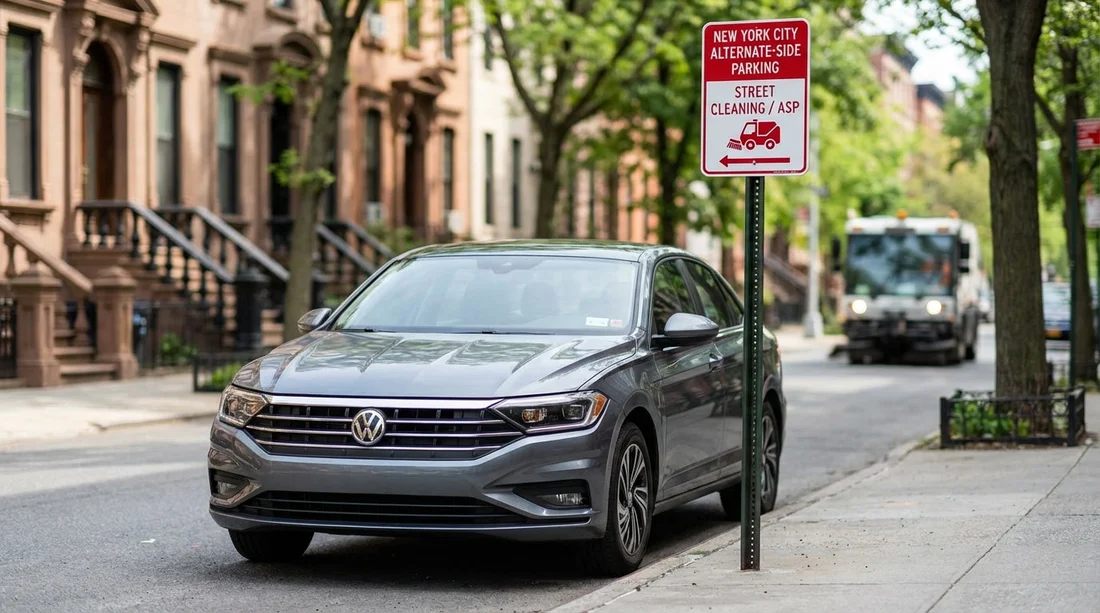
Quick Summary:
- Check both sides of the street, signs can differ by block.
- ASP means you must move during posted cleaning times, even briefly.
- Set two phone alarms, 30 minutes before and 5 minutes before.
- When unsure, use a garage or metered spot to avoid towing.
Alternate-side parking (ASP) is New York City’s street-cleaning system, and it catches out drivers more than almost any other kerbside rule. If you’re using car hire in New York, the biggest risk is not the driving, it’s leaving the car on the wrong side of the street during a cleaning window and returning to a ticket, or worse, a tow.
The good news is that ASP is predictable once you learn how to read the signs quickly, and you build a habit of setting reminders. This guide breaks down how ASP works, what the signs really mean, and how to plan parking so your day is not derailed by street sweeping.
If you’re collecting a vehicle via the airports around the city, many visitors pick up from Newark and drive into Manhattan or Brooklyn. Hola Car Rentals has options that suit different itineraries, including car rental Newark EWR for straightforward pickup, and larger vehicles such as SUV rental Newark EWR if you’re travelling with luggage or family. Whichever vehicle you choose, ASP rules apply the same once you park on NYC streets.
What is alternate-side parking in New York?
Alternate-side parking is the rule that requires parked cars to move out of the way during scheduled street-cleaning hours. The intent is simple: sanitation trucks and sweepers need access to the kerb, so one side of the street is cleared at a time. On many residential blocks, cleaning happens once or twice a week per side.
In practical terms, ASP means: if the sign says parking is not allowed on that side during certain hours on certain days, your car must not be there during that time. Some blocks expect you to be fully gone for the entire window. On other blocks, enforcement officers may allow “standing by” with the driver in the car, but you should not rely on that unless the local pattern is clear and you can comply safely.
How to read NYC kerbside signs quickly
NYC parking signs often stack several rules on a single pole. The fastest way to interpret them is to work from the most restrictive rule to the least restrictive, then confirm the time and day.
Step 1, find the ASP line. Look for wording like “NO PARKING” with day and time ranges, or “NO PARKING STREET CLEANING”. This is your street-sweeping rule and usually the one that triggers tickets for visitors.
Step 2, confirm the side of street and direction. Signs apply from that sign to the next sign, sometimes to the corner. If you parked after turning onto the block, walk back to the nearest sign behind your car and the next sign ahead. Different rules can apply mid-block.
Step 3, decode the days correctly. “MON & THURS” means those two days each week. “MON-THURS” means Monday through Thursday, which is very different. If the sign uses abbreviations, read slowly and double-check.
Step 4, check the hours. ASP hours are often in the morning, for example 8:30am to 10am, but can vary widely. Even a 90-minute window can be enough to get ticketed if you’re a few minutes late.
Step 5, spot any exceptions. You may see additional lines such as “EXCEPT SUNDAY” or “EXCEPT HOLIDAYS”. Do not assume holidays count, New York observes a specific holiday schedule, and enforcement can change during emergencies or weather events.
Step 6, ignore unrelated allowances when ASP is active. A “2 HR PARKING” rule or meter instruction does not override ASP. If ASP says no parking at 9am, your paid meter time does not protect you.
Typical ASP patterns, and why they trick visitors
Many neighbourhoods alternate days between sides. For example, one side might have cleaning Monday and Thursday, and the opposite side Tuesday and Friday. Visitors often think, “I’m good today because it’s Tuesday,” but they are on the Monday and Thursday side, so Tuesday is fine, until Thursday morning arrives and they forget.
Another common trap is arriving late at night, parking legally, then sleeping in. With car hire, you might be staying in an Airbnb or hotel outside Manhattan and parking on the street overnight. If cleaning starts at 8am, it is easy to miss the move time, especially with jet lag.
Finally, signs can change from one block to the next. You can move the car “just around the corner” and accidentally land on a block where cleaning starts earlier, or occurs on additional days.
What happens if you ignore street sweeping rules?
If you’re parked during ASP hours, you can receive a parking summons. In some cases, the car may be towed, particularly if the block is heavily enforced or if other restrictions apply (for example, a temporary no-parking zone). Getting a towed vehicle back costs time and money, and can be stressful if you are trying to stick to a schedule.
Tickets are typically attached to the windscreen. With rental vehicles, the process can involve additional admin fees if the ticket is billed back through the rental company. The simplest approach is prevention: treat the ASP window like a non-negotiable appointment.
Planning your day around cleaning windows
To avoid street-sweeping tickets, build a routine around the sign’s time window.
Use a two-alarm system. Set one alarm for 30 minutes before the start time so you can dress, pack, and walk to the car. Set another for 5 minutes before as your “leave now” prompt. This matters because finding a legal spot at the last minute can take longer than you expect.
Plan where you will move to. Before the cleaning window starts, identify the nearest side or nearby street that is legal during that time. Do this the night before, while you are not rushed. Ideally, pick a spot that stays legal for several hours so you do not have to shuffle repeatedly.
Consider your itinerary. If you have an early museum booking or a day trip, avoid relying on street parking that requires a move mid-morning. On those days, a garage can be the cheaper choice once you factor in the risk of tickets and lost time.
Build in buffer time. In dense areas of Manhattan, Brooklyn, and Queens, “quickly moving the car” can turn into a 25-minute loop. If you have car hire for convenience, protect that convenience by giving yourself parking time in the morning schedule.
Where to park during ASP, street, meters, and garages
Staying on the street: This is often the lowest-cost option, but requires discipline. Your best bet is to park on a side that has already been cleaned for the week, or on a street with fewer cleaning days.
Metered parking: Meters handle time limits and payment, but they do not override ASP. Always check for an ASP line on the same pole or nearby.
Garages and lots: Garages avoid ASP entirely. Rates vary dramatically by neighbourhood and time of day. If you know you cannot move the car, paying for a garage can be more predictable than gambling on enforcement.
How to avoid getting towed when you “wait it out”
Some New Yorkers handle ASP by sitting in the car during the cleaning window and moving when the sweeper arrives. This can work on certain blocks, but it comes with risks for visitors.
Know the difference between parking and standing. If the sign says “NO PARKING”, you may be allowed to stop temporarily with a licensed driver behind the wheel, but you still might get a ticket if an officer believes you are parked or you leave the vehicle. If the sign says “NO STANDING”, you must not stop at all during the restricted time. If you see “NO STANDING”, do not attempt to wait in the car.
Do not leave the vehicle unattended. Even stepping away for a coffee can be enough to be considered parked.
Keep the engine and positioning safe. You may need to pull out promptly for sweepers, cyclists, buses, or emergency vehicles. If the block is busy, it can be safer to move to a legal street rather than hovering.
A fast sign-check checklist for car hire drivers
Use this quick mental checklist every time you park in New York.
1, Days: Which days is this side restricted, and is tomorrow one of them?
2, Hours: When does the restriction start, and can I be at the car then?
3, Type: Does it say “No Parking” or “No Standing”?
4, Segment: Do the rules change mid-block between signs?
5, Backup: If I must move, where is my nearest legal alternative?
What about Sundays, holidays, snow, and special rules?
Sundays: Many ASP schedules do not run on Sundays, but not all restrictions disappear. Other rules like hydrants, bus stops, and driveways always apply.
Holidays: NYC has a specific holiday parking schedule that can suspend some rules. However, it is not wise to assume your block is exempt unless you have verified the holiday status for that day.
Snow and emergency rules: During snow events, New York can implement special parking rules or “snow emergency” regulations. These can override normal patterns and lead to towing on designated routes. If bad weather is forecast, switch to a garage or off-street parking where possible.
Construction and temporary signs: Paper “No Parking” notices can appear for film shoots, moving trucks, roadworks, or utility access. These temporary restrictions can be heavily enforced.
Choosing a pickup plan that makes parking easier
Many visitors prefer picking up outside the busiest parts of Manhattan and then driving in. If you’re planning routes that start in New Jersey, Hola Car Rentals pages can help you compare locations and vehicle types, such as car rental New Jersey EWR and car rental airport New Jersey EWR. If you need extra space for passengers and bags, you might also look at van hire New Jersey EWR.
Whatever your pickup point, the most important planning step for New York is deciding where the car will sleep each night. If your accommodation does not include parking, check the block’s ASP schedule as soon as you arrive, then set your reminders immediately.
FAQ
How do alternate-side parking rules work in New York? They require cars to move from the kerb during posted days and times so streets can be cleaned. The restriction applies only on the signed side, for the listed hours.
Can I sit in the car during street sweeping to avoid a ticket? Sometimes, if it is “No Parking” (not “No Standing”) and you stay with the vehicle, you may avoid being ticketed, but it is not guaranteed. The safest option is moving to a legal spot before the window starts.
How far do I need to move my car for ASP? You must move to a location where parking is legal during that restriction. Often that means the opposite side of the same street, but only if its ASP window is different and currently inactive.
What is the quickest way to read NYC parking signs? Find the street-cleaning line first, confirm the days and hours, then check whether it says “No Parking” or “No Standing”. Finally, walk to the next sign to confirm the exact segment.
What if I get an ASP ticket in a rental car? Pay attention to the instructions on the summons and the rental company’s policies, as admin fees can apply if charges are processed through them. Avoid repeat tickets by setting alarms and parking away from upcoming ASP windows.





























































































