


Quick Summary:
- Dash cams are generally legal in NY and NJ, if mounted safely.
- Avoid blocking the driver’s view, keep the screen out of sight.
- Audio recording consent differs, assume one-party in NY, one-party in NJ.
- Mount high behind the mirror, route cables neatly, never across airbags.
Hiring a car in New York often means busy motorways, dense city traffic, and the occasional confusing junction. It is no surprise that many drivers want a dash cam for evidence and peace of mind. The key questions for New York car hire are whether dash cams are legal, where you can mount one without risking a windscreen obstruction ticket, and what happens if your camera records audio.
This guide covers New York State and nearby New Jersey, with practical mounting options for a hire car and a checklist to reduce the chance of being stopped. It is informational rather than legal advice, and it is always sensible to follow any instructions from your rental agreement and local law enforcement.
Are dash cams legal in New York State?
In general, using a dash cam in New York State is legal. There is no blanket statewide ban on video recording from inside a privately used vehicle. The main legal and practical issues tend to be where you mount the camera and whether it creates a safety hazard, plus audio recording rules if your device captures sound.
For travellers arriving at JFK and collecting a vehicle, it helps to decide on your setup before you join city traffic. If you are comparing options for car hire at New York JFK, it is worth planning a mount that does not leave marks and does not interfere with the windscreen or mirror area.
Are dash cams legal in New Jersey?
New Jersey also generally allows dash cams for recording video while you drive. As in New York, the common enforcement risk is not the camera itself but the way it is attached and whether it obstructs vision. New Jersey drivers also need to think about audio consent and privacy if they record conversations inside the vehicle.
If your trip includes crossing the Hudson, collecting from Newark, or exploring the shore, choose a mounting position that works for both states. If you are picking up at Newark Liberty, see your local collection options for car hire at New Jersey EWR, then set up your dash cam before leaving the car park so you are not adjusting it at the kerbside.
Windscreen obstruction rules in NY and NJ, what matters in practice
Both New York and New Jersey enforce rules aimed at keeping the driver’s view clear. The exact wording can vary, but the practical test is straightforward: anything mounted to the windscreen or placed on the dashboard should not materially block your view of the road, signs, pedestrians, or other vehicles.
Police officers typically focus on obvious obstructions, a large device in the middle of the glass, a dangling cable across the driver’s view, or an object placed where it could become a projectile in a crash. Even if your dash cam is small, if it sits low and central it can draw attention.
For a hire car, you should also avoid adhesives that might damage tinting, leave residue, or mark the dashboard. Using a removable mount, and keeping it tucked behind the rear-view mirror area, usually provides the best balance of visibility and discretion.
Audio recording consent, NY vs NJ
Many dash cams record sound by default. That matters because states have different rules on consent for recording conversations. In everyday driving, you may capture speech from passengers, phone calls through the car’s hands-free system, or conversations during a traffic stop.
New York: New York is commonly treated as a one-party consent state for audio recording, meaning it is generally lawful if one party to the conversation consents. If you are part of the conversation, that can satisfy consent. However, recording a conversation you are not part of can raise issues, and context matters.
New Jersey: New Jersey is also widely understood as a one-party consent state for audio recording. Even so, privacy expectations can become relevant in certain settings, and recording sensitive conversations without telling passengers can create disputes.
Because travellers often cross state lines and may carry passengers who are not expecting to be recorded, a simple risk-reduction step is to disable audio recording in your dash cam settings. If you want audio for incident context, consider informing passengers clearly, and avoid recording conversations you are not involved in.
Where can you mount a dash cam in a hire car?
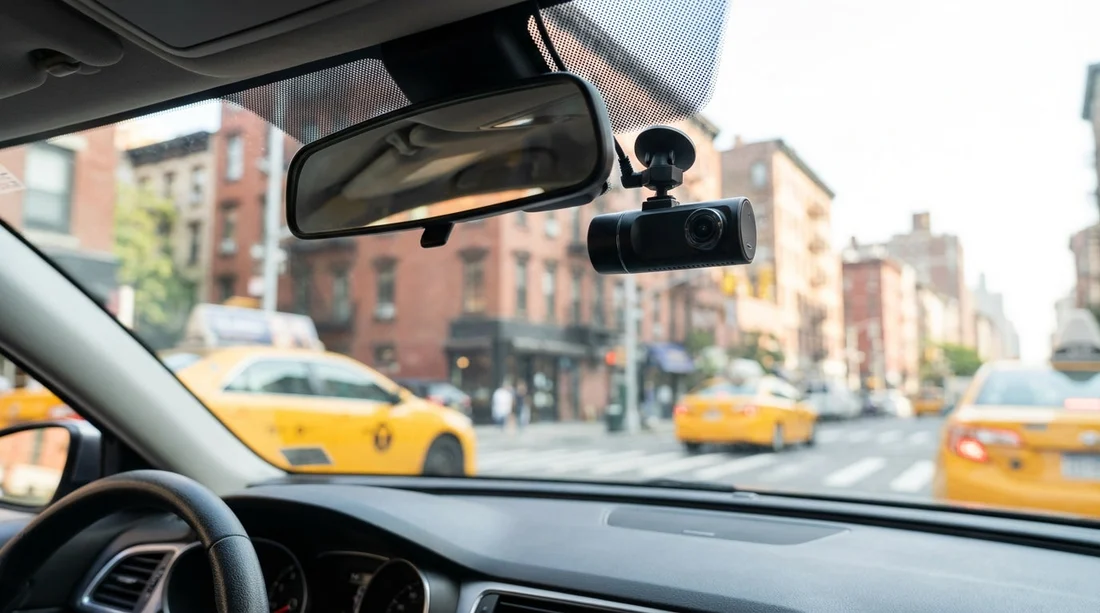
The safest mounting position is usually high on the windscreen, close to the centreline, tucked behind the rear-view mirror so it is largely outside the driver’s normal sight line. This tends to minimise obstruction while still giving a good view of the road. It also reduces glare and reflections compared with dashboard placement.
Here are practical mounting options that usually work well for New York and New Jersey driving.
Best option: high behind the rear-view mirror
Mount the camera high, either just to the passenger side of the mirror stem or directly behind the mirror where the camera lens can see past it. From the driver’s seat, you should barely notice the unit. Before you set off, confirm that you can see traffic lights when you stop close to the line, as some drivers mount too high and end up tilting the camera skyward.
If you are driving a larger vehicle, such as when choosing SUV hire in New York, check the mirror housing and sensor area, as some models have driver-assist cameras near the top of the windscreen. Keep your dash cam clear of those factory sensors.
Acceptable alternative: dashboard mount, but only if low-profile
A low-profile dashboard mount can work if it does not encroach into your view and does not interfere with airbags. Many cars have passenger airbags that deploy from the dashboard. If a mount or cable sits in the deployment path, it can become dangerous in a collision.
If you use a dashboard mount, place it as close to the windscreen base as possible, and confirm it does not reflect in the glass. In bright Manhattan sunlight, reflections can reduce footage clarity and distract you.
Avoid: centre-of-windscreen, low placement, and dangling power cables
Mounting in the middle of the windscreen, especially at eye level, is the easiest way to invite an obstruction allegation. Also avoid placing the camera low where it blocks your view of the bonnet line or pedestrians at crossings, which is particularly risky in busy parts of New York City.
Loose cables are another common issue. A power lead hanging down can draw attention and can interfere with steering or gear selection if it is routed badly. Worse, it can cross an airbag seam or get caught during an emergency manoeuvre.
Powering your dash cam safely in a hire car
Most travellers use a 12V socket charger or USB power. Keep it simple and reversible. Route the cable along the top edge of the windscreen and down the passenger side, then into the glovebox area or centre console, depending on socket location. Use small removable clips rather than permanent adhesive, and never push cable behind trim if you might damage it.
If you collect at Newark and your vehicle has multiple USB ports, you might be driving a newer model. For pick-ups near the terminals, options like Hertz car hire at Newark EWR can include vehicles with USB-C outlets, but you should still carry the right cable for your camera.
Practical mounting checklist that reduces ticket risk
Use this quick checklist before you leave the rental car park. It is designed to keep you within typical safety expectations for NY and NJ and to avoid the most common mistakes that attract attention.
1) Sit in your normal driving position. If you can see the dash cam body in your primary forward view, move it higher or behind the mirror.
2) Check mirror, sun visor, and sensor clearance. Do not block rain sensors, lane cameras, or the mirror’s full adjustment range.
3) Keep the windscreen area clean. A dirty glass patch under the mount can cause it to fall off, especially in winter cold or summer heat.
4) Angle the lens correctly. Capture the horizon and the bonnet edge, not mainly sky. Re-check after your first few miles.
5) Hide the screen while driving. A bright display can be distracting at night. Many cameras have a screen-off mode.
6) Route cables away from airbags. Avoid A-pillar airbag areas, steering column, and any marked airbag seams.
7) Consider disabling audio. It reduces privacy disputes, and video alone is often enough for incidents.
8) Respect private property rules. Some car parks, garages, and border facilities may restrict recording, comply with posted signs.
9) Remove the camera when parked. In busy areas, visible devices can encourage theft, even if inexpensive.
Using dash cam footage after an incident
If you are involved in a collision, your dash cam file can help clarify what happened. Save the clip promptly, as many devices overwrite older files on a loop. If police attend, you can mention you have video, but do not handle the camera while driving or during a tense roadside exchange. If asked to provide footage, you can offer to share it once you can do so safely.
Remember that footage can capture your own actions too. Drive within the speed limit and follow lane rules, especially on approaches to tunnels and bridges where enforcement is common.
Crossing between New York and New Jersey with a dash cam
Many itineraries include both states, for airports, shopping, or day trips. The simplest approach is to set your dash cam up to meet the strictest common-sense standards: minimal windscreen obstruction, no fiddling with the device while moving, and conservative audio settings.
If you are returning to New Jersey for a flight, you can keep your setup consistent across the trip. Travellers comparing Newark-area suppliers, including Payless car rental at New Jersey EWR, should still treat dash cam installation as a temporary add-on, remove it cleanly at drop-off, and ensure no clips or adhesive remain.
FAQ
Q: Can I use a dash cam in a New York hire car?
A: Generally yes, dash cams are usually lawful, but mount it so it does not obstruct your view and does not damage the vehicle.
Q: Where is the safest place to mount a dash cam in NY and NJ?
A: High on the windscreen behind the rear-view mirror is typically best, as it reduces distraction and keeps the device out of your main sight line.
Q: Will a suction mount on the windscreen get me a ticket?
A: A suction mount is not automatically illegal, but if it blocks visibility or looks unsafe, you could be stopped. Keep it small, high, and tidy.
Q: Do I need consent to record audio in New York or New Jersey?
A: Both states are commonly treated as one-party consent, but passengers may object. Disabling audio is a simple way to reduce risk and conflict.
Q: Should I tell the rental company I am using a dash cam?
A: You usually do not need to, but you must not modify the vehicle. Use removable mounts, avoid hardwiring, and return the car with no residue or clips left behind.





























































































