


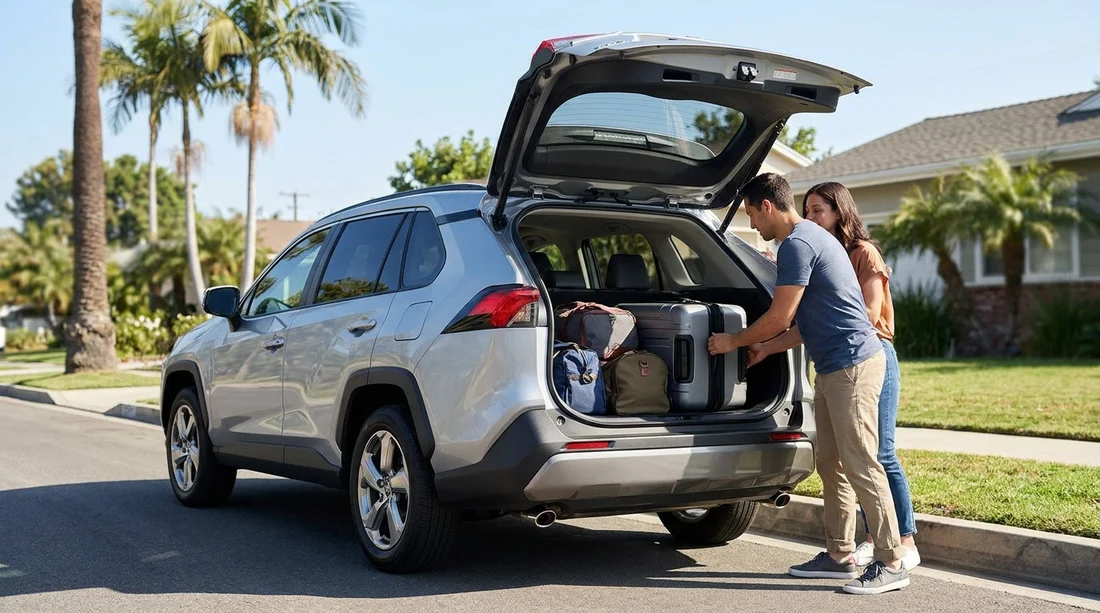
Quick Summary:
- Plan on two large suitcases plus one or two smaller bags.
- Swap one hard carry-on for a duffel to fit a buggy.
- Three large cases usually means folding seats or upgrading vehicle class.
- Measure suitcase length including wheels and handles before you travel.
When you are arranging car hire in Los Angeles, “intermediate SUV” sounds straightforward, but luggage fit is where travellers get caught out. The class usually refers to a compact-to-mid-size crossover SUV with a rear boot that is practical, not enormous. It is ideal for airport runs, beach days, and day trips, but it has limits once you add big suitcases, a buggy, or bulky beach gear.
This guide maps common suitcase and buggy combinations to typical intermediate SUV boot space, so you can choose the right class first time. For Los Angeles trips, it also helps to think about where the car is being collected, because airport luggage tends to be at its maximum. If you are collecting at LAX, the dedicated pages for Los Angeles LAX car rental and car hire at Los Angeles Airport (LAX) are useful references when you are comparing vehicle groups and policies.
What “intermediate SUV” usually means for boot space
Across major rental fleets, an intermediate SUV is commonly a 5-seat crossover with a split-fold rear bench. With all five seats in use, the boot is typically suitable for everyday luggage, but it is rarely deep enough for a full “stack” of hard-shell large cases.
Instead of relying on litres or cubic feet, it is more useful to think in suitcase “footprints”. Boot floors are often around 95 to 110 cm wide between trims, and roughly 75 to 90 cm deep to the seatbacks, with a boot lip that can make tall cases awkward when laid upright. In practical terms, that tends to translate to a two-large-suitcase floor plan, with smaller items packed around them.
Keep in mind that the exact model can vary at pick-up. That is why you should plan for the lower end of the class, not the best-case boot you saw in a photo.
Suitcase sizes used in this guide
To keep comparisons consistent, here are the typical sizes most travellers use:
Large suitcase (checked): about 75 x 50 x 30 cm, often hard-shell.
Medium suitcase: about 65 x 45 x 27 cm.
Carry-on cabin case: about 55 x 40 x 20 cm.
Soft duffel: variable, but more “compressible” than a hard case.
If your cases are expandable, treat them as one size up once expanded. Wheels and handles also add just enough length to cause an unexpected misfit when the boot is short.
Common luggage and buggy combinations that fit
Below are realistic load-outs that typically work in an intermediate SUV with all five seats available. They assume you are packing the boot only, not stacking above the parcel shelf, which is best avoided for visibility and security around Los Angeles.
Two adults, weekend or short break: 2 carry-ons plus 2 small backpacks. This is an easy fit, leaving space for shopping or a cooler.
Two adults, one-week trip: 2 medium suitcases plus 2 carry-ons. Usually fits with the mediums laid flat, cabin cases turned sideways.
Two adults, longer trip: 2 large suitcases plus 2 carry-ons. Often fits, but you may need to angle one carry-on or place it on its side.
Family with a compact buggy: 2 medium suitcases, 2 carry-ons, plus a compact umbrella stroller. This is one of the most reliable family combinations if the buggy folds slim.
Family with a travel-system buggy: 1 large suitcase, 1 medium suitcase, 2 carry-ons, plus buggy frame. This can work if the buggy separates into flatter pieces, but it becomes sensitive to boot height.
Beach-heavy packing: 2 large suitcases plus 1 carry-on, leaving room for soft items like towels. Replace rigid coolers with soft bags to reduce wasted space.
If you need to fit three large suitcases with all seats up, an intermediate SUV is unlikely to be comfortable. You might manage it with a mix of one large plus two mediums, but with three large cases you usually need either a larger SUV class or to fold part of the rear bench.
When you can use the split-fold seats, and when you should not
Intermediate SUVs often have 60/40 split rear seats. Folding the smaller section can transform what fits, but only if you have fewer than five passengers. Common LA scenarios include two adults and one child seat, where you can fold the other side for long items.
If you will consistently need all five seatbelts, plan your car hire around what fits with seats up, not folded.
How to judge fit quickly at pick-up
At collection, do a fast test before driving away. Place the largest case in first, flat, wheels to the rear, then try to add the second large case next to it. If it only fits diagonally, you are already close to the limit. Next, test the buggy. If you have to stack it on top of hard cases, you may lose rear visibility or struggle to close the boot cleanly.
Also check the boot lip height. Some intermediate SUVs have a raised lip that makes upright packing harder, especially with rigid cases that cannot flex.
If you are collecting in Orange County rather than central Los Angeles, you can compare options via Santa Ana (SNA) car rental or car hire at Santa Ana Airport (SNA), where vehicle groups can vary by location and season.
Packing tips that increase usable boot space
Choose one soft bag. Replacing a carry-on hard case with a duffel often creates room for a buggy or extra backpack.
Keep the parcel shelf usable. Packing above it reduces visibility and can attract attention when parked.
Put heavy, flat items on the floor. Hard cases on the bottom make it easier to “tessellate” smaller bags around them.
Measure your biggest case. The most common failure is assuming “large” always means the same. A 32-inch expandable case can be several centimetres deeper than standard.
So, is an intermediate SUV the right choice for Los Angeles?
For many travellers, yes. If you are two to four people with a sensible mix of medium and carry-on luggage, an intermediate SUV is a comfortable, easy-to-drive option for LA freeways and parking structures. It is also a good compromise if you want SUV visibility without moving up to a larger class.
However, if your group is five adults, or you have three large hard-shell suitcases plus a big buggy, you will likely have a smoother trip by selecting a larger SUV category. If you want to explore vehicle group expectations, the California SUV page at SUV rental in California (LAX) can help you compare what tends to be available around Los Angeles.
FAQ
How many large suitcases fit in an intermediate SUV boot with five seats?
Most intermediate SUVs fit two large suitcases, plus one or two smaller bags. Three large hard-shell cases usually require folding a seat section or moving up a class.
Will a buggy fit with two large suitcases?
A compact umbrella stroller often fits if you replace one rigid carry-on with a soft duffel. A full travel-system buggy may force you to drop to one large plus one medium suitcase.
Can I rely on exact boot measurements when arranging car hire in Los Angeles?
Not fully, because the model can vary within the class. Plan around typical “two large cases” capacity and bring one flexible bag to handle variation.
Is it better to stack luggage high or keep it below the parcel shelf?
Keep luggage below the parcel shelf where possible. It preserves rear visibility and is generally safer and more secure when parked around Los Angeles.
What is the quickest way to avoid a luggage mismatch at pick-up?
Load the largest suitcase first, then the second, then test the buggy. If the boot will not close cleanly without stacking high, consider swapping to a larger vehicle group.





























































































