


Quick Summary:
- Confirm the contract fuel policy and recorded level both state Full.
- Check the fuel gauge with ignition on and let it stabilise.
- Take time-stamped photos of the dashboard and the fuel line.
- Fix any mismatch before exiting, with amended paperwork or written notes.
Full-to-full is one of the fairest fuel policies for car hire, but only if you confirm the vehicle is actually supplied full before you leave. In Los Angeles, where you may collect at a busy airport facility and drive straight into traffic, a two minute check can prevent a fuel charge dispute later. The goal is simple, ensure the paperwork, the fuel gauge, and your own photo evidence all agree with each other.
If you are collecting around LAX, keep your confirmation and rental agreement handy. Hola Car Rentals publishes practical pick-up information for common locations such as Los Angeles LAX car rental and the broader car hire California LAX page, which can help you anticipate the handover process and what documents you should have ready.
1) Start with the fuel policy and the stated fuel level on your paperwork
Before you even look at the car, check your rental agreement on paper or on-screen. You are looking for two separate items that people often mix up, the fuel policy and the recorded fuel level at check-out.
Fuel policy should explicitly say full-to-full (sometimes phrased as “return full” or “same-to-same”). If it says pre-purchase, full-to-empty, or “pay on return”, your obligations and the provider’s starting fuel promise are different. If your confirmation email says full-to-full but the rental agreement does not, ask for it to be corrected before you drive off.
Fuel level at check-out may appear as “Full”, “8/8”, “1/1”, or a percentage. Some agreements show bars, for example 8 bars out of 8. Your job is to ensure the recorded level matches what the vehicle shows when powered on. If the contract says “Full” but the car reads 7/8, that mismatch is exactly what later disputes are built on.
2) Check the fuel gauge properly, not just a quick glance
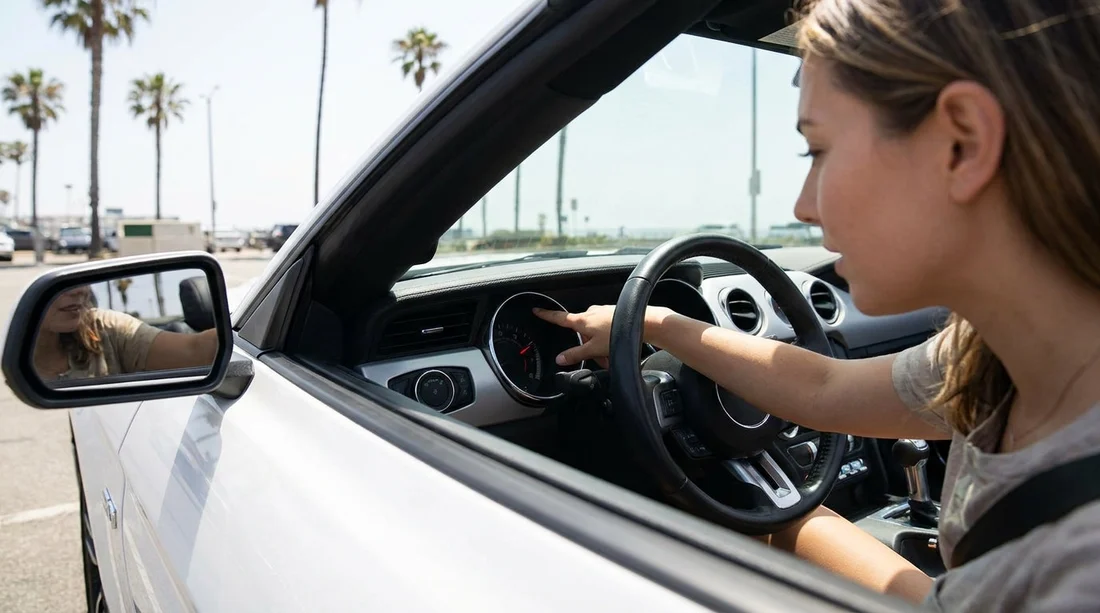
Modern dashboards can be misleading if you look too quickly. Do the check with the ignition on, and if possible, the engine running for a few seconds so the fuel reading stabilises. Then assess the fuel gauge in a way that would stand up in a dispute.
Look for “full” indicators. If the gauge is needle-based, it should be at the full mark rather than just near it. If it is digital bars, it should show maximum bars. On some cars, the display may show “Range” in miles. Range varies by recent driving, air conditioning, and traffic, so it is not proof on its own, but it can support your notes.
Compare against the paperwork notation. If your agreement says 8/8 and you see 7/8, do not assume it will “correct itself”. The safest approach is to ask the desk or exit booth to adjust the check-out fuel level on the agreement, or to authorise you to top up immediately and record it.
If you are collecting a larger vehicle, such as a family SUV or a van, confirm where the fuel gauge sits and whether the vehicle has multiple trip computers. Different trims display fuel in different menus. Hola Car Rentals also covers vehicle categories at LAX, including SUV hire Los Angeles LAX and van rental California LAX, which is useful for knowing what to expect at pick-up.
3) Take time-stamped photos that prove “full” beyond doubt
Photos are your simplest protection, especially when the car park is hectic and staff are processing many departures. Aim for clear, time-stamped images taken at the pick-up location.
Photo 1, dashboard with fuel gauge. Turn the ignition on so the gauge is visible, then photograph the whole instrument cluster. Make sure the fuel indicator and mileage are visible in the same shot if possible. This helps tie the fuel reading to the specific car you collected.
Photo 2, rental agreement fuel line. Photograph the part of the paperwork showing the fuel policy and the recorded fuel level, plus the vehicle registration or VIN snippet if it appears. If the agreement is digital, take a screenshot.
Photo 3, pump receipt if you top up. If you end up adding fuel right away to bring it to full, photograph the receipt and the pump display, showing gallons and total cost. In Los Angeles, stations near airports can be busy, so keep the receipt flat and legible.
4) If anything is off, fix it before you pass the exit point
The best time to resolve discrepancies is while you are still at the collection facility. Once you leave the exit barrier, it can be harder to prove what the gauge showed at pick-up.
Ask for a contract amendment. If the fuel gauge shows less than full, request that the agreement’s check-out fuel level is amended to match what you received. That way, you only need to return it to the same level, and you are protected from a “missing fuel” charge.
Do not accept vague assurances. “It’s basically full” does not help if the system says otherwise. You want a written note, an updated fuel level, or a documented instruction.
5) Understand common “full-to-full” misunderstandings in Los Angeles
“Full” on paper, not full on gauge is the most common. Systems are often pre-set to full, especially at peak airport times. Your photos and a quick correction prevent you being blamed for someone else’s missed refuel.
Range estimate confusion. Drivers sometimes think a low range number means the tank is not full. Range is only an estimate based on recent driving patterns, so use it as supporting information, not your primary proof.
6) A quick departure checklist you can follow every time
Step 1, read the agreement line for fuel policy and fuel level. Confirm it states full-to-full and “Full” or equivalent.
Step 2, power on the car and check the fuel gauge carefully. Wait a moment for the display to settle.
Step 3, take the dashboard photo, then photograph the agreement fuel line.
Step 4, if the gauge is not full, stop and request a correction or a documented plan before exiting.
This approach is quick, consistent, and works whether you are picking up at LAX or nearby hubs. If your trip involves Orange County as well, Hola Car Rentals also provides location detail for facilities such as car rental airport Santa Ana SNA, which can be helpful if you compare processes across collection points.
FAQ
How do I know my car hire is definitely full-to-full? Your agreement should state a full-to-full policy and record the check-out fuel level as full, such as “Full”, “8/8”, or “1/1”. Confirm the dashboard gauge shows the same before leaving.
What if the paperwork says full but the gauge is one bar down? Ask staff to amend the recorded check-out fuel level to match the gauge, or to refuel the car before you depart. Also take clear photos of the fuel gauge and the agreement line.
Should I top up immediately if it is not full? Only do so if staff cannot correct the record and you have written acknowledgement or clear evidence. If you top up, keep the pump receipt and photograph it alongside the dashboard reading.
Will a range estimate prove the tank was full? No. Range depends on recent driving and conditions, so it can vary widely even with a full tank. Use the actual fuel gauge and your paperwork as the primary proof.





























































































