


Quick Summary:
- Check the car class code, avoid compact 5+2 layouts for adults.
- Confirm seatbelts and headrests count, not just “7 seats” wording.
- Look for third-row legroom and cargo litres with all seats up.
- Request model examples or photos showing third row raised and accessible.
A “7-seater” sounds straightforward, but in Florida car hire listings it can describe very different layouts. Some vehicles are true three-row people carriers where the third row suits adults for reasonable journeys. Others are “5+2” crossovers where the third row works mainly for small children, and luggage space almost disappears once it is in use.
Because you usually book a category rather than a specific model, confirming a usable third row means interpreting the class description like a detective. The goal is to spot whether the third row is genuinely practical before you arrive at the counter, especially if you are travelling with seven people, or six people plus buggies, coolers, and beach bags.
If you are collecting near the coast, compare what is commonly offered at Miami Beach car hire locations versus larger airport fleets, where bigger three-row SUVs and minivans tend to be more available. For South Florida arrivals, it can also help to review typical categories offered around Fort Lauderdale airport.
Understand what “7 seats” often means in Florida car hire
Rental fleets commonly split “7-seater” options into two broad types. First are mid-size crossovers with a small third row, often marketed as “7-passenger SUV”. Second are larger SUVs and minivans with a more adult-friendly third row.
In practice, “usable” usually depends on three things: how easy it is to physically access the third row, whether adults can sit there without knees-up discomfort, and whether you still have meaningful luggage space once all seats are occupied. A car can technically have seven seatbelts while still being a poor choice for a family of seven with suitcases.
Decode car class descriptions and codes
Many suppliers show a “Group” or SIPP-style code, plus an example model list. You do not need to memorise every code, but you should know what to look for in the description.
Look for “Standard SUV”, “Full-size SUV”, “Premium SUV”, or “Minivan” wording. These classes are more likely to have a third row that adults can tolerate for longer drives.
Be cautious with “Intermediate SUV” or “Compact 7-seater” phrasing. This is where the 5+2 layouts often appear. They can be fine for two children in the back, but you will want to confirm third-row headroom and legroom before assuming it works for everyone.
Prefer listings that separate “7-passenger SUV” from “Minivan”. If “7-seater” is bundled with several unrelated vehicle types, your odds of getting a smaller third row increase.
If you are comparing city versus airport pickup, downtown locations can have different inventory. For example, you might see different category mixes around downtown Miami compared with larger airport fleets.
Confirm the third row is genuinely usable: a practical checklist
Use this checklist before you finalise car hire, and again when you receive confirmation details.
1) Verify seatbelts and headrests, not just “capacity”
Some listings say “up to 7” without clarifying whether the third row has two full three-point belts, or whether the centre seat in the second row is compromised. A usable third row should have proper restraints and headrests, ideally for two passengers, sometimes three in larger vehicles.
2) Check access method
Look for references to “second-row slide” or “one-touch tumble”. If the only way in is folding the seat forward awkwardly, it is a sign the third row is occasional-use. For families with child seats, easy access matters even more because a fixed child seat can block the pathway to the back.
3) Measure luggage space with all seats in use
This is where many trips go wrong. Look for cargo litres (or cubic feet) behind the third row, or at least suitcase icons. If you only see a big boot shown with the third row folded flat, that does not help a group of seven. As a rule, a 5+2 SUV may only take a couple of soft bags when all seven seats are up. A minivan typically keeps a deeper well behind the third row, which is why it is often the safer choice for airport arrivals with luggage.
Use model examples and photos the right way
Most Florida car hire results show “or similar” and a handful of example models. Treat those examples as a probability signal. If all examples are known for small third rows, assume the category is a 5+2. If the examples include larger three-row vehicles, your chances improve.
Photos can also mislead, because promotional images often show the vehicle with the third row folded flat to make the boot look enormous. When you are checking images, specifically look for at least one of these:
Third row shown raised, with visible headrests and seatbelts.
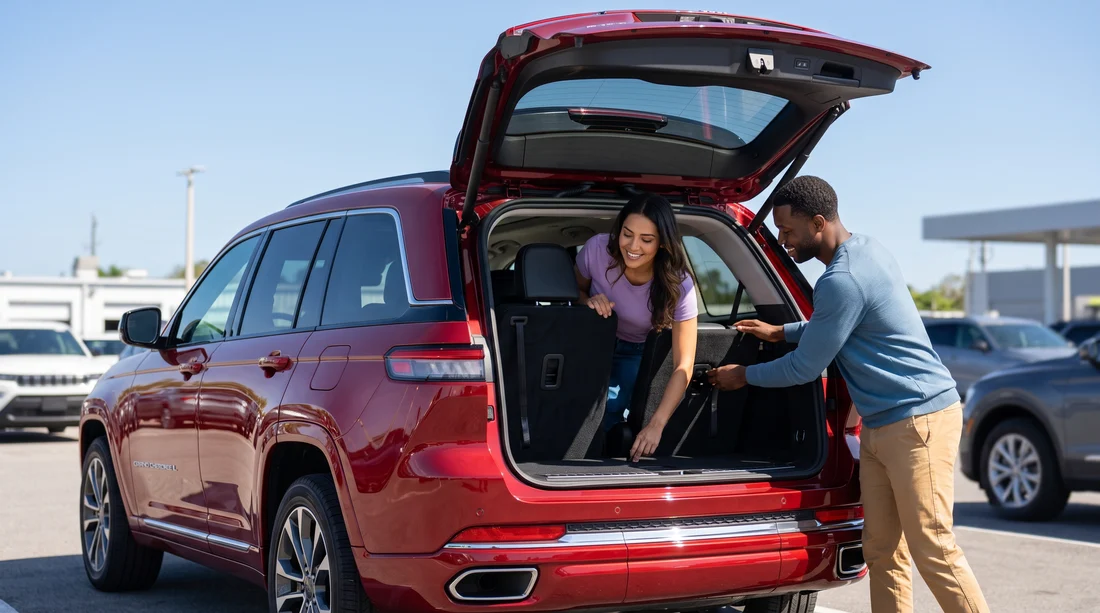
A view through the open tailgate with the third row up, so you can judge remaining depth for bags.
Interior side profile showing the seat base height and knee clearance.
If images are generic, focus on the written specs instead of relying on the picture.
Know when a minivan is the more reliable “usable third row” option
Travellers sometimes avoid minivans because they expect them to be harder to drive or park. In Florida, they are generally straightforward, and they solve the third-row problem neatly: better access, more consistent space, and usually the best luggage capacity with seven on board.
If your trip includes long highway days, theme parks, or multiple suitcases, checking minivan availability can save a lot of compromise. For arrivals in Central Florida, compare three-row options with categories commonly seen on Orlando airport van rental pages, since airport fleets often carry more people-mover inventory.
How to sanity-check at pickup without losing time
Even after careful selection, verify the actual vehicle before you load up. Do a quick two-minute check in the car park:
Raise the third row fully and ensure it locks, with headrests in place.
Sit in the third row for 20 seconds, and check knee room and foot space.
Open the boot with the third row up and compare it to your largest bag.
If it is clearly unsuitable for your group, it is easier to address immediately than after you have left the lot.
Choose the right category for your trip profile
To confirm a usable third row before car hire in Florida, match the vehicle class to your passenger and luggage reality, not just the seat count. For seven adults, or for six people plus lots of luggage, a larger SUV class or a minivan is usually the most dependable answer. For two adults and several small children with light bags, a 5+2 can still work if you accept the tighter third row and plan luggage accordingly.
The best outcomes come from combining three checks: category wording and code, third-row and cargo specs with all seats up, and example models that align with your comfort expectations. Do those, and you will arrive with far fewer surprises.
FAQ
How do I tell if a 7-seater is really a 5+2? If the category is compact or intermediate, and examples are smaller crossovers, it is often a 5+2. Confirm third-row space and luggage room with all seats raised.
Will I definitely get the model shown in the listing photo? No. Florida car hire usually sells a category, not a guaranteed model. Use the example models and specs to judge the typical third-row usability for that class.
How much luggage fits when all seven seats are in use? It varies widely. Many 5+2 SUVs only fit a couple of soft bags with the third row up, while minivans and larger SUVs usually keep space for several suitcases.
Is a minivan easier than a large SUV for seven passengers? Often yes. Minivans typically provide better third-row access and more consistent luggage space, with a lower step-in height for children and older travellers.
What should I check at pickup to confirm the third row is usable? Raise the third row, test the entry path, have an adult sit briefly, and check boot depth with the third row up before you load your bags.





























































































