


Quick Summary:
- Prepaying usually locks your base rate, not your LDW or SLI choices.
- If LDW is included in your voucher, you may be unable to remove it.
- You can typically add SLI and roadside cover at the desk locally.
- Always match names, card, and licence details, or coverage may be refused.
Prepaying for car hire can feel like it should fix everything in place, including insurance. In California, it rarely works that way. The key is understanding what was actually prepaid, what is merely “available”, and what the rental company is allowed to change at the counter.
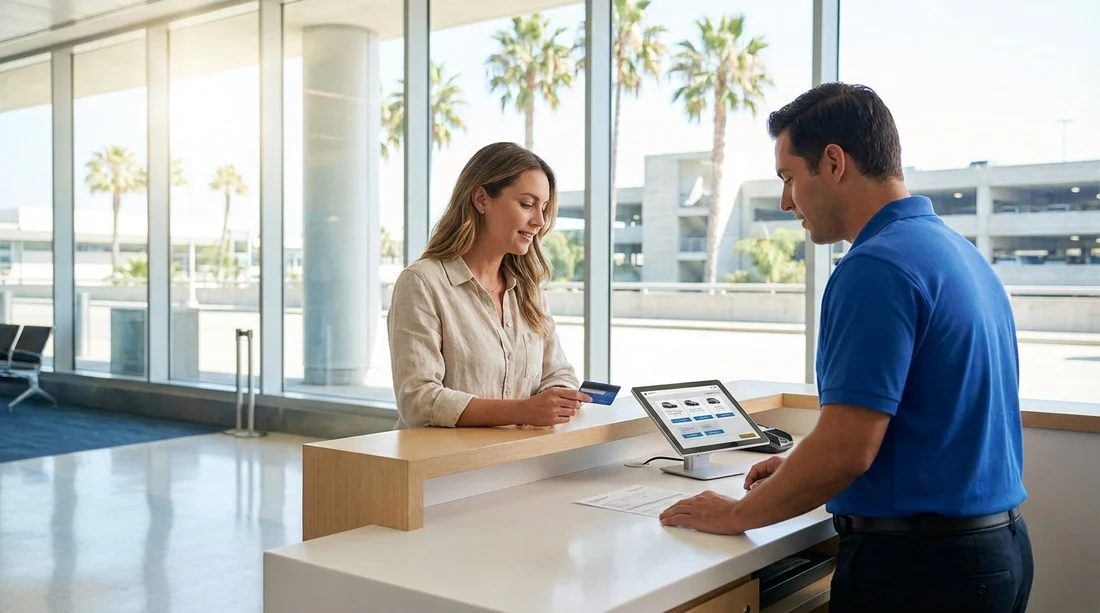
With most prepaid car hire reservations, you have prepaid a base rental rate and sometimes specific inclusions that appear on your voucher. At pick-up, the desk still has to verify eligibility, take a security deposit, confirm your driving licence details, and offer optional protections. Those optional protections often include Loss Damage Waiver (LDW) and Supplemental Liability Insurance (SLI), plus extras such as roadside assistance and personal accident coverage.
This article explains what is normally changeable at a California rental counter on prepaid versus pay-at-counter bookings, how LDW and SLI fit in, and why prices can differ at the desk. For location-specific car hire information, you can also browse Hola Car Rentals pages for car hire at San Francisco SFO, Enterprise car hire in California LAX, car hire in San Jose SJC, and car hire at Sacramento SMF.
What “prepaid” actually means for insurance in California
Prepaid car hire typically means you paid the broker or travel site before you travel, rather than paying the rental charges at the counter. It does not automatically mean you have prepaid every protection product the rental company sells.
There are three common scenarios:
1) Base rate prepaid, insurance optional at counter. This is the most common. Your voucher shows the vehicle category, rental period, and what is included. LDW and SLI may be listed as “not included” or “available at desk”. In this case, prepaying does not limit your ability to add or decline these options, subject to local rules and availability.
2) LDW included in the prepaid rate. Some rates include LDW (sometimes described as CDW/LDW). If the voucher says it is included, it is often bundled into the rate. At the desk, you may not be able to remove it to reduce cost, because the prepaid contract is built with it included.
3) Third-party coverage outside the rental agreement. Some travellers rely on their own car insurance, a premium bank card benefit, or a standalone policy. In that case, you may want to decline rental-company LDW or SLI. Prepayment does not usually stop you declining, but the desk will still follow their rules for deposits, proof requirements, and acceptable coverage.
LDW vs SLI, and which one causes most confusion
LDW usually relates to damage to, or theft of, the rental vehicle. It is not technically “insurance” in many rental agreements, it is a waiver that limits what the rental company can charge you for certain losses, often subject to exclusions. In California, the desk will typically present LDW as optional unless it is already included in your rate.
SLI is an additional liability product that increases third-party liability coverage beyond the state minimums provided by the rental company. In the US, liability is often the bigger gap for visitors, because your personal policy from home may not extend, and credit card benefits generally focus on vehicle damage rather than third-party liability.
The confusion comes from travellers assuming prepaying locks both items. In practice, the part that is “locked” is whatever your voucher states as included. Anything listed as optional can usually be added or declined at pick-up, with pricing set by the rental company at that location.
Does prepaying limit what you can decline at the desk?
Sometimes. The deciding factor is whether the coverage is baked into the prepaid rate or is an optional add-on.
If LDW is included on the voucher: you may be unable to decline it because there is no counter price to subtract from your prepaid total. Even if the agent can remove it in the system, you might not receive a refund through the prepaid channel, or the voucher may not allow amendments.
If LDW is not included: you can usually decline it. However, declining can increase the security deposit and may trigger stricter card requirements, especially for certain vehicle categories.
If SLI is not included: you can usually decline it. The desk should still provide the legally required minimum liability coverage, but minimum limits may be far lower than what you would choose for peace of mind.
If you want to use a credit card for damage cover: you may be asked to confirm you are the cardholder and primary driver. Some rental companies also require the card benefit to be in the driver’s name and may ask you to sign that you are declining LDW knowingly. Prepaying does not change these checks.
Does prepaying limit what you can add at pick-up?
Typically, no. Prepaid and pay-at-counter customers are usually offered the same menu of optional products at the desk, such as:
SLI to increase third-party liability limits.
Roadside assistance programmes, which may cover call-outs, tyre service, lockouts, or towing in some circumstances.
Personal accident and effects coverage type products, which vary by supplier.
What can be limited is the price you expected, not the ability to add the item. Counter prices in California can differ from online estimates because the desk is applying local taxes, location fees, and the supplier’s current rate for that day and branch.
What is actually changeable at the California rental desk
Think of the desk as having control over the live rental agreement, but not always over the prepaid voucher value.
Usually changeable: adding optional protections (SLI, roadside), adding additional drivers, adjusting fuel options, and sometimes upgrading vehicle class if available.
Often not changeable: removing inclusions already bundled into a prepaid rate, changing the prepaid pick-up or return times without affecting price, or rewriting a prepaid booking into a totally different rate family without re-pricing.
If you want maximum freedom to build the rental agreement at the desk, pay-at-counter can feel simpler. If you want cost predictability for the core rental, prepaid can be useful. Either way, insurance decisions should be based on what the voucher includes and what coverage you already have.
FAQ
Does prepaid car hire in California stop me from buying SLI at the counter? Usually not. If SLI is not included on your voucher, it is typically offered at the desk at the branch’s current price and terms.
If LDW is included in my prepaid voucher, can I decline it and get money back? Often you cannot, because the prepaid rate is packaged with LDW included. Even if an agent removes it, a refund may not be available through the prepaid channel.
Is LDW the same as liability insurance in California? No. LDW relates to damage or theft of the rental vehicle. Liability relates to damage or injury you cause to others, which is where SLI can increase protection.
Will declining LDW change the deposit on my car hire? It can. Many suppliers increase the security deposit when LDW is declined, and they may require a credit card in the main driver’s name.
Why is the counter price for insurance higher than what I saw online? Online figures may be estimates or based on different rate assumptions. Counter pricing reflects local taxes, branch pricing, and what is actually included in your voucher.





























































































