


Quick Summary:
- In Florida car hire, you usually install the hired child seat yourself.
- Ask staff to show seat parts, manuals, and vehicle anchor points.
- Check seat label, expiry date, missing parts, and visible damage.
- Practise fitting, tighten correctly, then recheck after a short drive.
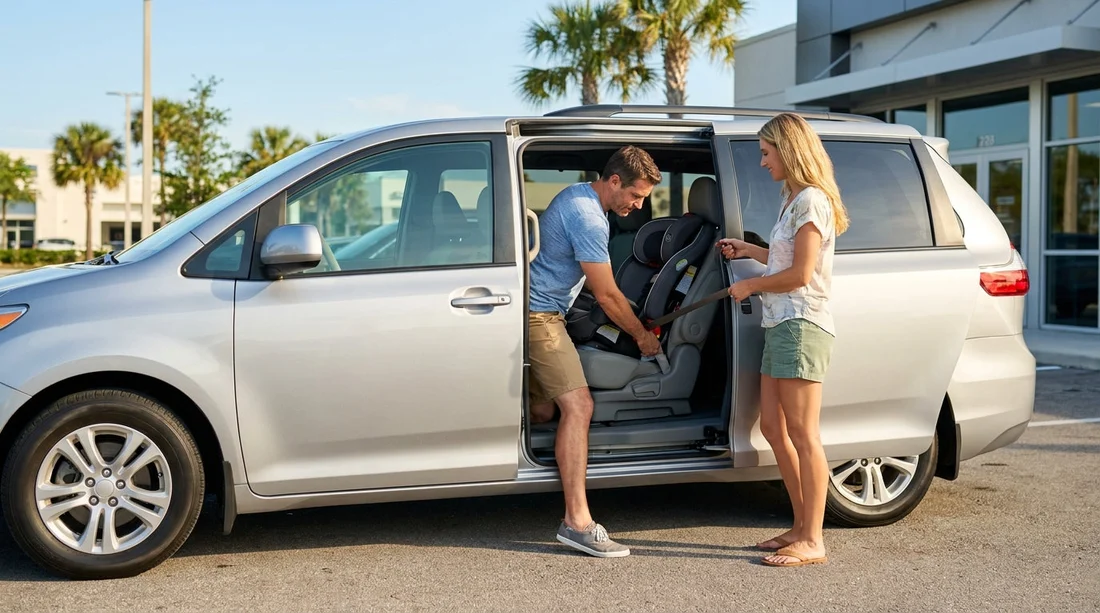
When you pick up a rental car in Florida and add a child seat, most renters are surprised by one practical detail, you are commonly expected to install it yourself. Policies vary by supplier and location, but it is normal for counter or lot staff to hand you the seat, confirm your booking, and leave the actual fitting to you. The reason is simple, staff are not always trained child passenger safety technicians, and companies avoid taking responsibility for a seat being installed incorrectly.
That does not mean you are on your own. You can still ask for time, space, and basic assistance to identify the correct seat, find the right belt path, and locate the vehicle’s LATCH anchors or top tether points. Planning ahead makes the pick-up far less stressful, especially after a flight or with tired children.
If you are arranging your Florida car hire around an airport arrival, build in extra time at the lot. For example, collections near Miami can be busy at peak periods, so it helps to be ready before you reach the car park. Hola Car Rentals provides location pages that make it easier to plan the pick-up area, such as Florida car hire and car hire at Miami Beach airport area.
What to expect at pick-up in Florida
Most rental desks treat child seats as an accessory, similar to a GPS unit. Typically, you can expect the process to look like this:
1) You receive the seat at the counter or from the lot booth. The seat may be in a bag or loose, and you are asked to confirm the type requested, infant seat, toddler seat, or booster.
2) You are directed to your vehicle. Staff may point out where the car is parked and may help carry the seat, but they often do not fit it.
3) You install before driving away. This is the moment to slow down. Do not feel pressured to pull out immediately because other cars are waiting.
4) You sign acknowledgement paperwork. Some suppliers include wording that the renter is responsible for correct use and installation of accessories.
If you are collecting in downtown areas, space can be tighter than at airports. Locations such as car hire in Brickell can mean you are fitting a seat in a multi-storey garage. In that case, ask where you can park briefly with doors fully open while you work.
Before you leave the desk, confirm the seat is suitable
Even if you have reserved the right category, always check the actual seat in front of you. Florida law focuses on using an appropriate restraint for the child’s age and size, and your priority is that the seat fits your child correctly.
Do these quick checks before walking away:
Seat type and size range: Look for the manufacturer label showing height and weight limits. Make sure it matches your child’s current measurements, not just age.
Condition: Check for cracks in the shell, frayed straps, sticky buckles, missing chest clip, or any missing base (for infant seats). If anything looks questionable, ask for a different seat.
Expiry date: Most car seats have an expiry date on the label. If it is expired or unreadable, request another.
Manual availability: The best result is a manual included with the seat. If not, check whether basic instructions are printed on the seat itself. Without clear instructions, you may struggle to route the belt correctly.
Step-by-step checks to do once you reach the car
Once you are at the vehicle, do a quick scan of the back seats. Look for the LATCH anchor symbols, sometimes small icons where the seat back meets the seat cushion, and locate top tether anchors, often on the rear shelf, seat back, or in the boot area for SUVs.
1) Pick the safest seating position. In general, the centre rear seat can be a good option if it allows a secure installation. If the centre position lacks anchors or does not allow a tight fit, use an outboard rear seat.
2) Choose LATCH or seat belt installation. Use one method, not both, unless the seat manufacturer specifically allows it. Pay attention to weight limits for LATCH use stated by the car seat manufacturer.
3) Get the belt path right. Rear-facing and forward-facing belt paths are different. Confirm you are routing through the correct guides.
4) Tighten properly. Press down where the child’s bottom would be, then tighten the belt or LATCH strap. Your goal is minimal movement at the belt path.
5) Do the inch test. Grip the seat near the belt path and try to move it side-to-side and front-to-back. It should not move more than about one inch.
6) If forward-facing, attach the top tether. This reduces head movement in a crash. Tighten the tether until snug, without lifting the seat off the vehicle cushion.
7) Adjust harness fit for your child. Straps should lie flat, chest clip at armpit level, and harness snug enough that you cannot pinch excess strap at the shoulder.
8) Recheck after a short drive. After 10 minutes, pull over safely and repeat the inch test. New installations can loosen slightly once the car moves.
If you run into a vehicle-specific question, such as where the tether anchor is hidden, ask the lot attendant to show you where it is, even if they do not physically install the seat. At some suppliers, attendants are familiar with common anchor locations in their fleet. This can be helpful at busier pick-up points such as Payless at Orlando MCO, where you may want to fit quickly without guessing.
Common issues renters face, and how to avoid them
Getting the wrong seat type. If you booked a toddler seat but receive a booster, do not accept it. A booster is not a substitute for a harnessed seat for a child who is too small.
Missing parts. Infant seats often need a base, and some convertible seats have additional pads. If any part seems absent, swap the seat immediately.
Seat belt locking confusion. Some cars require you to pull the belt all the way out to switch to locking mode. If you cannot make the belt stay tight, consult the vehicle’s sun visor label or quick guide, or ask staff where the handbook is kept.
Not enough time. Rushing is the biggest cause of mistakes. If you are tired or travelling late, consider doing the install before loading luggage, so you can focus.
Multiple seats. If you have two or three children, test that all seats fit without overlapping buckle stalks or blocking access. Sometimes moving one seat to the other side solves buckle conflicts.
Should you bring your own child seat instead?
Many families prefer bringing their own seat because they know its history, expiry date, and how it fits their child. Airlines usually allow car seats to be checked, and some parents use a travel bag to protect it. The trade-off is carrying bulky gear through the airport and the risk of damage in transit.
Hiring a seat can be convenient for short trips, but you should still plan to install it yourself and check it carefully. If you are not confident fitting a particular seat type, practise at home with a similar model, or choose a vehicle category that gives you room to work calmly. If you are collecting a larger vehicle for family luggage, pages like van hire in Miami can help you compare space for rear seats and prams.
FAQ
Do I have to install a hired child seat myself in Florida? In most Florida car hire pick-ups, yes. Staff usually provide the seat, but the renter completes installation and checks.
Will rental staff help me fit the child seat? They may point out anchor locations or provide space and time, but many locations will not physically install it for liability reasons.
What should I check on the child seat before leaving the lot? Confirm the seat is the correct type and size range, not expired, undamaged, complete with parts, and has clear instructions on labels or a manual.
How do I know the child seat is tight enough? Do the inch test at the belt path. If the seat moves more than about one inch side-to-side or front-to-back, tighten again.
What if the hired seat does not look safe or is unsuitable? Ask for a replacement immediately before you drive away. It is far easier to swap at pick-up than later in your trip.





























































































