


Quick Summary:
- Most Los Angeles EV rentals include a basic charging cable, but not always.
- Confirm connector type, cable presence, and any adapter at the counter.
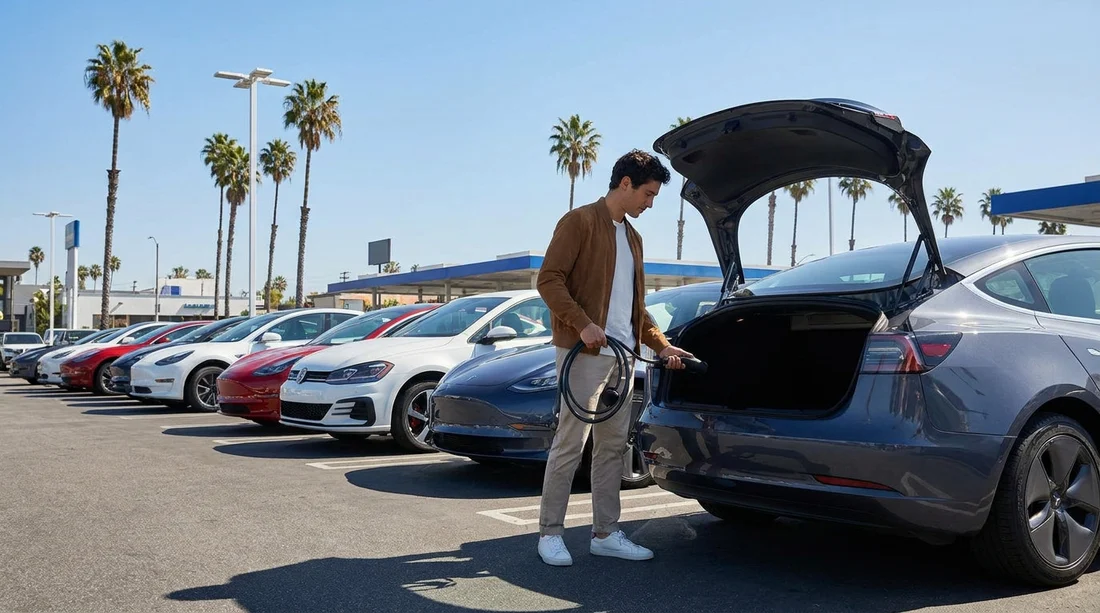
- Check the boot immediately, then photograph charging kit and condition.
- Ask about home, Level 2, and DC fast-charging compatibility before leaving.
Picking up an electric vehicle for car hire in Los Angeles can be wonderfully smooth, until the first charging stop reveals you do not have the right cable or the car cannot use the charger you planned. The key is understanding what EV rental cars typically include, what they often do not include, and what you should verify at the counter so you can charge straight away.
Because EV models vary and charging standards differ, there is no universal guarantee that every rental will come with the same charging kit. Even within the same brand, the contents can change by location, fleet rotation, or prior customer returns. If you are collecting at the airport, these checks matter even more because it is easier to sort issues before you leave the rental facility. For location-specific pick-up context, see car hire at Los Angeles LAX.
What EV rental cars typically come with at pick-up
In Los Angeles, many EV rentals come with some form of portable charging cable, often stored in the boot under the floor panel or in a side compartment. This is commonly called the “mobile connector” or “granny cable”, even though the exact kit differs by manufacturer. In practice, what you get is usually intended for slower charging options rather than high-speed charging on the road.
A portable AC charging cable: This may plug into a standard wall outlet (slow), or into a higher-power outlet with the right plug head. The cable may be brand-specific or a generic J1772 lead, depending on the vehicle.
Basic documentation: Often a quick-start guide or QR-code card for the infotainment system and charging basics. It may not include detailed charging advice, so a few smart questions at the counter can save time.
What EV rentals often do not include
To set realistic expectations for car hire in Los Angeles, it helps to know what is commonly missing.
No DC fast-charging cable: For CCS or NACS (Tesla) DC fast charging, the cable is built into the charging station. You do not bring your own lead to a fast charger in normal circumstances. What you may need is an adapter, not a cable.
No adapters (or only one adapter): Adapters are the most variable part of the kit. A Tesla may or may not include a J1772 adapter for AC charging. A non-Tesla EV will not typically include a Tesla (NACS) to CCS adapter. If you were planning to rely on a specific charging network, you need to confirm compatibility at pick-up.
No guarantee of a full battery: Some operators provide EVs with a target state of charge, others aim for “reasonable”, and policies vary by supplier and booking terms. If you want to drive straight to Anaheim, Malibu, or Palm Springs without charging, confirm your expected starting charge before you walk to the car.
Charging standards you should know in Los Angeles
Los Angeles has excellent charging coverage, but your experience depends on matching the car to the charger type.
Level 1 (120V): Slow, useful overnight at a house. A portable cable might support this, but it is not guaranteed. Even if included, it can add only modest range per hour, so it is best as a fallback.
Level 2 (240V AC): Common at hotels, car parks, and some attractions. Many EVs use J1772 for AC charging, while Teslas use NACS with an adapter for J1772 posts. Some Level 2 chargers have a tethered cable, others expect you to supply one.
DC fast charging: The go-to for road trips. Non-Tesla EVs often use CCS for fast charging, while Teslas use NACS. Access to Tesla Superchargers for non-Tesla vehicles depends on vehicle compatibility and station support, so you should not assume it will work on day one without checking.
If you are choosing between providers and vehicle classes, Hola Car Rentals pages can help you compare pick-up arrangements at LAX, for example California car rental at LAX and Avis car hire at Los Angeles LAX.
What to confirm at the counter so you can charge immediately
When you collect your car hire in Los Angeles, a two-minute conversation can prevent an hour of frustration later. Ask direct, checklist-style questions.
1) Is a charging cable included, and where is it stored? Ask staff to confirm it is in the boot, and to note it on the check-out if their process allows. If you are in a hurry, at least ask them to tell you the usual storage spot so you can verify quickly.
2) What connector does this specific car use for AC and DC charging? Do not rely on assumptions like “all EVs are the same”. Knowing whether it is J1772, CCS, or NACS guides where you can charge and whether you need an adapter.
3) Are any adapters included? The most useful adapter scenarios are Tesla-to-J1772 for AC, or NACS-to-CCS where supported. If no adapter is included, you can still charge at many stations, but your options may narrow.
4) What is the starting battery percentage? Check the dashboard yourself too. If you have a long first leg, ask whether a higher state of charge is available, or whether another EV in the row is more suitable.
5) What is the return policy for charge level? Some returns require a minimum percentage, others aim for “as received”. Knowing this affects how you plan your last charge near the airport.
If you are picking up from LAX and comparing suppliers, these pages can help you focus on EV-specific questions: Budget car rental California LAX and Payless car rental Los Angeles LAX.
Do a quick on-car check before leaving the lot
Even if staff confirm a cable is included, check it yourself before you drive away. This is particularly important after long travel days, when it is easy to miss something.
Open the boot and find the kit: Look under the boot floor and in side compartments. Some EVs have a front boot where accessories live.
Confirm the connector matches the car: A loose cable in the boot is not helpful if it is the wrong type. Make sure the vehicle-end connector fits your charge port and the wall-end plug looks intact.
Photograph what is included: Take a quick photo of the cable, adapters, and the bag, plus any labels. This helps if there is confusion at return.
Check the charge port door and pins: Ensure the flap opens, the area looks clean, and nothing seems damaged. If you see issues, report them before leaving.
What if your EV rental does not include a cable?
If you open the boot and there is no cable, you still have options, but act quickly while you are near the rental desk.
Return to the counter immediately: Ask them to provide the missing kit or swap the vehicle. Missing accessories can happen due to previous renters or turnaround errors.
Adjust your charging plan: Use tethered public stations that provide the cable, which is common for DC fast charging and many Level 2 posts. This can keep you moving even without a portable lead.
Do not improvise with unsafe equipment: Avoid using unknown extension leads or unapproved plugs. Safety and compatibility matter, especially with higher-power outlets.
FAQ
Do electric rental cars usually include a charging cable in Los Angeles? Often yes, but it is not guaranteed. The safest approach is to confirm at the counter and verify the cable is in the boot before leaving.
Will I need my own cable to use fast chargers around Los Angeles? No. DC fast chargers provide their own attached cable. What you may need is the correct connector type or an adapter, depending on the vehicle.
Where is the charging cable typically stored in an EV rental? Common locations include under the boot floor, a side compartment in the boot, or occasionally the front boot. Ask staff where it should be for your model.
What should I ask at pick-up to avoid charging problems? Ask whether a cable and any adapters are included, what connector types the car uses, what the starting battery percentage is, and what the return charge policy requires.
If my rental EV is missing the cable, what is the quickest fix? Go straight back to the rental desk to request the kit or a vehicle swap. If you must leave, plan to use tethered chargers that do not require your own lead.





























































































