


Quick Summary:
- Most California rentals provide an inflator kit, not a full spare wheel.
- You can ask in advance, but availability is rarely guaranteed.
- Check the boot at pick-up and request a swap before leaving.
- Have roadside support in mind for longer routes or remote highways.
It is a common surprise for drivers arriving in California that their rental car may not have a traditional spare wheel. Instead, many modern vehicles come with an inflator kit, typically a small compressor and a sealant bottle designed to temporarily repair simple punctures. If you are arranging car hire and you know you would feel safer with a spare, it is reasonable to ask for one before you arrive, but it is important to understand what rental companies can realistically provide.
This guide sets expectations for what is usually supplied with US rental cars, why inflator kits are so common, and the practical steps you can take to improve your chances of getting a vehicle with a spare wheel. It also covers what to check at the counter and on the lot, and how to prepare if you are driving longer distances across California.
Why many rental cars in California do not carry spare wheels
Many newer cars, especially compact and mid-size models, are built without a full-size spare. Manufacturers often remove spares to reduce weight, improve fuel efficiency, free up boot space, and lower production costs. Some models may have a temporary “space saver” spare, while others have only a tyre inflator kit. Rental fleets frequently reflect these factory configurations, so the rental company may not be “withholding” a spare, the vehicle may never have been designed to carry one.
Fleet standardisation also plays a part. Large rental operations in California manage thousands of vehicles across multiple locations. Keeping a consistent, manufacturer-supplied tyre solution simplifies maintenance. It also reduces the chance of missing parts, for example a jack or wheel brace, after quick turnarounds.
Can you request a spare wheel instead of an inflator kit?
Yes, you can request it, but it is not guaranteed. In California, requests like “vehicle with spare tyre” are usually treated as preferences, not a promised feature, unless it is explicitly included in your rental agreement or confirmed by the supplier in writing. Even then, availability depends on the specific car on the lot at your pick-up time.
In practice, there are three outcomes when you ask:
1) They place a note on your booking. This can help, but it does not ensure a spare will be present. The agent may not know which specific vehicle you will receive until you are at the counter.
2) They offer a different vehicle category. Some larger cars, SUVs, and vans are more likely to include at least a temporary spare. If a spare wheel matters to you, being flexible on vehicle type can improve your chances.
3) They cannot confirm, but suggest checking at pick-up. This is common. The most reliable moment to solve it is before you drive away.
What is typically supplied with US rental cars
Across the US, including California, you can expect one of the following setups:
Inflator kit only: A compressor with a sealant canister. This may fix small punctures in the tread area, but it will not help with sidewall damage, a split tyre, or a tyre that has come off the rim.
Temporary spare: A smaller spare tyre designed for short distances and reduced speeds. It is better than sealant for many punctures, but still has limits and is not ideal for long motorway stretches.
Full-size spare: Less common in newer passenger cars, more common in some SUVs, trucks, and certain vans.
No practical tyre solution visible: Rare, but it happens when equipment goes missing or has been removed. This is exactly why a boot check before departure matters.
How to improve your chances before pick-up
When arranging car hire, focus on steps that rental staff can actually act on.
Ask for a vehicle with a spare, not “a spare wheel added”. Many locations do not carry separate spare wheels to allocate between cars. Your best bet is being given a car that already has one.
Consider the vehicle class carefully. Compact and economy cars are most likely to have inflator kits only. If your route includes long distances, mountain roads, desert stretches, or rural areas, a larger class may reduce stress. If you are flying into Northern California, you can compare pick-up options such as car rental at San Francisco SFO and ask the desk what is typical for the classes available that day.
Pick an airport location if possible. Airports often have bigger fleets and more choice on the lot, which can make it easier to swap cars. For example, travellers collecting near the capital might use car hire at Sacramento SMF, where a larger on-site inventory can help if you need an alternative.
Plan for support rather than assuming a spare. If a spare wheel is essential for your peace of mind, treat it as a requirement to verify at the vehicle, not a request that will be fulfilled automatically.
What to check at the counter and on the lot
The most effective approach is a quick, methodical check before you leave the rental facility. Even if you have been told the car has “tyre equipment”, verify what that actually means.
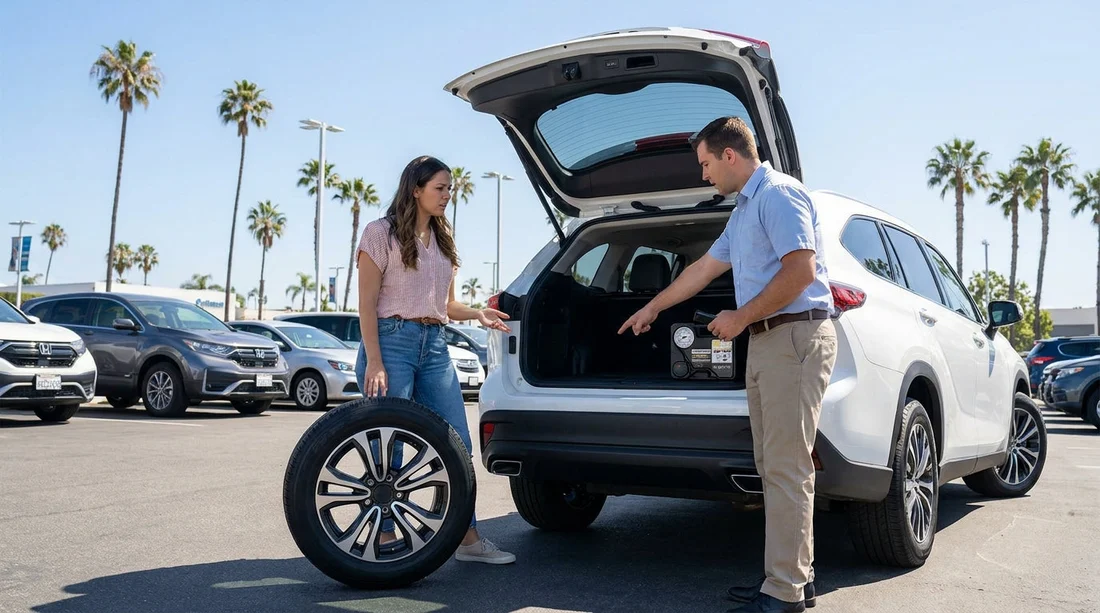
Open the boot and lift the floor panel. Look for a spare, jack, and wheel brace. If you see an inflator kit, check whether the sealant bottle is present and in date, and whether the compressor power lead is intact.
Check the tyre condition and warning lights. If a tyre looks low, ask for it to be addressed before you depart. A slow leak can turn into a bigger problem once you are on a freeway.
If you need a spare, request a different car before leaving. This is usually easier than trying to resolve it later from a roadside location. Bigger facilities, such as those serving major hubs like car hire at San Jose SJC, may have more flexibility to switch you into a vehicle that matches your preference.
Roadside assistance, punctures, and who pays
Policies vary by supplier and product, so read your rental agreement carefully. Generally, if you have a puncture, the key questions are whether roadside assistance is included, whether tyre damage is covered, and what you should do first. Some drivers try to use sealant immediately, but it can complicate later repairs and may not help if the damage is significant.
If you are travelling with family, carrying luggage, or driving longer routes, it can be helpful to collect from a location where the supplier network is strong. Depending on provider and availability, pages such as Enterprise car rental in San Jose SJC can be useful for understanding supplier options tied to specific airports and cities.
FAQ
Can I guarantee a spare wheel for car hire in California? Usually not. You can request a vehicle with a spare, but unless it is confirmed as an included feature, it is typically subject to availability at pick-up.
Are inflator kits standard on US rental cars? They are increasingly common, especially on newer compact and mid-size vehicles. Some cars still have temporary spares, and fewer have full-size spares.
What should I do if my rental car has neither a spare nor an inflator? Tell the staff before you leave the lot and ask to swap vehicles. If you notice later, contact the rental company immediately and follow their roadside guidance.
Will an inflator kit fix any puncture? No. It may help with small tread punctures, but it will not repair sidewall damage, large tears, or blowouts, and it is only a temporary measure.
Is it worth choosing a larger vehicle just to get a spare? It can be, especially for long-distance California driving. Larger classes are more likely to include a spare, but you should still confirm by checking the boot before departure.





























































































