


Quick Summary:
- Most Texas car hire bookings guarantee a class, not a specific model.
- “Or similar” means the same category and capacity, with brand variations.
- Request preferences early, but expect substitutions when fleets run low.
- Arrive on time, choose common classes, and confirm key features pre pick-up.
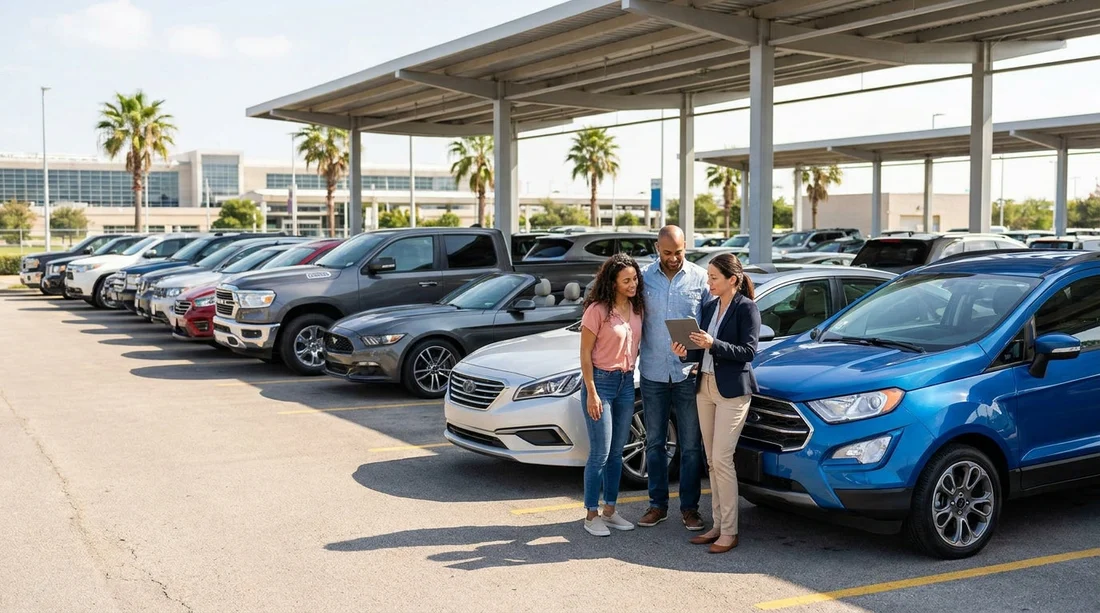
When arranging car hire in Texas, many travellers expect to select an exact make and model, especially if the listing shows a familiar vehicle photo. In practice, most rentals are sold as a vehicle class, such as Economy, Intermediate, Full Size, Standard SUV, or Minivan, followed by the words “or similar”. That wording matters because it sets the expectation: you are reserving a category with comparable size and features, not a guaranteed badge on the bonnet.
This article explains what “or similar” really means, what you can realistically request, and how to improve your chances of getting the car type you want before you reach the counter.
What “or similar” means for car hire in Texas
In Texas, “or similar” is the industry’s way of managing real-world supply. Rental fleets change daily due to late returns, maintenance, damage, cleaning time, and one-way rentals that move vehicles between cities. Because of that, rental companies typically guarantee:
A class and a set of core attributes, not an exact make and model. Attributes usually include the number of doors, seats, luggage capacity, transmission type, and sometimes fuel type. For example, an Intermediate car could be a Toyota Corolla, Hyundai Elantra, or Nissan Sentra, and all would be treated as comparable.
A price tied to the class, which is why upgrading to a bigger class costs more, and why you may be offered an alternative vehicle if the exact model shown is not available.
Photos on booking pages are often illustrative. They show a representative example, not a promise that a specific vehicle will be waiting in the bay.
Can you ever choose an exact make and model?
Sometimes you can get close, but it is not the norm. Standard car hire reservations at major Texas airports and city branches are usually class-based. Even if you select “Toyota Camry or similar”, that does not lock in a Camry.
There are a few situations where you might effectively select an exact vehicle, but availability still rules:
Specialty or premium categories, where a branch carries a smaller, more defined set of vehicles. Even then, the promise is typically “model family” rather than a precise trim.
Direct selection at pick-up, where an agent offers a choice from what is physically on the lot. That is still not a guarantee before you arrive, but it can help you match your preference if multiple options are ready.
Longer lead times and quieter periods can improve consistency, because the branch has more time to align stock with upcoming reservations.
If an exact make and model is essential, treat the online listing as a request, not a certainty, and plan for acceptable alternatives within the same class.
How classes are decided, and why “similar” can feel different
Two vehicles can be considered “similar” by category rules, yet feel different in everyday use. Differences often show up in:
Boot space shape, which affects whether suitcases stack neatly.
Cabin width and rear legroom, especially in compact saloons and small SUVs.
Tech packages, such as Apple CarPlay, parking sensors, or adaptive cruise control. These are not always guaranteed, even if common.
Engine size and driving feel, which can vary between brands in the same class.
That is why it helps to focus your preferences on must-have features, rather than a single make. If you need room for two large cases, or you need all-wheel drive for a rural itinerary, those are more actionable requirements than a preferred badge.
What you can realistically request before pick-up
While exact models are rarely guaranteed, you can often request preferences, and some requests are more likely to be met than others. The most realistic requests are:
Transmission type, with automatic being the default for most Texas rentals.
Passenger and luggage capacity, which aligns directly with class rules.
SUV versus car, if you book the correct category. If you book a saloon class, the branch is not obliged to provide an SUV.
Child seats and add-ons, subject to local supply and fitting requirements.
Accessibility needs, which should be flagged early so the provider can advise options.
Requests that are harder to secure include specific infotainment features, exact colour, or a particular trim level. These depend on the individual vehicle the branch has available on the day.
Practical ways to improve your chances of getting the car you want
To tilt the odds in your favour with car hire in Texas, focus on the decisions you can control.
1) Book the right class for your non-negotiables
If you need higher seating, easier loading, or more luggage volume, book an SUV class rather than hoping for an upgrade. For travellers flying into North Texas, browsing an SUV-focused option such as SUV rental at Dallas DFW can help you compare what is typical in that category.
2) Choose pick-up locations with larger fleets
Big airport locations generally have more vehicles and faster turnover, which can mean more choice. If your trip starts at a major hub, you can review location-specific information like car hire at Dallas DFW Airport or car rental at Houston IAH to understand typical demand patterns and vehicle mix.
3) Aim for earlier pick-up times when possible
Earlier collections can offer more options before the day’s peak departures. Late afternoon can be tighter, especially during holiday weekends, large events, or when flight disruptions cause demand spikes.
4) Keep your preference list short and feature-based
Instead of asking for one exact model, prioritise two or three features that matter most, for example “compact SUV with good boot space” or “full size car with comfortable rear seats”. This gives staff flexibility to match you with an available vehicle that still fits your needs.
6) Consider the day-to-day realities of Texas driving
Texas roads can mean long distances and fast motorways, particularly around Dallas, Houston, and Austin. For comfort and stability, many travellers prefer Intermediate or Full Size cars, or a midsize SUV, over the smallest classes. If you are arriving via Austin, check options such as Alamo car rental at Austin AUS, where the available mix may differ from other cities.
What to check in the listing before you reserve
Even when you cannot lock in a specific make, you can reduce surprises by checking the details tied to the class:
Seating and luggage guidance, and whether it is “recommended” or “maximum”. Maximum capacity can be tight in practice.
Door count, particularly if you need easy access for child seats.
Fuel policy, so you know whether you should return full to full.
Included mileage, useful for longer Texas itineraries.
Deposit and card requirements, because payment rules can affect pick-up more than vehicle choice does.
Insurance and excess terms, so you can compare like-for-like between classes.
At the counter, how to ask for the best match
Being clear, polite, and specific is the best approach. When you arrive, explain what matters and why, for example “we have two large suitcases and a pushchair, so we need the boot space promised in the class”. If offered a choice, quickly check:
Boot depth and opening height, not just overall size.
Tyre condition and basic controls, so you are comfortable before leaving.
Driver-assist and connectivity, if those affect your journey, but be flexible because these vary.
If you are travelling through South Texas, reviewing location context like car rental at San Antonio SAT can help you anticipate local demand, especially around busy travel days.
FAQ
Q: Does “or similar” mean I might get a completely different type of car?
A: Usually no. It means a different make or model within the same class, with comparable seats, luggage space, and general size.
Q: If I reserve an SUV, can I be given a saloon instead?
A: In normal circumstances you should receive the class booked or an equivalent alternative. If an SUV is essential, booking the SUV class is the best way to signal that need.
Q: Can I request a specific model, like a Ford Mustang, with car hire in Texas?
A: You can request it, but standard reservations rarely guarantee it. Your best chance is choosing the closest category and keeping acceptable alternatives in mind.
Q: How can I improve the odds of getting the vehicle I prefer?
A: Pick the correct class, choose larger locations with bigger fleets, arrive earlier, and state two or three must-have features rather than one exact model.
Q: What should I do if the vehicle offered is smaller than the class I reserved?
A: Explain the mismatch in passenger or luggage needs and ask the agent to provide a vehicle that meets the class requirements or an appropriate alternative.





























































































