


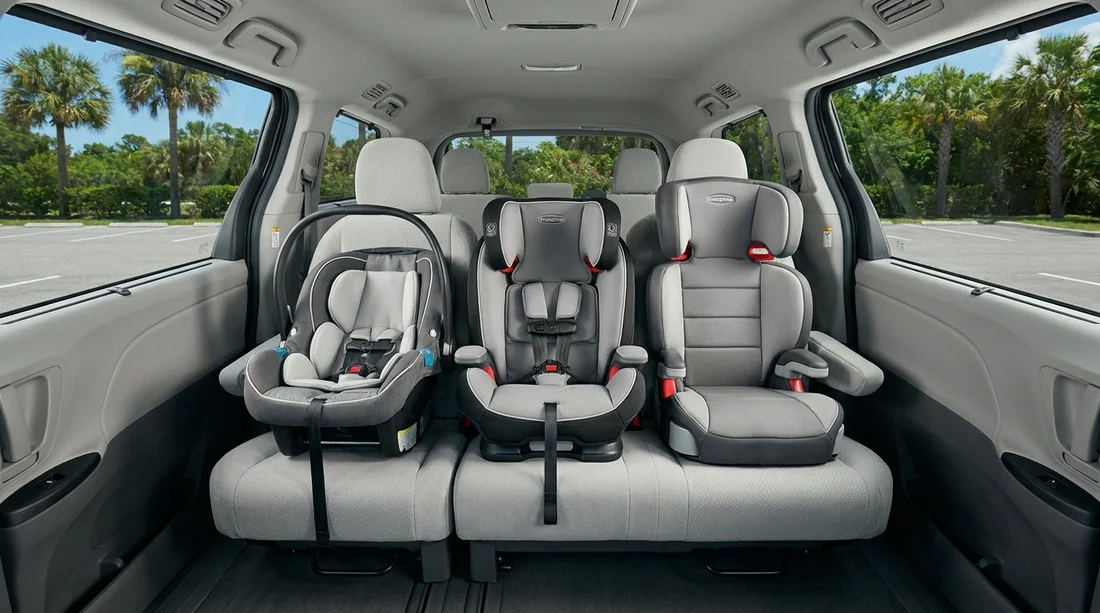
Quick Summary:
- Choose minivans, large SUVs, or full-size sedans for three-across.
- Check for three headrests and three lap-and-shoulder seat belts.
- Confirm LATCH positions, buckle access, and centre-seat width at pickup.
- Avoid compact cars and many crossovers, which are often too narrow.
Fitting three child seats across one row is one of the trickiest parts of planning car hire in Florida. The challenge is rarely just “number of seats”. It is about usable width, where the buckle stalks sit, whether the middle position has a proper shoulder belt, and whether the car’s rear bench has a flat, supportive shape that lets seats sit side-by-side without tipping.
Rental fleets also add uncertainty because you usually book a car class, not a specific model. That means the best approach is to choose the classes most likely to work, then verify a short checklist at the counter and again at the car before leaving the lot.
Why three-across is difficult in rental cars
Most US vehicles technically have three rear seating positions, but many are not designed for three bulky child seats. Common obstacles include narrow hip room, heavily bolstered outboard seats that push child seats inward, and centre “hump” contours that lift the middle seat base. Another frequent issue is buckle access, where the seat belt buckles are recessed or overlap, making it hard to click in the third seat securely.
Also note that “LATCH for three” is uncommon. Many vehicles provide LATCH anchors on the two outboard seats only. Some allow centre-seat installation using seat belts, and some allow borrowing inner anchors for the centre, but the allowed spacing varies by manufacturer. In practice, planning for at least one belt installation is wise when aiming for three-across.
US rental car classes most likely to fit three child seats
When you are selecting car hire in Florida, start with classes that tend to have the widest rear benches and the most family-oriented layouts.
Minivans (7- or 8-passenger) are usually the easiest solution. Many minivans can avoid three-across entirely by using two captain’s chairs in the second row plus a third seat in the third row. If you truly need three in one row, some 8-seat minivans have a removable or built-in middle seat in row two, often with better geometry for child seats than most cars.
Large SUVs can work well, especially those with a wide second row and three headrests. However, many large SUVs have a second-row bench that is contoured or has a narrow centre, so you still need to check. A benefit is that you may place two seats in row two and one in row three, which is sometimes more realistic than a strict three-across in one row.
Full-size sedans are sometimes a surprisingly good three-across candidate because their rear benches can be wide and relatively flat compared with some crossovers. You must still check for three headrests and a full shoulder belt in the centre position.
Car types that are usually too narrow
Economy, compact, and midsize cars rarely fit three full-size child seats across without special narrow seats. Even if you can physically place three, buckle access may be poor, or one seat may sit on top of another’s base, which is not acceptable.
Small and midsize crossovers often have less usable width than you would expect. The cabin may look tall, but the rear bench can be tight at the hip, and the centre position may be raised and narrow.
Pickups can be hit-or-miss. Crew cabs may have generous space, but rental availability and the rear-seat shape can make three-across unpredictable.
Rear-seat layouts and features that matter most
Rather than relying only on the class name, look for these rear-seat clues when you inspect the vehicle at pickup.
Three full seat belts is non-negotiable. The centre should be a lap-and-shoulder belt, not a lap-only belt. Check that the shoulder belt comes from the pillar or roof and that it does not rub across a child seat at an odd angle.
Three head restraints are a good sign that the manufacturer intended the centre seat for real use. Missing or very small centre head restraints can be a warning that the middle position is compromised.
A flatter bench and minimal bolstering usually helps. Heavy bolsters can push child seats together at the top, creating gaps at the base or causing tilt.
Buckle placement and stiffness matters. Long, floppy buckle stalks can help you reach between seats, while recessed buckles can make fastening almost impossible once seats are installed.
What to confirm at the counter for Florida rentals
Because you are booking a category, not a guaranteed model, use the counter conversation to reduce surprises. Ask to see the exact vehicle assigned before finalising, especially if three children need seats on day one.
Confirm these points in plain terms:
1) The assigned vehicle has three usable rear seating positions with three headrests and three lap-and-shoulder belts. If the agent cannot confirm, ask to inspect the car.
2) LATCH availability and positions. Ask where the lower anchors are. If you need three seats, expect to use at least one seat belt install. If you have a preference, for example placing a rear-facing seat outboard, verify that the outboard position has the correct anchors and clearance.
3) Third-row access and folding if choosing an SUV or minivan. If you might split seats between rows, ensure you can still reach buckles and that a seat does not block access to another child.
4) The rear bench width and centre comfort. Even a quick look can reveal a very narrow middle section or a high driveshaft hump that makes a secure install harder.
If you are arriving via a major hub, you may find broader fleet choice. For context on airport pickup, see car rental at Tampa TPA or car hire for Disney Orlando MCO, as availability can differ by location and season.
Practical three-across strategies that often work
Mix installation methods. A common approach is LATCH for one or two outboard seats and a seat belt install for the centre. This can free up space because LATCH positions can be fixed and sometimes pull seats closer to the door.
Place the bulkiest seat in the centre only if it installs securely and still allows buckling on both sides. Often, a booster is best outboard where the child can access the buckle, while a harnessed seat sits centre. Your best arrangement depends on children’s ages, independence, and whether you need to reach a third row.
Consider a minivan or three-row SUV to avoid three-across. Two seats in the second row and one in the third row can be more realistic in rentals. If you are comparing larger options around Miami, you can review SUV-focused availability via SUV hire in Coral Gables.
Allow time at pickup. A correct install takes longer than simply loading bags. Florida heat and crowded lots can add pressure, so build in extra minutes to check belt paths, tightness, and recline angles for rear-facing seats.
Common rental counter surprises to plan around
Even in a “large” class, you might be assigned a model with a narrow middle seat or awkward belt geometry. If the vehicle clearly cannot accommodate your setup, request an alternative in the same class, or ask what upgrade options exist that day. Locations with varied fleets can help, such as car rental in Doral and nearby neighbourhood branches like Dollar car rental in Brickell, where inventory can differ.
Also watch for centre seats that double as an armrest. They may have a seat belt but a very narrow cushion, making three-across unlikely. Likewise, some SUVs have a second row that slides or reclines, and if it is not locked evenly, a child seat can sit unevenly.
FAQ
Which rental category is most reliable for three child seats across in Florida?
Minivans are typically the most reliable, followed by some large SUVs and full-size sedans. Even then, confirm the exact vehicle’s rear-seat layout before leaving.
Can I assume a “7-seater SUV” will fit three seats across the second row?
No. Many three-row SUVs have a narrow or raised centre position in the second row. Often it is easier to place two seats in row two and one in row three.
Do I need LATCH in all three positions to do three-across?
Usually not. Most vehicles only have LATCH in the two outboard seats. A seat belt install in the centre is common and can work well if the belt path and buckle access are good.
What should I physically check on the car at pickup?
Check for three headrests, three lap-and-shoulder belts, buckle accessibility, and a bench shape that lets seats sit flat. If possible, do a quick test-fit before departing.
Is a full-size sedan a sensible choice for car hire with three children?
Sometimes, yes. Some full-size sedans have wide, flatter rear benches that handle three-across better than certain crossovers, but you still need to verify belt and buckle geometry.































































































