


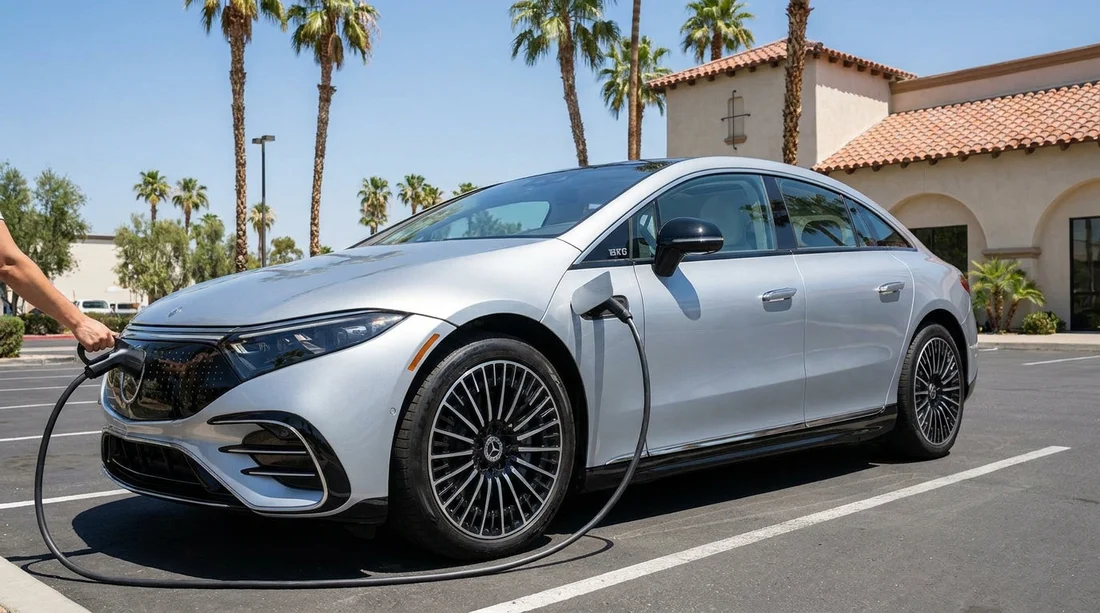
Quick Summary:
- Most non-Tesla EV rentals use CCS, while Teslas use NACS.
- For AC charging, J1772 is common, and Teslas may need an adapter.
- Ask if a Level 1 cable is included for standard wall sockets.
- Check the charge port, connector shape, and release method before driving.
When you arrange an EV through a car hire provider in Los Angeles, the biggest practical question is not range, it is compatibility. Which connector fits the car, which cable is actually supplied, and which plugs you will meet at local chargers can make the difference between a smooth day out and an avoidable detour.
Los Angeles is one of the easiest US cities for public charging, but it is also a mix of connector standards and network quirks. The good news is that you can usually predict what you will get by knowing the vehicle type and by doing a quick check at pick-up.
If you are comparing different US pickups with Hola Car Rentals, the broader car hire process and policies are similar even if locations differ. For example, the guidance on inspecting a vehicle before leaving a desk is just as relevant when looking at EV charge ports, whether you are browsing Hertz car hire Nevada Las or planning other airport collections.
Connector basics you will encounter in Los Angeles
In LA you will run into three common charging situations: slow AC charging at hotels or destinations, DC fast charging on major networks, and home style charging from a standard socket. The connector type depends on the car and the charger.
J1772 (AC charging) is the common AC plug for most non-Tesla EVs in North America. You typically see it at destination chargers, car parks, and workplaces. Charging is slower than DC fast charging, but it is perfect for topping up while you are eating or shopping.
CCS (DC fast charging) is the most common fast-charging connector on non-Tesla EVs. It looks like a J1772 plug with two extra pins underneath. If your rental is a Ford, Hyundai, Kia, Volkswagen, Polestar, BMW, Mercedes, or similar, CCS is the most likely DC connector you will use in LA.
NACS (Tesla connector) is Tesla’s plug, now also adopted by many manufacturers for newer models. On a Tesla, this is the only inlet you use for both AC and DC charging.
What connector should you expect on an EV rental in Los Angeles?
Most EV rentals in Los Angeles fall into two buckets: Tesla models, and non-Tesla models from mainstream brands.
If your rental is a Tesla, expect NACS. You will use the Tesla connector at Superchargers and many destination chargers. Teslas can also charge at J1772 destination units with a simple adapter, and many rental fleets include it. Ask at the counter if it is in the car, and where it is stored.
If your rental is not a Tesla, expect CCS for fast charging and J1772 for AC charging. That means you can use most DC fast chargers labelled CCS, plus J1772 chargers at hotels and car parks. On many newer non-Tesla EVs, the inlet is a combined CCS port which accepts both the J1772 and CCS connector shapes.
Newer non-Tesla EVs may have NACS. Manufacturers are transitioning, but fleets can include a mix of model years. If you are given a newer vehicle with a Tesla style port, treat it like NACS, and verify what adapters are included so you can use CCS stations if needed.
Even outside California, this CCS versus Tesla split is becoming the most important distinction to check in advance, similar to how travellers compare fleet expectations across other US rentals listed on Hola, such as Avis car rental Seattle Sea or other regional pages.
Which cable is usually provided with the car?
Public chargers in Los Angeles nearly always have their own tethered cable. For DC fast chargers and most public AC posts, you do not bring your own cable, you plug the station’s connector into the car. That means the “cable included” question mainly matters for using a standard wall socket.
Level 1 portable cable (120V) is sometimes provided. It plugs into a normal US wall socket and adds only a few miles of range per hour, but it is useful if you are staying overnight somewhere with a convenient socket. Do not assume it is included, check the boot or underfloor storage, and confirm it is listed with the vehicle accessories.
Tesla J1772 adapter is often included with Tesla rentals, because it unlocks a lot of hotel and car-park charging. If it is missing, you are not stuck, but you will be more dependent on Superchargers.
How to check the connector at pick-up in under one minute
You can confirm compatibility quickly before leaving the lot.
First, locate the charge port and open it. On many cars there is a button near the driver’s door, a touch point on the port door, or a control on the infotainment screen.
Second, look at the inlet shape. If it is a small oval with a single opening, that is Tesla NACS. If it looks like a J1772 shape with two large pins below, that is CCS. If it is only the J1772 shape without the lower pins, the car may be a plug-in hybrid or an older EV, so clarify before relying on DC fast charging.
Third, ask what accessories are supplied. Specifically ask whether a Level 1 cable is included and, for Teslas, whether the J1772 adapter is present. For EV road trips, those two items are the most useful.
If you are used to petrol car hire, think of this as the EV version of confirming fuel type and where the cap release is. The same habit helps wherever you travel, including pickups highlighted on Hola pages such as car hire Portland PDX.
Charging in Los Angeles: what the connectors mean in practice
For day-to-day urban driving, most travellers can rely on a mix of destination charging and occasional fast charging. If you have CCS, you will find plenty of compatible DC units. If you have a Tesla, Superchargers are widespread and generally straightforward.
For standard sockets, only count on it if you have a portable cable and permission to use the outlet. Level 1 charging is slow, but it can be enough to recover local miles overnight.
Common pitfalls and how to avoid them
Assuming every “fast charger” fits. Always check the connector label on the charger screen or the plug itself. In LA you may see multiple cables at one stall, but not always.
Arriving with a very low battery. Keep a buffer, especially in traffic or during hot afternoons when energy use can rise. In an unfamiliar city, a 15 to 20 percent buffer helps you reroute if a site is busy.
Mixing up plug-in hybrids and full EVs. Some rentals are plug-in hybrids that only support AC charging, typically via J1772, and cannot use DC fast charging. If you specifically need fast charging capability for longer distances, confirm you are receiving a full battery-electric vehicle with CCS or NACS.
These checks are part of choosing the right car hire option for your itinerary. If your travel spans multiple cities, it can help to compare expectations and typical vehicle types across listings such as National car rental Portland PDX, even if your current trip is centred on Los Angeles.
FAQ
Will my Los Angeles EV rental come with a charging cable? Often, public charging cables are attached to the station, so you may not need one. Some rentals include a portable Level 1 cable for wall sockets, but it is not guaranteed, so confirm at pick-up.
What connector is most common for non-Tesla EV rentals in Los Angeles? CCS is the most common for DC fast charging on non-Tesla EVs, and J1772 is common for AC destination charging. Many vehicles use a combined CCS inlet that accepts both.
If I rent a Tesla, can I use non-Tesla destination chargers? Yes, if you have a Tesla to J1772 adapter. Many Tesla rentals include it, and it allows you to use a wide range of hotel and car-park AC chargers.
Do I need to bring my own adapter to charge in Los Angeles? Usually no, because most public chargers have the correct connector for your car type. The main adapter that matters is the Tesla J1772 adapter for destination charging, which you should confirm is included.
How can I quickly tell whether the car uses CCS or Tesla NACS? Open the charge port and look at the inlet. Tesla NACS is a single small oval opening, while CCS looks like a J1772 plug with two extra large pins below.































































































