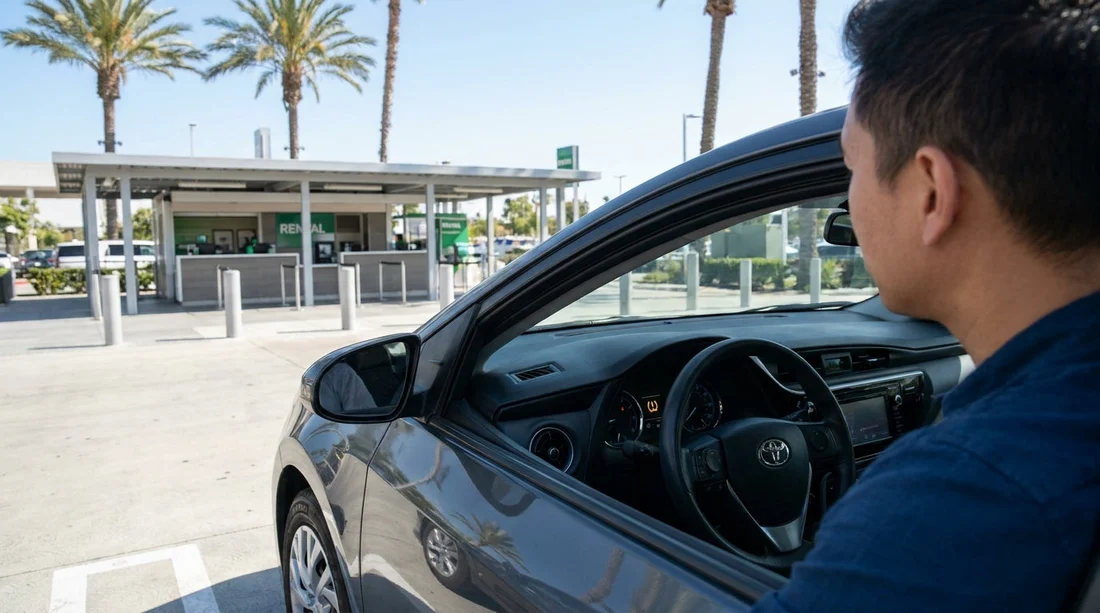
Quick Summary:
- Do not leave until staff confirm tyre pressures were checked with a gauge.
- Ask for the warning light to be noted on the condition report.
- Request a different vehicle if the light stays on after inflation.
- Photograph the dashboard, tyres, and paperwork before leaving the lot.
Seeing the tyre-pressure warning light at rental car pick-up in California is common, and it is also something you should treat seriously. Tyre pressure affects braking distance, handling and fuel economy, and an under-inflated tyre can overheat on long freeway drives. The key is to deal with it while you are still at the counter or in the pick-up bay, so there is a clear record of what you found and what the staff did about it.
Whether you are collecting from Los Angeles, San Francisco, San Jose or Orange County, the same approach helps. If you arranged your car hire through Hola Car Rentals for a major airport location such as Los Angeles Airport (LAX) or San Francisco (SFO), you can still follow the steps below with the on-site rental desk. The goal is simple, do not accept uncertainty about tyre condition before you leave the premises.
Why the tyre-pressure light might be on at pick-up
A tyre-pressure monitoring system (TPMS) light can come on for several reasons, and not all of them mean a puncture. Temperature swings are a big factor in California, a cool morning in coastal areas can drop tyre pressures enough to trigger the warning, then the light may clear later when the tyres warm up. Another common reason is that the tyres were topped up recently but the system has not yet re-registered the correct values. Less ideally, the vehicle may have a slow leak, or one tyre may simply be significantly under-inflated from sitting on the lot.
Because you cannot easily tell which situation it is just by looking, treat the warning as an inspection item. The important thing is that you should not be the first person to “test” the car on the freeway with an unresolved warning light.
What to do before you start the engine and move the car
Start by checking the basics while you are still parked in the pick-up area. Look for obviously low tyres, sidewall bulges, nails or screws in the tread, and damage on the wheels. Then take a clear photo of the dashboard showing the warning light and the odometer reading. If you later need to explain what you saw at pick-up, time-stamped photos are helpful.
If the car has an in-vehicle screen that shows individual tyre pressures, note the readings. If it shows one tyre dramatically lower than the others, do not drive off. A difference between tyres can point to a leak rather than normal temperature-related changes.
How to ask staff to check the warning properly
Go back to the attendant or desk and be specific. Ask them to check tyre pressures with a gauge, not just visually, and ask what pressure the vehicle requires. Many cars have a tyre-pressure sticker in the driver’s door jamb that lists recommended PSI for front and rear tyres. You can politely request that the pressures be set to that specification, not an arbitrary number.
If you are picking up from a high-volume airport site such as car hire at LAX, staff may offer to direct you to an air station. That can be fine, but you should still request a staff member to confirm the warning is addressed before you depart. If they want you to inflate the tyres yourself, do it only if you feel comfortable, and only if there is a gauge available so you can verify each tyre. Do not guess pressures.
After inflation, ask whether the TPMS light should clear immediately or after a short drive. Some vehicles reset quickly, others need a short distance to recalibrate. However, if one tyre drops again quickly while you are still on-site, request another vehicle.
Get it written down, condition report notes matter
Before you leave the lot, ask for the issue to be recorded on the condition report or check-out document. The note should state that the tyre-pressure light was illuminated at pick-up, and what action was taken, for example “tyres checked and inflated” or “customer requested swap due to TPMS warning.” If the staff check the tyres and tell you it is safe, a written note protects you from later disputes that you ignored a warning or caused tyre damage.
Also ask for the paperwork to show the date and time. Keep a photo of the report on your phone. If the rental uses a digital check-out, take screenshots of any condition notes you can access.
When to request a different vehicle instead
It is reasonable to request another vehicle before driving off if any of the following are true:
First, the tyre-pressure light remains on after pressures are set correctly and the vehicle has been driven a short distance on the lot. Second, the screen shows a tyre pressure that is significantly below specification or falling. Third, you see visible tyre damage, including a sidewall bubble, exposed cords, or a nail that looks fresh. Fourth, staff cannot check pressures promptly and ask you to “just monitor it.” In California traffic, especially around Los Angeles, that is not a good starting point for your trip.
If you booked a particular category, for example a family vehicle through a minivan rental at LAX, mention that you need a like-for-like replacement so you can safely carry passengers and luggage. A tyre issue is a safety matter, so you are not being difficult by asking for a swap.
If you drive off and the light comes on later
Sometimes the warning appears after you leave due to a temperature drop or a gradual leak that was not obvious at pick-up. If the car feels normal, you can pull in somewhere safe, check the tyres visually and then check pressures at a service station. Add air only to the recommended PSI shown on the door sticker. If the light clears and stays off, it may have been a minor pressure change.
However, if the light flashes, if the car pulls to one side, or if you need to add air repeatedly, treat it as a potential puncture. Do not continue at highway speed on a suspect tyre. Contact the rental provider using the phone number on your rental agreement and follow their breakdown or roadside process. Keep records of any instructions you are given, and take photos of the tyre and the dashboard light.
FAQ
Should I accept a rental car if the tyre-pressure light is on? You should not drive off until the tyres are checked with a gauge and the issue is noted on the condition report. If the light stays on after correct inflation, request another vehicle.
Will the tyre-pressure light turn off immediately after adding air? Sometimes it clears right away, but many cars need a short drive to recalibrate. If it does not clear after correct pressures and a brief on-site drive, ask staff to recheck or swap cars.
What should be written on the condition report? Ask for a clear note that the TPMS light was on at pick-up, plus the action taken, such as “tyres checked and inflated to door-sticker PSI,” or “vehicle exchanged due to warning light.”
Can I just stop at a petrol station after leaving and top up? You can, but it is better to resolve it at pick-up so there is a record. If you do top up later, inflate only to the door-sticker PSI and keep a photo of the dashboard and tyre readings.
When is it safer to request a different car straight away? Request a replacement if a tyre looks damaged, one tyre reads much lower than the others, the warning light remains on after inflation, or staff cannot confirm pressures before you leave.