


Quick Summary:
- Confirm whether the car has a spare tyre or tyre inflator kit.
- Locate the jack, handle, wrench and towing eye before driving away.
- Check for the wheel-lock key and confirm it fits locking nuts.
- Ask what roadside help covers, including punctures, hours, and fees.
In Texas, a puncture can go from minor inconvenience to a major delay fast, especially if you are driving long distances between cities, heading out to Hill Country, or navigating hot roadside conditions. When you pick up a car hire vehicle, it is worth spending a few minutes confirming what puncture equipment is actually in the car and what support you will receive if you cannot change a wheel safely. Not every rental vehicle carries a full-size spare and many newer models use an inflator kit instead.
This guide walks through exactly what to ask at the counter and what to inspect at the vehicle, so you do not discover missing tools on the shoulder of I-10 or a rural farm-to-market road. If you are collecting at major hubs, these checks are equally relevant whether you are arranging car hire at Dallas DFW or picking up around Houston, Austin, San Antonio, or El Paso.
1) Ask first: spare tyre, space saver, or inflator kit?
Start by asking the agent what puncture solution the vehicle is meant to have. There are usually three possibilities.
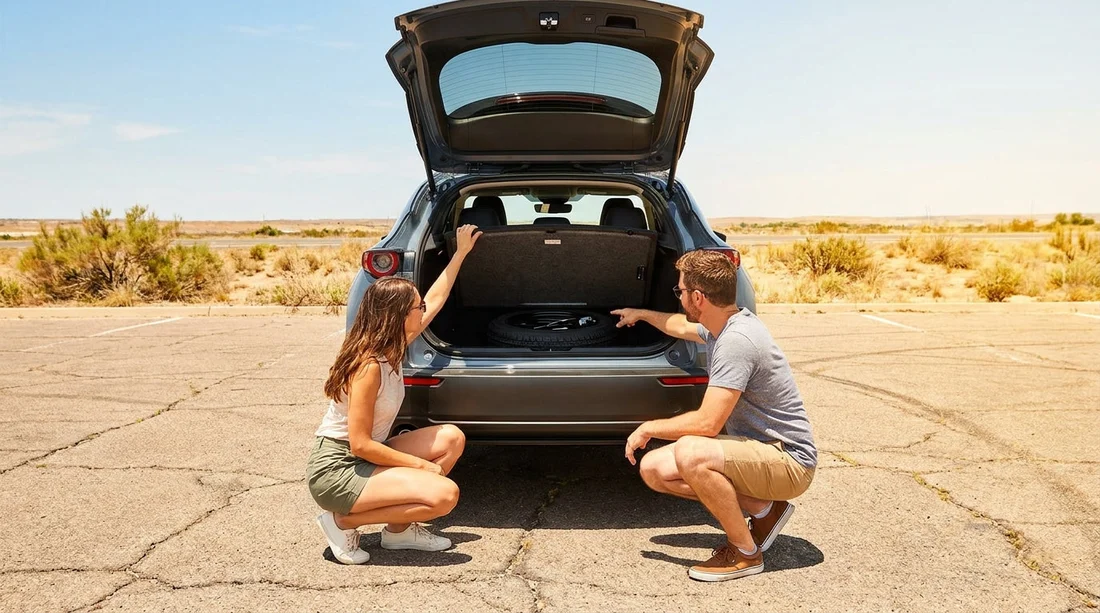
Full-size spare is the most straightforward, but it is not guaranteed. If provided, check whether it matches the wheel type and whether it is stored under the boot floor, beneath the vehicle, or on a rear carrier.
Space saver spare is a smaller temporary wheel. If that is what you get, ask about speed and distance limitations and confirm those are written in the vehicle handbook or a sticker near the spare. Temporary spares often have restrictions that matter if your hotel is 150 miles away.
Tyre inflator kit usually includes a 12V compressor and a sealant bottle. This can be adequate for small tread punctures, but it is not a universal fix. Sidewall damage, larger holes, or a tyre that has come off the bead may not seal. Also, sealant can complicate later repair, which may affect how the rental company handles tyre service.
Even if the agent says it is included, verify it physically at the car. You are aiming to confirm the equipment is present, intact, and usable, not just listed on a sheet.
2) Locate the equipment before you leave the lot
Open the boot and lift the floor panel, or check the storage compartment where the tools should be. Confirm you can access the spare or kit without special tools. Some vehicles require removing a cover, undoing a plastic nut, or using an included tool to lower an underbody spare.
Look for the full set, not just one piece. A usable setup typically includes a jack, jack handle, lug wrench, towing eye, and all inflator kit parts if no spare.
If anything is missing, you want that corrected before you exit. This matters on Texas roads where service can be far apart and heat can make roadside delays riskier.
3) Check the spare tyre condition, pressure, and access
If the car has a spare wheel, inspect it like you would any other tyre. Do not assume it is ready.
Pressure: spares are often underinflated because they are rarely checked. Many vehicles list the spare pressure on the door jamb label. If the tyre looks low, ask the staff to inflate it before you go.
Tread and damage: look for cracks, bulges, or very worn tread. A space saver will have limited tread, but it should not be visibly damaged or perished.
Correct size and type: confirm it is intended for that vehicle. A mismatched wheel can create handling issues or trigger warning lights.
Access method: if the spare is stored under the vehicle, ask for a quick demonstration of how to lower it, and confirm the lowering tool is present. Underbody systems can seize or be confusing in the moment.
4) Confirm you have the wheel-lock key, and that it fits
A common rental-car headache is locking wheel nuts without the matching key. If the car has locking nuts or bolts, the key is usually a small patterned socket stored with the tools or in the glovebox.
Ask staff if the vehicle uses wheel locks, then locate the key. If you can, do a simple fit check by placing the key on one locking nut to confirm it seats properly. You do not need to fully loosen anything, just confirm compatibility. Without the key, you may be unable to remove a wheel even if the spare and jack are present.
If you are collecting at a busy airport station such as Houston IAH, this small check can save a lot of time later, because replacement keys are not always immediately available outside normal hours.
6) Clarify roadside assistance: what is covered, and what is chargeable?
The title question is about spare tyres and jacks, but the practical reality is that support matters as much as hardware. Ask whether puncture help is included, whether they will bring a replacement wheel, what the hours and typical response times are, and whether there are call-out fees.
If you are driving a larger vehicle, confirm whether policies differ for SUVs. This can be relevant when arranging something like an SUV rental from Houston IAH, because wheel sizes and tool kits can vary, and a full-size spare may take more space.
8) Plan for Texas distances and conditions
Texas trips often involve long motorway runs and high temperatures, which can turn a simple puncture into a safety issue. Keep water in the cabin, know where your emergency number is, and do not assume mobile signal will be strong everywhere outside metro areas.
If your itinerary spans multiple cities, note where you can access major stations such as Austin AUS or San Antonio SAT in case you need in-person help.
Ultimately, the goal is simple: know whether you can self-rescue with a spare and tools, or whether your real support is the roadside assistance phone number. Once you have confirmed spare versus inflator kit, the wheel-lock key, the full tool set, and the coverage details, you can leave the rental lot confident about what happens if a tyre problem appears.
FAQ
Q: Do rental cars in Texas always come with a spare tyre?
A: No. Many include a space saver spare, but some provide only an inflator and sealant kit. Always confirm at pick-up and check the boot yourself.
Q: Where is the wheel-lock key usually stored?
A: Common locations are the tool pouch with the jack, a foam insert under the boot floor, or the glovebox. If you cannot find it in two minutes, ask staff to locate it.
Q: If the car only has an inflator kit, is it safe to keep driving?
A: It depends on the puncture. Sealant kits generally help with small tread holes, not sidewall damage. Follow the kit instructions and arrange professional inspection as soon as practical.
Q: What should I do if the spare is flat or the jack is missing?
A: Do not leave the rental location. Request a replacement vehicle or the missing equipment to be supplied and documented before you depart.
Q: Will roadside assistance change the tyre for me?
A: Often yes, but coverage varies by provider and package. Confirm whether puncture call-outs are included, whether there is a fee, and what hours they operate.































































































