


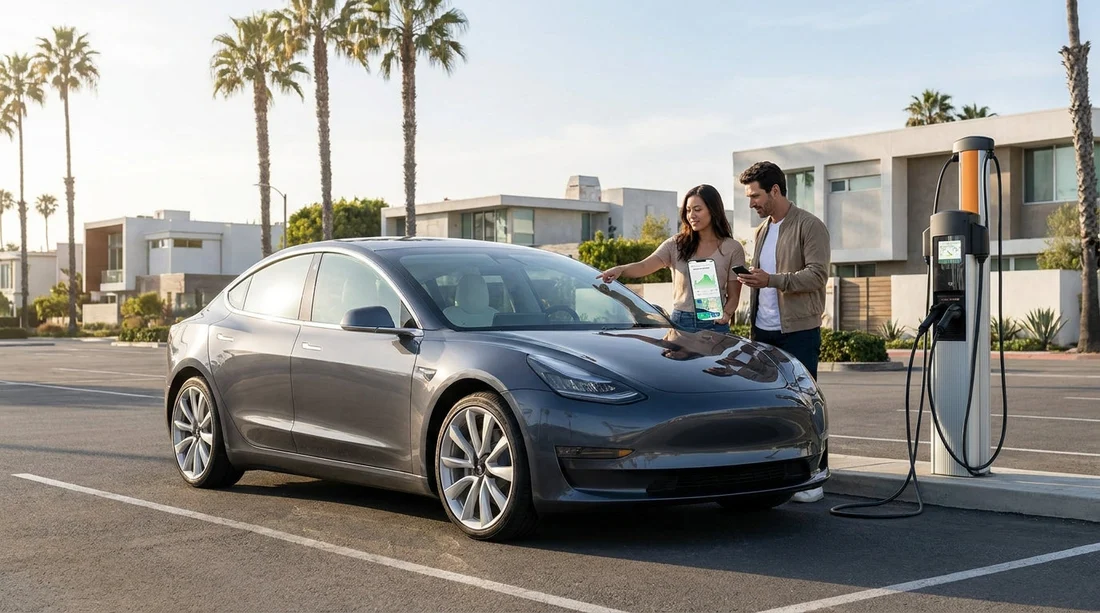
Quick Summary:
- Compare quoted range with freeway speeds, hills, AC use, and passengers.
- Confirm the charging port type and whether DC fast charging works.
- Ask what cables, adapters, and network access are included with the vehicle.
- Map chargers near your stay, and save backups for peak hours.
EVs can be an excellent fit for Los Angeles travel, but range and charging depend on details that are easy to miss when arranging car hire. LA driving often mixes stop start traffic with fast freeway stretches, and day trips can include steep climbs and hot weather. Before you commit to an EV rental, it is worth checking a few practical points so you can predict real range, understand what charging access you will have, and avoid last minute surprises.
If you are collecting at the airport, location and timing matter because you may want to start with a healthy battery. See practical pickup context for car hire at Los Angeles LAX, since the first charging stop can depend on where you exit the airport area.
1) Understand the difference between advertised range and usable range
Most EVs display an estimated range that is based on test cycles and recent driving. Treat the number as a guide, not a promise. In Los Angeles, the usable range you should plan around is usually lower when you combine higher motorway speeds, air conditioning, and elevation changes.
Before you finalise car hire, check which model you are likely to receive and look up its battery size and typical real world efficiency. You do not need perfect maths, you need a conservative plan. As a rule, build in a buffer so you are not arriving at chargers with a near empty battery.
Key range reducers in LA include:
- Freeway speeds, especially sustained driving above 65 mph.
- Hills and mountain roads towards Malibu canyons or Angeles National Forest.
- Heat and heavy air conditioning use in summer.
- Extra passengers and luggage, especially in larger EVs.
- Stop start congestion, which can help efficiency but increases time spent in AC.
A good habit is to plan day trips using 70 to 80 percent of the displayed range. Keep the remaining 20 to 30 percent as contingency for detours, charger queues, or a charger being offline.
2) Check starting battery level policy at pickup
Unlike petrol cars that are often provided full to full, EVs may be handed over at a range of charge levels. Some operators aim for a high state of charge, others specify a minimum. You should confirm what “ready to drive” means in practice so your first day does not start with an immediate charging stop.
Ask these questions before confirming:
- What percentage is the battery typically at on collection?
- Is there a minimum guaranteed level?
- Is there time to swap vehicles if the battery is unexpectedly low?
If you are landing late, knowing the starting charge matters even more, since some nearby fast chargers can be busier in the evening. Planning around this is part of choosing the right Los Angeles area car hire option, including broader regional considerations like car hire in California from LAX if you intend to leave the city.
3) Identify the port type and fast charging capability
In the US, most non Tesla EVs use CCS for DC fast charging and J1772 for Level 2. Teslas commonly use their own connector, although many locations now offer Tesla compatible and mixed options. The crucial point is not just the plug shape, it is whether the car supports DC fast charging and what maximum speed it can accept.
Before booking, verify:
- Which charging inlet the vehicle has.
- Whether DC fast charging is enabled and functional.
- The maximum DC charge rate, which affects time at a fast charger.
An EV that peaks at a lower fast charge rate can still work well in LA, but you will want longer stops or more frequent top ups. If your itinerary includes longer freeway legs, faster charging can significantly reduce downtime.
4) Ask exactly what charging kit and access you receive
Travellers often assume a cable will be in the boot, but inclusions vary. For smooth charging in Los Angeles, clarify what comes with the car and what does not. Level 2 public chargers commonly require you to bring nothing, but hotel and holiday let setups may depend on having a portable cable or adapter.
Confirm these items:
- Level 1 or Level 2 portable charging cable, if provided.
- Any adapters supplied, and which sockets they fit.
- Whether a charging network card or RFID fob is included.
- Whether the car includes in car navigation that shows chargers, or just phone mirroring.
Also ask how payment works at public chargers. Many networks require an app with a stored payment method. It is wise to set up key charging apps on your phone before you travel, rather than in a car park with patchy signal.
5) Map charging near your accommodation, not just around attractions
LA is spread out, and the best charging plan is usually “charge where you sleep” plus a backup. If your hotel offers EV charging, check how many bays they have, whether it is first come first served, and whether there is a nightly fee. If you are staying in an apartment or rental home, confirm the presence of a dedicated outlet and whether it is accessible.
When you cannot rely on overnight charging, find two or three convenient public options close to where you will be in the evening. Chargers near busy retail corridors can be occupied at peak times, especially at weekends. Having a fallback reduces stress and helps you keep the battery in a comfortable range for the next day.
8) Return charge expectations and end-of-trip charging
Just as pickup charge varies, return expectations can vary too. Confirm whether you need to return the EV at a specific percentage, whether there is a minimum, or whether you can return at any level with a fee. This matters most if you have an early flight, because you may not want to hunt for a fast charger at dawn.
To simplify the last day:
- Identify a fast charging site near your final destination or route to LAX.
- Charge the evening before if your accommodation supports it.
- Allow extra time for traffic plus a charging stop if required.
When travellers focus on price alone, they sometimes miss that a slightly different vehicle or provider may align better with their charging routine. If you are weighing options, browsing categories like Budget car rental at Los Angeles LAX can help you compare practicalities alongside cost, while still keeping your charging needs front and centre.
If you are comparing options beyond LAX, you might also be considering Orange County. Charging patterns can differ between neighbourhoods, so it helps to think about your base when arranging car hire at Santa Ana SNA for stays further south.
For larger groups or lots of luggage, it can be useful to compare with non EV options such as minivan rental in California from LAX, then decide based on convenience rather than novelty.
FAQ
How much EV range should I plan for in Los Angeles? Plan conservatively. Assume you will use 70 to 80 percent of the displayed estimate for day planning, then keep a buffer for traffic, heat, hills, and charger availability.
Do EV rentals usually come with a charging cable? It varies by operator and model. Confirm whether a portable Level 1 or Level 2 cable is included, and whether any adapters are provided for different sockets.
Is fast charging always available on a rental EV? Not always. Check the port type and confirm that DC fast charging is enabled and working, plus the vehicle’s maximum charge rate so you can estimate stop duration.
Should I rely on hotel charging in LA? Only if you confirm access details. Ask how many bays exist, whether they are reservable, any fees, and what happens if the chargers are occupied when you arrive.
What is the simplest charging strategy for visitors? Aim to charge where you sleep, then use DC fast chargers for top ups on longer days. Keep a backup station saved in case your first choice is busy or offline.































































































