


Quick Summary:
- A manager’s special books a category, not a guaranteed make or model.
- ‘Or similar’ allows substitutions, so size and equipment can vary.
- Confirm seats, luggage capacity, transmission, and essentials before paying.
- Check deposits, mileage, fuel policy, tolls, and insurance details carefully.
A ‘manager’s special’ is a discounted car hire rate where the supplier prioritises filling their fleet efficiently. In practice, you are usually booking a category rather than a specific make and model, and the car you receive is based on what is available at pick-up time.
The deal can be excellent value if you are flexible, but it is not ideal if you need a specific body style, a third row, extra boot space, or a particular set of features. Understanding how the category system works and what “or similar” really allows helps you avoid surprises at the counter.
What a ‘manager’s special’ typically includes
Most manager’s special rates share three core traits.
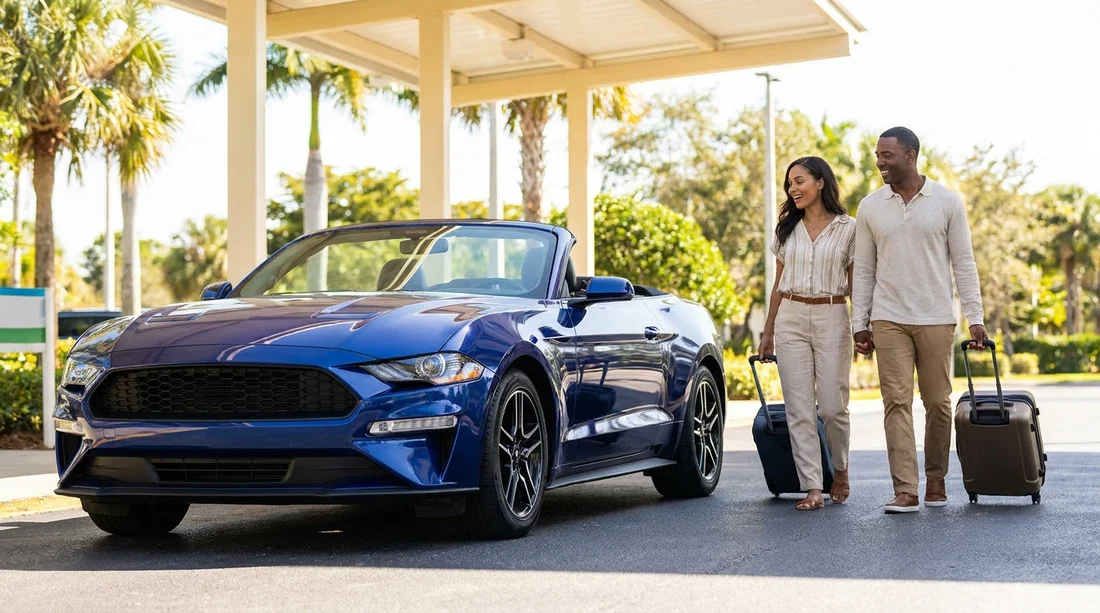
1) You reserve a class, not a car. The listing often shows a generic picture and a broad label such as economy, compact, intermediate, or “manager’s special”. That is deliberate. You are agreeing to accept a vehicle the rental location chooses from a defined range, sometimes spanning several adjacent classes.
2) The words ‘or similar’ do heavy lifting. “Or similar” means the supplier can provide another vehicle they consider comparable in size and value, not necessarily identical in shape, equipment, or boot layout. A hatchback can substitute for a small saloon in some fleets, and two cars with the same passenger count can have very different luggage capacity.
3) Assignment is availability-led. The location may prioritise turning over cars that are due back soon, balancing cleaning capacity, or moving vehicles between branches. In busy Florida hubs, particularly airport locations, the “special” can change meaning hour by hour.
How the car class system works in Florida
Florida car hire categories are usually tied to an industry standard size class and a maximum number of passengers and bags. The exact model line-up can vary by supplier and season. With a manager’s special, you may not know which model is in play until pick-up, and sometimes not even which body type.
When you see wording like “economy or similar” or “compact or similar”, the “similar” is the supplier’s judgement within that class. When you see “manager’s special”, it may mean “a vehicle chosen from a selection of classes we need to move today”. The trade-off is price versus certainty.
If you are comparing options around Miami, it can help to read the vehicle category notes carefully on pages such as car hire in Miami (MIA), where the practical realities of airport demand and category-based allocation are common.
What you might receive, and what you should not assume
A manager’s special can sometimes result in a pleasant surprise, such as receiving a larger car than expected because smaller cars have sold out. However, it can also mean receiving something less convenient for your plans, while still being within the agreed category range.
Do not assume a particular boot shape. Two “5-seater” cars can differ significantly, especially if one is a hatchback and the other a saloon. If you have two large suitcases and a pushchair, the difference matters.
Do not assume AWD or high ground clearance. If you are planning beach parking, uneven driveways, or carrying bulky gear, you may prefer an SUV class rather than leaving it to chance. For travellers who know they want that format, browsing a defined category like SUV rental in Miami Beach can reduce uncertainty compared with a manager’s special.
Do not assume seating is interchangeable. A “7-seater” requirement is not compatible with a typical manager’s special unless it explicitly states 7 seats. If you truly need multiple rows, look at a dedicated option such as minivan rental in Miami Beach, because a standard special is unlikely to guarantee that capacity.
What to check before you book, if you need space, seats, or specific features
If you are considering a manager’s special car hire deal in Florida, these checks reduce the risk of getting a car that does not suit your trip.
Passenger count and luggage allowance. Confirm the maximum passengers and the stated luggage capacity. Treat luggage figures as a guide, and consider the real-world mix: large suitcases, golf clubs, prams, cool boxes, and beach chairs. If your group fills every seat, luggage space often becomes the limiting factor.
Automatic versus manual. In Florida, automatics are the norm, but always confirm transmission type. If it is not explicitly stated, do not assume.
Toll readiness. Many Florida routes involve toll roads, especially around Orlando, Miami, and Tampa. Review how the rental handles tolls: transponder programmes, admin fees, and whether you can use your own pass. This is a cost and convenience issue, but it affects your day-to-day experience.
Pickup location constraints. Airport branches often have the widest inventory, but they also see the fastest churn. If you are flying into the Gulf Coast, comparing inventory patterns around Tampa Airport (TPA) can help set expectations for what “available today” might look like.
Why the deal can be cheaper
Manager’s special pricing is commonly driven by fleet management. If a branch has too many cars in one class, or expects returns in a certain pattern, discounting a flexible category helps them keep utilisation high. It also reduces the promise they have to make to you, because they are not committing to a specific model line.
When a manager’s special is a good idea, and when it isn’t
Good fit: short city stays, flexible travellers, couples, and anyone happy with “a car that works” rather than a particular style. It can also suit business trips where you mainly need reliable transport from A to B.
Less suitable: families who need guaranteed seating, groups with lots of luggage, road trips with bulky kit, or travellers who require specific accessibility or comfort features. In those cases, choosing a defined vehicle type, such as a larger people carrier or van, is usually a better match for the trip. If you are planning to move larger items or have a bigger group, a category like van rental in Doral is inherently more predictable than a manager’s special.
Finally, remember that Florida is large and varied. A compact car may feel fine in Miami’s urban grid, but less relaxing for long highway stretches with a full load of passengers and luggage. Matching vehicle size to the reality of your itinerary is often more important than the headline deal.
FAQ
Is a manager’s special always smaller or worse than a standard booking? No. It is based on availability, so you might receive a similar or even larger car, but it is not guaranteed.
Does ‘or similar’ mean I will get the same body type shown in the photo? Not necessarily. Photos are typically illustrative, and “or similar” allows substitutions within the class definition.
Can I request a specific model with a manager’s special car hire rate? You can ask, but the point of the rate is flexibility. The branch is unlikely to guarantee a specific model.
What should I prioritise if I’m travelling with children in Florida? Prioritise guaranteed seating, luggage space, and confirmed child seat availability. If you need three rows, avoid flexible “special” categories.
Will I know the exact car before I arrive at the pickup desk? Usually not. You generally learn the assigned vehicle at pick-up, once the branch matches you to current inventory.































































































