


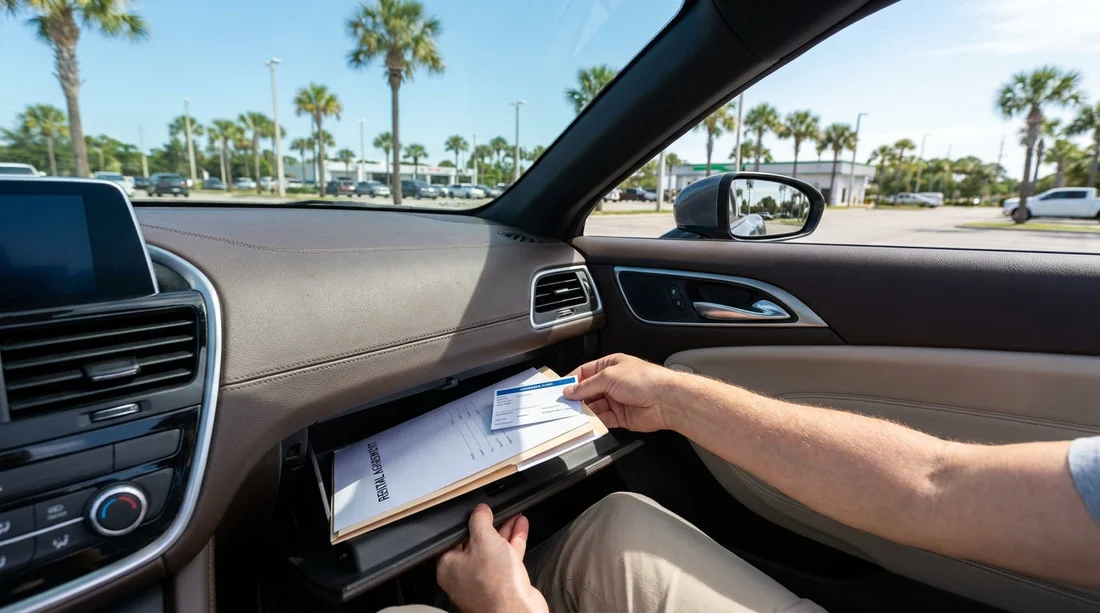
Quick Summary:
- Check the rental agreement copy and confirm all authorised drivers are listed.
- Find the registration and ensure plate number and VIN details match.
- Review insurance paperwork for Florida coverage, exclusions, and clear claims contacts.
- Save accident and roadside numbers now, before you enter busy traffic.
Picking up a car hire in Florida is usually quick, but the smartest time to slow down is before you roll out of the rental bays. If you are stopped by law enforcement, involved in a minor collision, or need roadside help, the documents in the glovebox can save time and reduce stress. Some paperwork may be digital, but Florida driving realities still favour having the key vehicle documents easily available in the car.
This checklist is designed for the moment you have the keys and you are still within the rental counter area or car park. Take two minutes, open the glovebox, and verify what is there, what is missing, and what should be corrected before you join the highway.
1) Rental agreement, what should be inside and what to verify
Your rental agreement, sometimes called the rental contract, is the single most important document to locate. Many companies provide it in a folder in the glovebox, on the sun visor, or handed over at the counter. Even if you received an email copy, check whether a printed version is in the vehicle because it can be useful during a stop or after a crash.
Before you drive off, confirm these details match what you agreed:
Named drivers: Ensure every permitted driver is listed. If a partner or friend will drive, they must appear on the agreement if required by your provider. If only one name is shown, assume only that person is authorised.
Vehicle details: Match the make, model, colour, and the vehicle identification number (VIN) if it is displayed on the contract. You can compare the VIN to the one visible through the windscreen on the driver side dashboard.
Fuel policy: Note whether it is full-to-full, pre-purchase, or another arrangement. Keep this in mind when you leave areas like Orlando MCO where refuelling options vary by direction of travel.
Tolls and admin fees: Florida has toll roads around Orlando, Miami, and beyond. The contract usually explains whether you are enrolled in a toll programme, how charges are calculated, and what happens if you use cashless toll lanes.
2) Vehicle registration, why it matters and what to check
In Florida, the vehicle registration is the document that proves the car is legally registered. In many states, including Florida, drivers are expected to present registration information when requested during a traffic stop. Rental companies typically keep a copy of the registration in the glovebox.
Open the glovebox and look for a registration card or a paper labelled with the vehicle’s plate number. Then check:
Licence plate match: Compare the plate number shown on the registration to the plate on the car.
Expiry: It should be current. Rental fleets manage this closely, but mistakes can happen.
If the registration is missing, do not leave the property. Return to the counter or the booth and request the correct document or a different vehicle. This is especially important if you are heading straight out of a busy pick-up area like Downtown Miami, where being pulled over without paperwork is the last thing you need.
3) Insurance and liability information, what you should be able to show
Insurance documentation varies by provider and by the coverage you selected. Some companies include an insurance card or proof of financial responsibility with the registration. Others include a separate summary sheet showing liability coverage provided by the rental company and any optional protections you purchased.
In the glovebox, look for any of the following:
Proof of liability coverage: This may be a card, certificate, or a printed page referencing Florida coverage. It should identify the insurer or self-insured entity and contact information for claims.
Coverage summary: If you added protection products, confirm the names match what you expected. Wording differs by company, so focus on what is included and what is excluded.
Be clear on one practical point: insurance paperwork in the glovebox is for the vehicle and the rental company’s coverage, not proof that you personally have valid insurance elsewhere. If you rely on a UK policy, travel insurance, or a credit card benefit, keep those details separately on your phone and in your email, and know how to access them offline.
If you are collecting near Miami International and will be driving across South Florida, it helps to understand your arrangement before entering heavy traffic corridors. Locations such as Florida MIA can be fast-paced at peak times, so confirm coverage while you are still parked.
4) Accident report form and incident instructions
Many rental vehicles include a simple accident report form or an information sheet explaining what to do after an incident. It may be a small booklet in the glovebox wallet, or a single page with checkboxes.
You want to see clear guidance on:
Who to call first: Emergency services for injuries or hazards, then the rental company or their claims line.
What information to collect: Other driver details, vehicle details, witness contacts, and photos.
When to involve police: The guidance may specify accidents with injuries, blocked roads, suspected impairment, or disputes.
5) Roadside assistance and breakdown contact details
Florida heat, long distances, and occasional storms mean roadside support matters. Your glovebox should include a roadside assistance card or a contact sheet with a 24-hour number. Even if you have your own breakdown cover, you still need the rental company’s preferred process, because unauthorised towing can create extra fees.
Verify these items:
24/7 phone number: Preferably with an international dial format if you do not have a US SIM.
Basic instructions: What to do for flat tyres, battery issues, lockouts, and towing.
Before you leave, save the number to your phone. If you are driving a larger vehicle, such as a people carrier, it is also worth confirming whether tyre changes are included or whether you must wait for authorised support. This is particularly relevant if you have arranged a larger option like a minivan rental in Miami Beach and you are carrying passengers and luggage.
FAQ
Do I legally need a paper copy of the rental agreement in Florida? Not always, but having it makes problem-solving faster. If the agreement is only digital, keep it downloaded on your phone and confirm you can access it without signal.
What should I do if the registration is missing from the glovebox? Do not leave the rental area. Return to the counter or booth and request the registration copy or a different vehicle with correct paperwork.
Is proof of insurance required to be in the glovebox? Rental firms typically provide proof of the vehicle’s coverage or financial responsibility with the registration or a separate card. You should be able to present something if asked.
Where do I find the VIN to match the paperwork? Check the VIN plate visible through the windscreen on the driver side, and compare it to the contract or registration details if shown.
Should I keep roadside assistance numbers somewhere else too? Yes. Save the number in your phone and consider a note in your wallet, because your glovebox is not helpful if you are locked out.































































































