


Quick Summary:
- Match each symbol to the correct panel, then confirm it on the car.
- Check the legend for codes like scratch, dent, chip, and crack.
- Compare diagram notes with written remarks, mileage, fuel, and photos.
- Ask staff to add missed damage and countersign before leaving the lot.
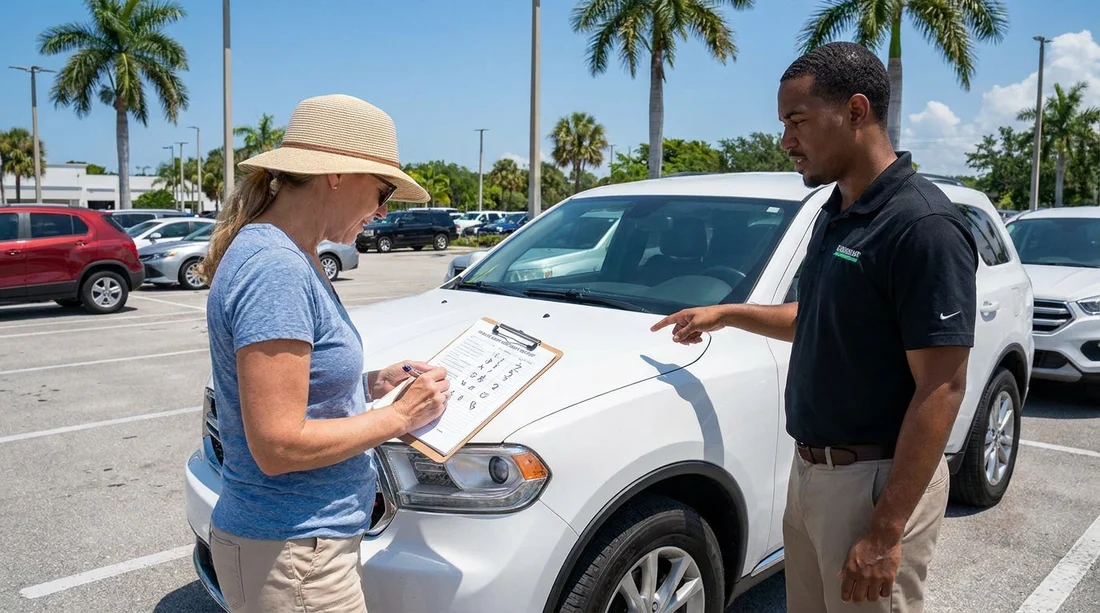
At pick-up, most Florida car hire companies hand you a “vehicle condition report” with a small car outline covered in marks, arrows, and abbreviations. That diagram is not decorative, it is the rental firm’s record of what damage existed before you took the keys. If you understand the symbols and how they map to real panels, you can spot pre-existing damage, get it recorded properly, and greatly reduce the chance of a dispute when you return the car.
This guide explains the most common damage-diagram symbols you will see in Florida, what they usually mean, and how to do a fast but thorough check before you drive away.
What the condition-report diagram is actually recording
A condition report is typically split into three parts: a diagram of the vehicle, a legend explaining the codes, and written fields for notes such as mileage, fuel level, and sometimes tyre condition. The diagram is a map, each side of the car is broken into panels, and symbols are placed where damage was seen previously.
In busy pick-up locations like airports and downtown branches, you might collect your vehicle quickly and the report may have been prepared earlier. That is why you should treat the diagram as a starting point, not proof that everything else is flawless. Whether you are collecting near Miami or Fort Lauderdale, the process is similar, so it helps to know what you are looking at before you arrive. If you are comparing pick-up points, these local pages can help set expectations about location flow and hours: car hire at Fort Lauderdale Airport and car hire in Downtown Miami.
Common damage-diagram symbols and what they mean
There is no single universal standard, but most Florida rental condition reports use similar shorthand. Always start with the legend on your document, because one company’s “S” could mean scratch, while another uses “SC”. Below are symbols and terms you will commonly encounter and how to interpret them in practice.
Scratch, scuff, scrape is often marked as S, SC, SCR, or a short line on the panel. A scratch usually means paint has been marked but the panel is not pushed in. Scuffs and scrapes can indicate paint transfer from another object. Look closely in sunlight because fine scratches can be hard to see under canopy lighting.
Dent, ding is often D, DN, or a small circle. A dent implies the panel is deformed. Some reports also grade size, for example “D1” or “D2”, or add a measurement in centimetres. If the dent is near a body line or panel edge, it can look minor from one angle but obvious from another, so check from multiple viewpoints.
Chip is frequently C, CH, or a dot on the bumper or bonnet. Stone chips are common on Florida highways. Chips on windscreens may be marked separately because glass damage has its own thresholds.
Crack is commonly CR, CK, or a jagged line, often used for bumpers, lights, or glass. A crack in a plastic bumper can be subtle until you press gently around it. Never force anything, just look for separation lines and missing paint around an impact.
Broken or missing is often B, BRK, MIS, or “X”. This might refer to missing hubcaps, trim pieces, or a broken lens. If a tail light is marked, verify whether it is a surface scuff or an actual crack that could allow water in.
Glass damage might be coded separately, for example WS for windscreen, GL for glass, or a star symbol for a chip. If you see any windscreen marking, inspect from inside and outside. Small chips can grow into cracks in Florida heat.
Tyres and wheels may be shown with small circles near each wheel, or with codes like W for wheel, R for rim, or CU for curb rash. Kerb scuffs are common on alloys. If the report mentions wheel damage, confirm which wheel, front left and rear right get mixed up easily when you are in a hurry.
How to read the diagram like a map, panel by panel
Most diagrams show multiple views: left side, right side, front, rear, roof, and sometimes a close-up of the windscreen and wheels. The key is to match the symbol location to the physical panel. Start at the front left and work clockwise, so you do not miss anything.
Use consistent terms. In US rental paperwork you may see “driver side” and “passenger side”, which correspond to left and right when you are seated in the car. If you are used to UK wording, keep a quick mental note: driver side in Florida is the left side of the vehicle.
How to document pre-existing damage properly before you leave
The goal is to align three things: the diagram, the written notes, and your own evidence. Take clear photos in good light, including wide shots of each side and close-ups of every marked area. Make sure your photos also capture the number plate and a wider angle that shows the damage in context.
Then compare the report with the car. If you find damage that is not recorded, go back to the desk or attendant immediately and ask for the report to be updated. The simplest approach is: point to the exact place on the vehicle, point to the matching panel on the diagram, and request that they add the correct symbol or a written note. Get confirmation on the paperwork before you drive away.
If you are picking up at a high-volume location such as Orlando International, the handover can be quick, but you still have time to do a structured check. These pages provide useful context on the typical pick-up environment and vehicle types: car rental at Orlando MCO and SUV rental at Orlando MCO.
What else to verify on the condition report
Symbols are only part of the story. Also check the non-diagram fields, because disputes sometimes arise from simple mismatches.
Fuel level should match the gauge. If it says “full” but the gauge is slightly below, ask for a correction. Small differences can matter if the return policy is strict.
Mileage or odometer reading should be plausible for the vehicle you are receiving. A mismatch can create confusion if an earlier report was attached by mistake.
Accessories such as charging cables, child seats, toll devices, or parcel shelves may be listed separately. If anything is missing or already damaged, get it written down.
Florida-specific pick-up tips that reduce disputes
Florida sun and sudden rain can both hide and reveal damage. If the car is wet from rain or washing, water can mask scratches. In that case, focus on dents and cracks, and take photos anyway.
If you are collecting from a beach area, you may see more wheel and bumper scuffs due to tight parking and kerbs. This is one reason to pay extra attention to the wheels and bumper corners when picking up in coastal neighbourhoods. For location context, see Payless car rental Miami Beach.
FAQ
Do all Florida rental companies use the same damage-diagram symbols? No. Most use similar abbreviations, but the meaning can vary, so read the legend on your specific report and ask if any code is unclear.
If damage is marked on the diagram, can I still be charged for it? Usually pre-existing damage shown on the report should not be charged to you, but only if it is clearly documented and the report is linked to your agreement.
What should I do if I find unmarked damage after leaving the car park? Contact the branch immediately and document the time, photos, and the exact location of the damage. The closer to pick-up you report it, the easier it is to resolve.
Are small wheel scuffs worth noting on the report? Yes. Wheel and rim marks are common sources of disputes. If you can see it, photograph it and ask for it to be recorded.
Should I take photos even if the report already shows the damage? Yes. Photos help confirm severity and location, and they support the condition report if there is any disagreement at return.































































































