Quick Summary:
- Choose EV car hire for cities and day trips with frequent chargers.
- Skip EVs for remote routes where charging gaps add hours.
- Set up charging apps and payment before collecting the car.
- Confirm connector type and whether the car includes a cable.
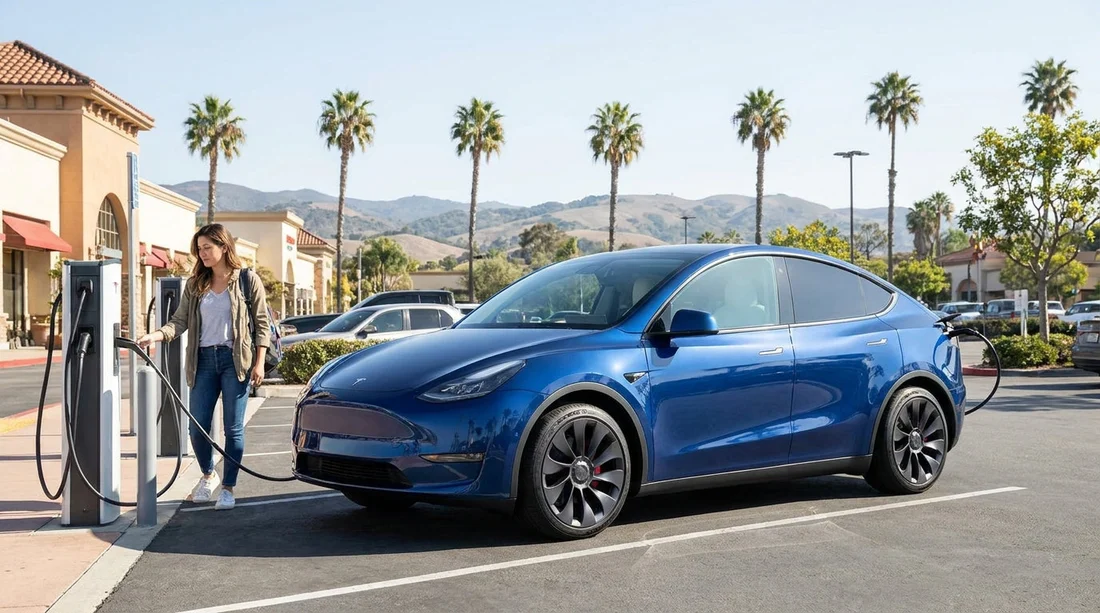
Electric car hire in California can be brilliant, but overnight charging is the difference between effortless and constantly planning. If you cannot rely on plugging in at your hotel, rental home, or a friend’s driveway, the question becomes whether public charging will fit your route, your tolerance for stops, and your comfort with apps and connectors. California has one of the best charging networks in the US, yet availability varies sharply between city centres, coastal corridors, and inland or mountain areas.
This guide helps you decide before you pre-book by looking at charging access, app setup, cable expectations, and the most common trip types where an EV is, or is not, the right call.
Start with your trip shape, not the car
Without overnight charging, an EV works best when your days look like this: moderate mileage, predictable routes, and plenty of time flexibility. It becomes harder when your days look like this: long drives, late arrivals, early starts, or a need to detour into quieter areas with fewer chargers.
As a rough planning mindset, assume you will do one meaningful public charge per day on an EV trip without home charging. If that sounds like friction, a hybrid or petrol car may be the smoother choice. If you are happy combining charging with meals, shopping, or scenic breaks, EV car hire can still be stress-free.
If you are flying in and collecting at an airport, it can help to compare pick-up locations and vehicle categories early. Hola Car Rentals has local pages such as car hire at San Francisco SFO and car rental at San Jose SJC that make it easier to see typical options around the Bay Area.
Charging availability in California: excellent, but uneven
California has dense fast charging on major motorways and around big cities. The challenge without overnight charging is not “Are there chargers?” but “Will the chargers be where and when I need them, with minimal queueing?”
It is harder in these scenarios:
National parks and mountain towns. Chargers exist, but they can be fewer, slower, or busy at peak times. If you cannot charge overnight near the park, you may need to arrive with plenty of buffer and plan a longer stop on the approach.
Rural inland routes. Distances can be long and options limited, so a single out-of-service unit can force a major detour.
A practical approach is to check your top three days, the ones with the longest drives, and map out at least two charging options along each. If you cannot find comfortable back-up choices, an EV may feel like a gamble.
Apps and payment: do the admin before you land
Public charging in the US often requires using the operator’s app, a membership, or tap-to-pay. With rental cars, the friction usually comes from set-up rather than the charging itself. Before your trip, do this on your own phone:
1) Download the main charging apps you expect to use. You want the apps installed, accounts created, and permissions allowed.
2) Add a payment method and confirm it works. App failures at the charger are frustrating, especially if your battery is low.
3) Learn the basics of starting and stopping a session. Some chargers require you to start the session in-app before you plug in, others after.
4) Save key locations. Favourite the chargers near your accommodation and your likely lunch stops.
If you are arriving via the Sacramento region for wine country, Tahoe, or state capital visits, researching availability around your pickup point can reduce surprises. See local context on car hire at Sacramento SMF.
Connector types and cables: what to expect from a rental EV
Most modern EVs in the US use these standards:
Level 2 (AC) charging: commonly J1772 for non-Tesla vehicles. This is the typical “destination” charger in car parks and hotels.
DC fast charging: commonly CCS for non-Tesla vehicles, and NACS for many Tesla sites. Access depends on the vehicle and, increasingly, whether adapters are provided or supported.
For travellers who cannot charge overnight, DC fast charging is what keeps the trip moving. Level 2 is still useful if you can charge during a long meal, a museum visit, or an evening in a shopping area.
Should you expect a cable in the boot? Sometimes yes, sometimes no. Many public Level 2 stations have a tethered cable, so you do not need to bring anything. However, some accommodation-based sockets or private wall units may require a portable cable, and not every rental includes one. If your plan relies on any non-tethered charging, clarify what is supplied with the car category you select.
How to plan days without overnight charging
Think of your battery like your “day tank”. If you wake up at 80 to 100 percent, you can treat charging as optional. If you wake up at 25 to 40 percent, charging becomes a task. Without overnight access, you will often start day two and beyond at whatever you managed the night before.
These habits help:
Charge when it is convenient, not when it is critical. If you see an open fast charger at a good point in your day, consider topping up even if you do not strictly need it.
Avoid arriving somewhere remote on a low battery. Plan to arrive with enough range to handle a closed charger, a queue, or a detour.
Use charging time as meal time. A 20 to 40 minute fast charge can match a lunch stop, making the “extra time” feel minimal.
Do not chase 100 percent on fast chargers. Charging speed typically slows above 80 percent. Multiple shorter charges are often quicker than one long session.
When a petrol car or hybrid may be the better choice
If you cannot rely on overnight charging, you may want to avoid full EV car hire when:
You have a tight schedule. Early starts, late check-ins, or event times can make charging stops stressful.
You are heading into charging-sparse areas. Some desert routes, mountain drives, and less-developed corridors can add uncertainty.
You dislike app friction. If you want to step out, fill up in five minutes, and go, a hybrid or petrol option matches that expectation.
Travelling with bulky luggage, surfboards, or multiple passengers can also steer you towards larger vehicle categories. For Orange County arrivals, comparing categories like SUV hire at Santa Ana SNA can help you balance space needs against efficiency.
Practical checklist before you pre-book
Check your accommodation: If you cannot charge on-site, search for reliable chargers within a short walk or drive.
Estimate your longest day: If it is consistently very long, consider hybrid or petrol.
Confirm connector expectations: Ensure your likely charging network matches the car type.
Prepare apps and payment: Do not leave account creation to the kerbside at a charger.
If your plans involve picking up in Southern California and doing a mix of beaches, theme parks, and LA day trips, looking at pickup logistics can still matter for timing and convenience. The car rental at Santa Ana airport page is useful for comparing options around Orange County.
FAQ
Is electric car hire in California risky without overnight charging? It is not inherently risky in big cities and on major corridors, but you will need to plan charging stops. If your itinerary includes remote areas or fixed schedules, the risk of delays increases.
How much extra time should I allow for charging each day? Many travellers manage with 20 to 60 minutes of fast charging per day, often combined with meals. Extra time can rise if you face queues, need slower Level 2 charging, or must detour.
Do I need to bring my own charging cable for a rental EV? Usually no for public charging, because most Level 2 and all fast chargers have tethered cables. If your plan relies on a private socket or a non-tethered unit, confirm what the rental provides.
Which trips suit an EV best when you cannot charge overnight? City breaks, coastal driving, and day trips with plenty of services suit EVs well. You can charge during shopping or meals and keep the itinerary comfortable.
When should I choose a hybrid or petrol car instead? Choose a hybrid or petrol car if you have long driving days, limited charging near your accommodation, or need maximum predictability. It reduces planning and avoids queue uncertainty.