


Quick Summary
- On winter drives from Reno to Lake Tahoe, all wheel drive helps, but California and Nevada chain rules still matter more than your badge.
- Even with AWD, highway chain controls often require you to carry chains in the boot and may ask you to fit them in the heaviest snow.
- Plan your route, check the forecast and choose a rental with suitable tyres so you are ready for fast changing mountain weather.
AWD versus chains around Lake Tahoe
The routes from Reno to the Lake Tahoe basin, such as Interstate 80 over Donner Summit and US 50 towards South Lake Tahoe, climb quickly into high passes. In cold fronts they can switch from wet to snow packed within a few kilometres. An all wheel drive rental gives you better traction when roads are merely damp or lightly snowy, but it is not a free pass to ignore chain rules.
On the California side, Caltrans uses levels of chain control. Under moderate conditions you may see signs that allow four wheel drive and all wheel drive vehicles with proper winter tyres to continue without chains, while two wheel drive cars must fit them. However, those same signs usually state that all vehicles in the control area must carry chains, and in the strictest level even all wheel drive vehicles can be required to stop and fit them.
Why you should still carry chains in the boot
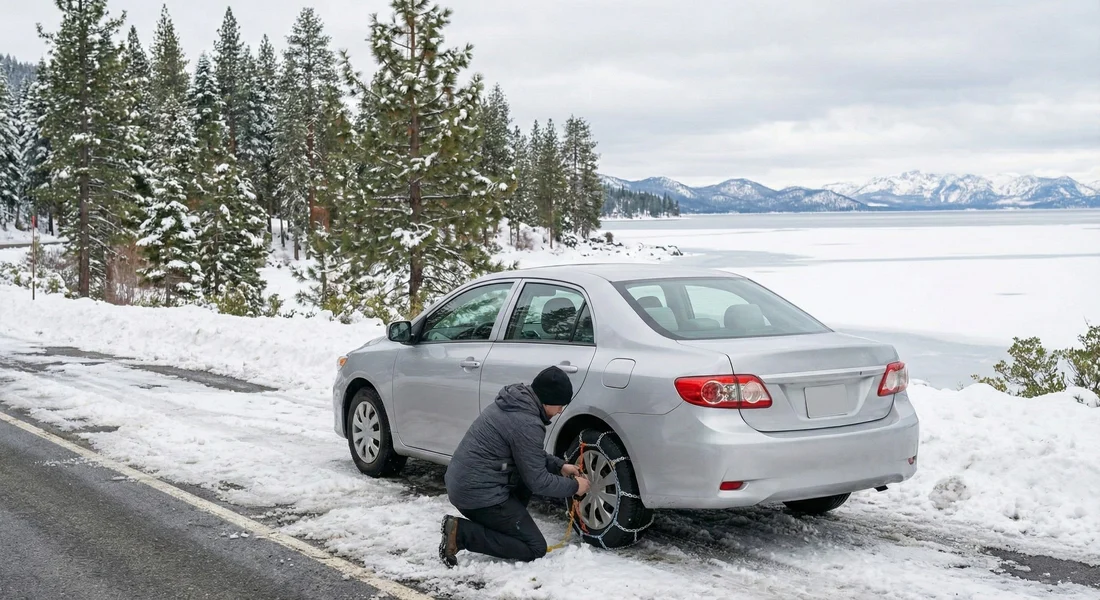
Because conditions can change quickly, it is smart to treat chains as an essential piece of safety kit, not an optional extra. Even if you leave Reno on clear tarmac, a snow band can move across the passes by the time you reach the state line. If the control level is raised while you are in the mountains, having chains in the boot means you can comply with instructions instead of turning back or waiting hours for conditions to improve.
Chain controls are enforced by law on both main Tahoe corridors, and ignoring them can lead to fines or being turned around at checkpoints. Carrying chains, a shovel and basic winter gear is part of being a responsible driver in the Sierra Nevada, whether you are in a compact saloon or a large SUV.
Rental rules, tyres and chain fitting
Not every rental company handles chains the same way. Some brands do not permit fitting chains at all, because of potential damage to wheel arches or sensors, while others allow them when required by law. When you collect your vehicle through Hola Car Rentals, read the section on winter driving conditions in your voucher and ask staff to explain whether chains are allowed and whether the tyres are suitable for mountain use.
If you are starting your trip at a major California airport rather than Reno itself, consider picking up a vehicle at a convenient car rental location such as Sacramento. From there it is a straightforward drive towards the Sierra with time to check conditions before you commit to the passes.
For families or groups carrying skis, luggage and snow gear, a larger vehicle can make winter driving less tiring. Options such as a high riding SUV from Sacramento or a spacious minivan for the whole crew give you more room to keep wet kit away from seats and heating vents.
Planning routes from Reno to the lake
The most direct options from Reno lead either to the North Shore via Mount Rose Highway and Incline Village or to Truckee and Donner Summit before dropping down into the basin. In winter, always check the latest road reports before choosing which way to go. High routes can close temporarily for avalanche control or to clear jackknifed lorries.
Build extra time into your schedule so that you are not tempted to rush if conditions worsen. Keep fuel above half a tank, carry warm layers for everyone and remember that stopping distances are much longer on snow and ice. Pull over only in designated areas and avoid the temptation to stop in the middle of a narrow shoulder to take photos of the snow covered lake.
How Hola Car Rentals helps with winter flexibility
Winter trips are vulnerable to late storms, pass closures and delayed flights. Booking with Hola Car Rentals gives you Free Cancellation up to 48 hours before pick up on many rates, so you can move your dates if a strong front is forecast. Our All Inclusive plus rate wraps in maximum coverage and clear liability limits, and selected itineraries include maximum liability cover up to 300,000 dollars for extra reassurance on mountain roads.
FAQ for chains and rentals on Lake Tahoe winter drives
Do I need chains in the boot if my rental is all wheel drive?
Yes, you should still carry chains. In many chain control zones the rules say that four wheel drive and all wheel drive vehicles with proper winter tyres may continue without fitting chains at first, but they must still carry them and can be asked to install them if conditions worsen.
Can I be fined for ignoring chain control signs?
Drivers who ignore chain requirements risk fines, being turned around at checkpoints or being held liable if they cause a crash while not complying. It is safer and cheaper to respect the controls and wait out a storm if you are unsure.
What type of vehicle is best for Reno to Lake Tahoe in winter?
An SUV or mid size saloon with good tyres and chains in the boot will suit most visitors. For more luggage and ski equipment, options such as a larger van from Sacramento can be more practical.
How far ahead should I watch the forecast?
Start checking conditions a few days before your drive and look again on the morning you depart. Use the flexibility of Hola Car Rentals products to adjust your travel day if a major storm is expected to hit the passes during your planned crossing.
With the right preparation, respect for chain rules and a well chosen vehicle from Hola Car Rentals, winter drives between Reno and Lake Tahoe can be memorable for the scenery rather than the stress.































































































