


Quick Summary:
- Count passengers and child seats first, then add luggage volume realistically.
- Choose a category with extra boot space, not maximum seat count.
- Check rear-door access, ISOFIX availability, and top-tether anchor locations.
- Plan for strollers and beach gear, upgrade one class for comfort.
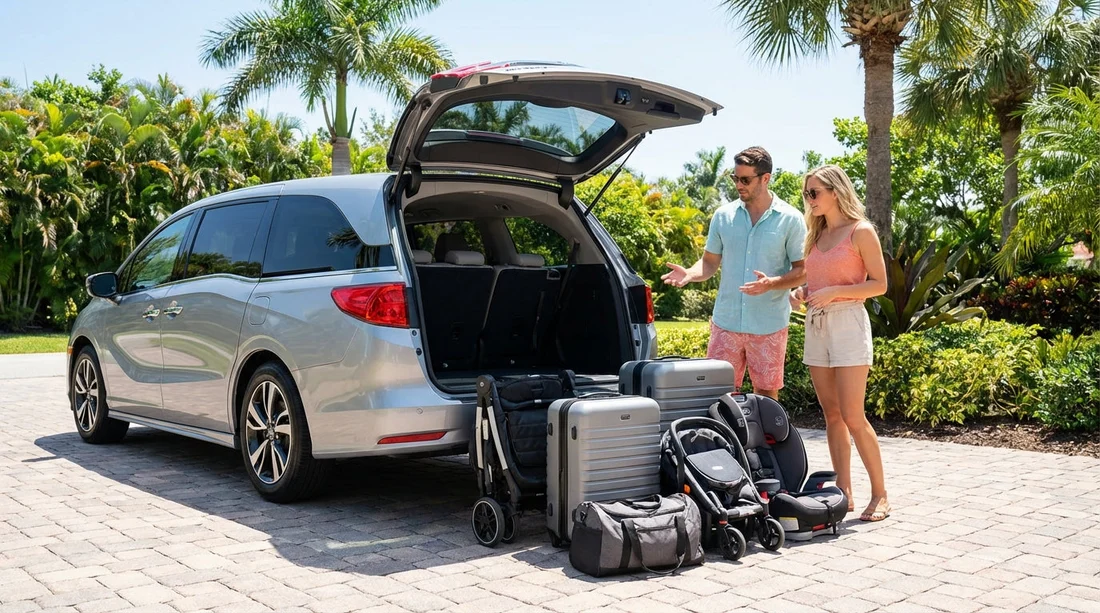
Choosing the right rental car size in Florida is easiest when you think in real objects, not marketing labels. Family travel usually includes at least one child seat, a stroller, and bulky “soft” items like swim bags that still take up boot space. Car categories can vary by brand and model, so the goal is to pick a class with enough room for passengers, child-seat fit, and the boot you actually need, then add a small buffer for comfort.
This guide is written for families arranging car hire in Florida, especially those landing at Miami or Orlando and driving with children. It focuses on practical checks you can do before you book, even when the exact model is not guaranteed.
Step 1, List people and seats, not just passengers
Start with the fixed items, people and child seats. Write down:
1) Adults and children travelling. Remember that teens count as adult-sized passengers for shoulder room and legroom.
2) How many child seats, and what type. Rear-facing infant seats typically take more front-to-back space. High-back boosters are easier for belt routing but still need a full seating position and a head restraint behind it in many vehicles.
3) Who needs to sit next to whom. Two children who need help with buckles may be easier if an adult can sit adjacent, but that can force three-across seating. If you need three seats in the second row, do not assume a “mid-size SUV” will manage it comfortably, many do not.
If you are collecting a car near Miami, comparing category options on a location page can help you visualise typical fleets. For example, travellers arriving by the coast often review options around Miami Beach to see which categories are commonly offered for family trips.
Step 2, Translate luggage into boot volume you can picture
Families often underestimate luggage because items are irregularly shaped. Use a simple rule of thumb based on common travel pieces:
Carry-on suitcase: small but rigid, stacks well.
Medium suitcase: the typical checked bag.
Large suitcase: often only one fits across many boots.
Stroller: can be compact umbrella style or large travel system, this is the wildcard.
Beach gear: cool boxes, chairs, inflatable toys, and grocery runs add up quickly.
Now decide which of these must be inside the boot. If you do not want bags on laps or stacked to the roof, size up. Florida driving often includes longer stretches, plus sudden rain, so keeping the cabin uncluttered helps comfort and visibility.
Step 3, Understand what car categories really mean for families
Car rental categories are best treated as a range. Two “intermediate SUVs” might differ a lot in boot depth and second-row width. Still, category thinking is useful when you pair it with family needs.
Small and compact cars, best for light packers and one child seat
These are usually fine for two adults, one child, and light luggage. Add a second child seat and you may still fit, but boot space becomes the limiter once you include a stroller. Compact cars can also have tighter rear-door openings, which makes installing a rear-facing seat harder on your back.
Choose this size only if you have one child seat, one compact stroller, and no big hard-shell cases. If you are staying city-centre, a smaller footprint is easier for parking. Travellers picking up in downtown Miami sometimes compare options around Brickell where tight parking can influence the decision.
Mid-size and full-size sedans, better rear-seat space but boot shape matters
Sedans can surprise you. Rear legroom is often decent, and the boot can take multiple suitcases. The catch is boot opening height and depth. Some large strollers do not fit through a narrow boot opening even if the boot volume looks big on paper.
Choose a sedan if you have one or two child seats and mostly suitcases rather than bulky gear. If you need easy access for buckling children, check that rear doors open wide, and plan for the front passenger seat to move forward if using a rear-facing infant seat behind it.
Crossovers and standard SUVs, the popular compromise
This is where many Florida family trips land. A standard SUV class often gives you a taller boot opening for strollers and a higher seating position that some parents find easier for lifting children into seats.
But do not assume all SUVs are wider. Many are effectively tall compact cars. Two child seats fit well in most, three-across is usually difficult. If you are travelling with two children plus an adult who must sit in the second row, consider a larger class or a minivan instead.
Large SUVs, good for luggage and comfort, but third rows reduce the boot
A common mistake is booking a 7-seater SUV to “get more space” and then discovering that using the third row leaves little boot behind it. If you need seven seating positions in use, plan for limited luggage space unless you can fold part of the third row or you are travelling with soft bags only.
Large SUVs can still be a good match for five people when the third row stays folded, giving a generous boot and good cabin space. They can also be easier for fitting multiple child seats because second-row benches may be wider than smaller SUVs, but that varies.
Minivans, the most predictable solution for child seats and luggage
For families, minivans are often the least stressful option. You typically get:
More usable boot space even with passengers, especially if you keep one rear section available for luggage.
Better access thanks to sliding doors, which helps in tight car parks.
More child-seat friendly layouts and flexibility for older children climbing in and out.
If you have three child seats, two strollers, or a mix of children and grandparents, a minivan category can avoid a lot of compromise. If you want to look at family-oriented categories, browsing a dedicated page like minivan rental in Doral can help set expectations for typical space and seating.
Step 4, Child-seat fit checks you can do before booking
Even without a guaranteed model, you can choose a category that is likely to work. Focus on these practical fit points:
Rear-facing seats need front-to-back room. If your infant seat is long, avoid the smallest classes unless the front passenger can give up legroom.
Door opening and sill height matter. A car can have enough cabin space but still be awkward to install a seat if the door opening is tight.
ISOFIX, LATCH, and top-tether anchors vary. Not every seating position has anchors. Many cars have ISOFIX or LATCH on the two outer rear seats, with top tethers on the back of the seat or parcel shelf. If you need three seats installed, you may need to use seatbelts for at least one position.
Three-across is a special case. If you need three child restraints in one row, aim for a minivan or a large vehicle with a genuinely wide second row. Otherwise, you risk arriving to find it physically cannot be done safely.
Step 5, Choose size using these common Florida family scenarios
Two adults, one baby, one stroller, two medium suitcases. A compact SUV or mid-size sedan often works, but pick SUV if you want an easier stroller load and higher boot opening.
Two adults, two children in car seats, one large stroller, beach gear. A standard SUV can work if luggage is moderate. If you have a large travel system stroller plus multiple hard-shell bags, consider a large SUV or minivan for a stress-free boot.
Two adults, three children in seats or boosters. Consider a minivan first. A 7-seater SUV might still be tight for three-across, and using the third row can shrink the boot.
Four adults plus two children. This is where “seats” is not the same as “space”. A large SUV with third row folded may not seat everyone. A minivan or a truly large SUV with adequate second-row width is often the better match.
Step 6, Airport arrivals, allow a buffer for the first and last day
The hardest moment for space is often the airport day, not the beach day. Everyone has all luggage at once, you are tired, and you want to load quickly. If your trip includes Orlando theme parks, you may also carry more daily items like snacks, prams, and changes of clothes.
If you are flying into Orlando, consider how much boot space you want for the drive out of the airport and the first supermarket stop. Researching local fleet expectations through pages like Enterprise at Orlando MCO can help you decide whether a larger class is worth it for your group.
Step 7, Quick decision checklist before you confirm your car hire
1) Can everyone sit with proper shoulder belts? Middle seats sometimes have different belt geometry.
2) Will a rear-facing seat force an adult into the dashboard? If yes, size up a class.
3) Can you load the stroller without removing wheels? If no, plan for extra time or a larger boot opening.
4) Are you likely to use the third row? If yes, re-check luggage space with that row up.
5) Do you want an uncluttered cabin for long drives? If yes, add one category of space.
Finally, remember that rental classes can include multiple models. Choosing the right category reduces the risk of a poor fit, and gives you a more comfortable, safer setup for children and luggage during Florida driving.
FAQ
How do I estimate whether the boot will fit our stroller and suitcases? Treat the stroller as a suitcase-plus in volume, especially travel systems. If you have two medium suitcases plus a stroller, a compact car is often tight, while a standard SUV or minivan is more reliable.
Is a 7-seater always best for families with lots of luggage? Not necessarily. If the third row is in use, boot space often becomes small. A large SUV with the third row folded or a minivan usually carries more luggage while still seating five comfortably.
Do all rental cars in Florida have ISOFIX or LATCH for child seats? Many do, but not all seating positions will. Most commonly the two outer rear seats have anchors, while the centre seat may require a seatbelt installation. If you need three restraints, plan for a vehicle class known for wider seating and flexible anchor points.
Should we choose an SUV just because it is higher? Height can help with loading children and strollers, but some SUVs are not wider than compact cars. Choose based on second-row width, boot opening, and how much luggage you carry, not the badge.
What is the safest approach if we are unsure between two categories? Size up one class for breathing room, especially with rear-facing seats and bulky gear. The extra boot capacity and easier access usually make airport loading and daily stops much simpler.































































































