


Quick Summary:
- SMS roaming helps if your bank sends OTPs for counter authorisations.
- Set up app approvals before flying, and test they work.
- Bring a backup credit card in the main driver’s name.
- Ensure international use is enabled and credit limit covers the hold.
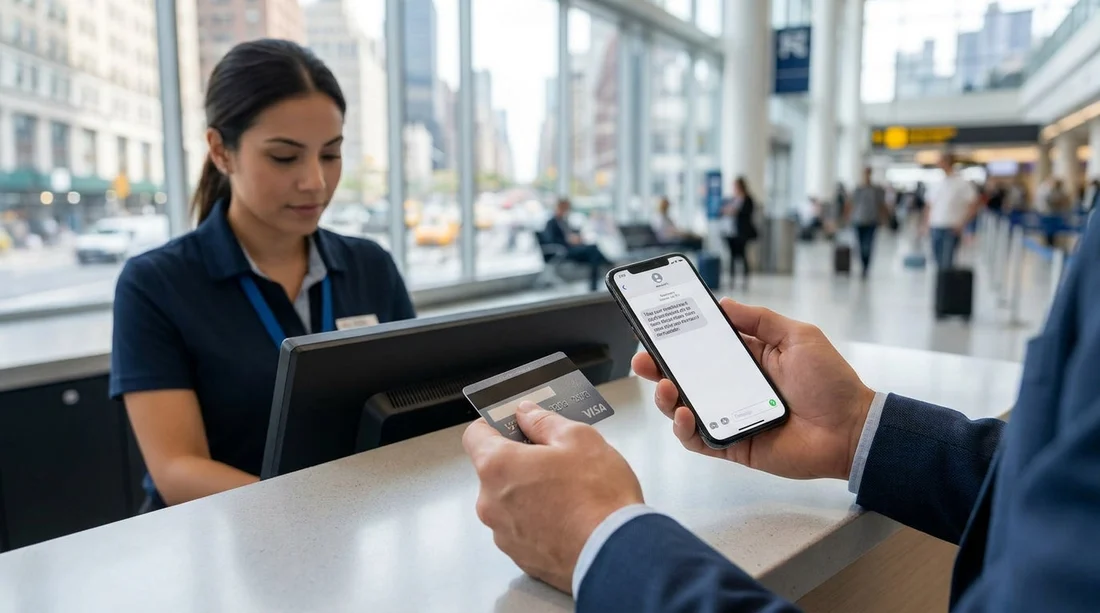
At a car hire counter in New York, your card is often used in a way that looks unusual to fraud systems, especially if you normally spend in another country. That is why people worry about SMS roaming and one-time passcodes, also called OTPs. The short, practical answer is that you might need SMS roaming, but you can usually avoid relying on it by setting up alternative verification methods before you travel.
This article explains when banks send OTP texts during card authorisations, why car rental deposits are a common trigger, and what to do to prevent payment or deposit-hold delays at pick-up.
Why car hire pick-up can trigger extra bank verification
Car hire transactions are different from a normal purchase. At pick-up, the rental desk typically performs a card authorisation, not a final charge. This authorisation places a refundable hold, often called a security deposit, to cover fuel, damage, tolls, or additional days. Because it is a higher amount and is done with a merchant type associated with deposits and later adjustments, it can score higher for fraud checks.
In New York, the risk score can increase if any of these apply: you are using a foreign card, the transaction is in USD when you usually spend in GBP or EUR, the authorisation amount is larger than your recent purchases, the merchant is at an airport, or your billing address and current location do not match.
If the bank decides it needs confirmation, it may ask for step-up authentication. Depending on the issuer, that could be an SMS OTP, an in-app approval, a push notification, a call to your registered number, or a decline that requires you to contact the bank.
When do banks send OTP texts for card authorisations?
SMS OTPs are most common in card-not-present online payments, but they can also appear with in-person transactions if the bank’s fraud engine flags the authorisation. With car hire, that flag can happen at the counter even if your card is physically present.
Unusual location or first-time merchant: If you have never used that rental brand or paid in the US before, the bank may want confirmation.
Large deposit hold: Deposit holds can be several hundred dollars or more, depending on car group, insurance, and local policies. Higher amounts are more likely to trigger verification.
Multiple attempts: If a card is declined and the agent retries, or tries a different amount, repeated attempts can escalate fraud controls.
Name mismatch or driver change: If the cardholder is not the main driver, or details do not align, the merchant may reattempt the authorisation after edits, which can prompt bank checks.
Magnetic stripe fallback: If chip and PIN fails and the terminal falls back to swipe, some issuers treat it as riskier and may require extra verification.
Not every bank uses SMS for this. Many issuers have moved to app-based approvals. The problem is that travellers sometimes discover at the counter that their bank expects an SMS OTP, but their phone cannot receive it without roaming or because their SIM is not active.
Do you actually need SMS roaming in New York?
You only need SMS roaming if your bank will send verification codes by text to your home number, and you have no other way to approve the transaction. Some customers can receive SMS over Wi-Fi calling, but that is not universal and should not be relied on at a busy rental desk.
To decide, check your bank’s authentication method for overseas card transactions. Look in your banking app settings for security approvals, and review recent travel payments. If your bank routinely sends SMS OTPs for suspicious transactions, enabling roaming can prevent a dead-end situation where the authorisation cannot be confirmed.
However, there are reliable alternatives that reduce the need for SMS roaming, and they are often better because they work even if mobile signal is weak in terminals or garages.
Best ways to avoid counter delays and deposit-hold problems
1) Enable app-based approvals and offline access
If your bank supports push notifications or in-app approvals, ensure the app is installed, logged in, and able to authenticate with Face ID, fingerprint, or a passcode. Test it before departure. Some apps require periodic re-verification and can lock you out if you have not logged in for a while.
2) Tell your bank you are travelling
Many banks no longer use formal travel notices, but some still have a travel setting or a fraud notification preference. Make sure US transactions are not blocked, and that international usage is enabled for the specific card you will present.
3) Carry a backup card that matches the main driver
A second credit card in the main driver’s name is one of the simplest ways to prevent delays. If the first card triggers an OTP you cannot receive, you can try the backup without changing the driver details. Ideally, the backup card is from a different issuer, as fraud systems and verification methods vary.
4) Avoid switching SIMs right before pick-up
If you plan to use a local SIM or eSIM in the US, consider keeping your home SIM active at least through pick-up, or ensure you can still receive verification via app. Swapping SIMs can also temporarily affect banking app security prompts if the bank uses device or number signals.
5) Keep sufficient credit limit for the hold
A deposit hold reduces available credit. If your credit limit is tight, the authorisation may be declined even though you can afford the rental overall. This is a common cause of counter delays that is mistaken for an OTP issue.
Why airport locations can be stricter
Airport counters handle high volumes of one-way trips, late-night arrivals, and international customers. That combination can lead to tighter verification rules, both from banks and from rental companies.
If you are comparing pick-up points, it can help to read the payment and deposit requirements on the specific location page you are using. For example, see details for car rental at New York JFK or for nearby alternatives such as car rental at Newark EWR. If you are landing in New Jersey, the regional options may be listed under car rental in New Jersey (EWR).
Vehicle choice can also affect the deposit amount. Larger categories sometimes come with higher holds, which can increase the chance of a bank verification step. If you are considering a larger family vehicle, review the category information for minivan hire at New York JFK.
FAQ
Will I always get an SMS OTP when collecting a rental car in New York? No. Many pick-ups go through with no extra steps, and many banks use app approvals instead of SMS. OTPs are more likely when the transaction looks unusual or the hold is large.
Can I approve a car hire authorisation without SMS roaming? Often yes. If your bank supports in-app approvals or push notifications, you can confirm the transaction over mobile data or Wi-Fi. A backup credit card is also a practical fallback.
Why does the deposit hold cause declines even when I have funds? A hold reduces your available credit immediately. If the hold plus your existing balance exceeds your limit, the authorisation can be declined even if you can pay the final rental cost later.
Does using a debit card increase the chance of verification issues? It can. Debit transactions can be treated differently by both banks and rental companies, and holds can tie up your money rather than just reducing available credit. A credit card in the main driver’s name is usually smoother.
If my card is declined once, should the agent keep trying? Usually no. Multiple attempts can trigger stronger fraud blocks. It is better to verify with your bank, approve in-app if available, or switch to a backup card.































































































