


Quick Summary:
- Most Florida EV networks accept card payments through apps or terminals.
- Debit and mobile wallets often work, but authorisation holds are common.
- If your rental needs a credit card, use it for charging.
- Set up backup apps, save receipts, and charge early to avoid issues.
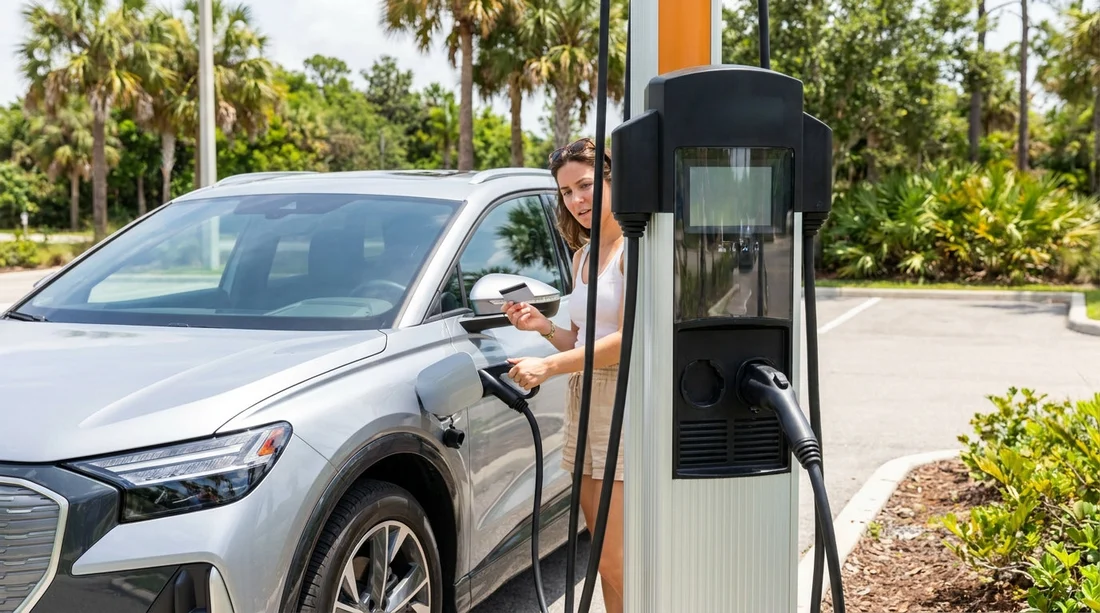
Driving an electric rental in Florida can be straightforward, but payment rules at public chargers can catch people out, especially if you are relying on debit only or a mobile wallet. The short, practical answer is that you often do not strictly need a physical credit card at the charger, but you usually do need a card based payment method somewhere in the process. Many networks ask you to add a card to an app, some offer tap-to-pay terminals, and a few locations support alternatives like fleet or membership accounts. Because you are using a rental car, there is an extra layer, you need to keep rental deposit rules and billing evidence in mind.
This guide focuses on what typically happens in Florida when you plug in at public charging stations, and what to do if you do not have a credit card available. If you are comparing US car hire options and airports, Hola Car Rentals’ pages like car hire at Tampa TPA and car hire at Newark EWR can help you understand provider requirements before you travel, even if your route begins outside Florida.
Do Florida public EV chargers require a credit card?
In most cases, Florida public EV chargers require a card backed payment method, but not always a traditional credit card inserted into a reader. You will commonly see three payment setups:
1) App-first networks: You download the network’s app, create an account, then add a payment card. The charger starts from the app or by scanning a QR code. In this setup, a credit card is common, but many networks allow debit cards too, and sometimes mobile wallets through the app.
2) Tap-to-pay or chip terminals: Some newer stations have a payment terminal on the unit. You can tap a contactless card or phone wallet. Again, it may be credit or debit, but a bank card is still required.
3) Membership or fleet access: Less common for visitors, these use a pre-arranged account. For a rental customer, this is usually only relevant if your employer has an account or if you are given a charging card by a programme.
So, do you need a credit card specifically? Often, no. Do you need card based payment capability? Usually, yes.
Debit cards, mobile wallets, and authorisation holds
If you use a debit card at a charger, be aware of authorisation holds. Charging networks may place a temporary hold to confirm funds, even if the final cost is lower. The hold amount can be noticeably higher than a typical short top-up, and it may take time to release, depending on your bank.
Mobile wallets can work well at tap-to-pay terminals, but they do not solve every issue. Some chargers rely on an app that requires a card number entry rather than a wallet token, and some payment terminals are sensitive to weak signal or hardware wear. In practical terms, if you are travelling with only a phone wallet and no physical card, you may find some chargers that will not cooperate.
For a rental car, the hold question matters twice. Your car hire agreement may already have a deposit hold on your card, and charging holds can stack on top. If you are budgeting tightly, it is safer to use a credit card with a higher available limit, or keep additional funds available when using debit.
How rental car policies affect EV charging payments
Public charging is usually paid by the driver directly, not by the rental company, unless you have a specific charging package in your rental agreement. Even then, many packages cover home network charging only or provide partial reimbursement rather than direct billing.
What matters is that many car hire providers prefer or require a credit card for the rental deposit, especially at airports. If your rental requires a credit card in the first place, then using the same card for charging is the simplest way to keep transactions consistent and to avoid declined payments due to fraud checks.
If you are comparing suppliers for US car hire, it can help to check location pages and brand options in advance. For example, you might compare requirements across providers shown on Enterprise car hire in Austin AUS or see different supplier approaches on Thrifty car rental in Dallas DFW, then apply those insights to Florida airport counters.
Practical ways to charge in Florida without a credit card
If you do not have a credit card, you still have options, but you will need to plan ahead. Here are workable approaches that usually succeed:
Use a debit card in the charging app: Many networks allow debit cards. Add the card before you start driving, so you are not troubleshooting in a hot car park with low battery.
Choose chargers with card readers: When your route allows, prefer stations known for tap-to-pay reliability. It reduces dependency on mobile signal and account logins.
Keep more than one payment method: Carry a second debit card if you can, or have a back-up wallet option. A declined payment when you are at 6 percent battery is not fun.
Charge earlier than you think you need: This is not just range anxiety, it is payment resilience. If you hit problems with one network, you have enough charge to reach another.
What to do at the charger: a step-by-step checklist
When you pull up to a public EV charger in Florida with a rental car, use this quick checklist to reduce payment issues:
1) Match the connector to your car: Ensure you are at the right plug type. Payment will not help if the connector does not fit.
2) Start the session the correct way: Some stations require you to authorise in the app first, others want you to plug in first. The screen prompts matter.
3) Watch for authorisation messages: If you see a pending amount higher than expected, that is often a temporary hold, not the final price.
4) Save the receipt: Take a screenshot of the session summary in the app, especially if the charger stops early or bills oddly.
5) End the session properly: Stop it in the app or on the charger before unplugging if required. This helps avoid idle fees.
Keeping costs predictable with a rental EV
To keep EV charging costs predictable in Florida, treat charging like tolls, small charges that can vary by location and time. Use the network’s pricing screen before you start, and prefer locations with clear per-kWh pricing where possible. If the price is per minute, charging speed matters, and some rentals may charge slower if the battery is cold soaked from heavy air conditioning use.
Also, keep your charging history organised. If you later see a pending hold that has not dropped off, you will want timestamps, session IDs, and the station location. This makes support queries faster, whether the issue is with your bank or the charging operator.
FAQ
Do I need a physical credit card at the EV charger in Florida? Not always. Many chargers let you pay via an app or contactless terminal using debit or a mobile wallet, but a card backed payment method is usually required.
Can I use a debit card to charge a rental EV in Florida? Often yes, but expect possible authorisation holds that temporarily reduce your available balance. If your rental deposit is also on debit, keep extra funds available.
Will the rental company pay for my public charging sessions? Usually no. Most public charging is paid by the driver directly, unless your rental includes a specific charging package in the agreement.
Why did the charger take more money than the session cost? It may be a temporary authorisation hold. The final amount usually posts later, and the hold is released based on the network and your bank’s processing times.
What is the safest way to avoid being stranded with payment problems? Set up at least two charging apps before driving, carry a back-up card, and charge earlier than necessary so you can reach an alternative station if needed.































































































