


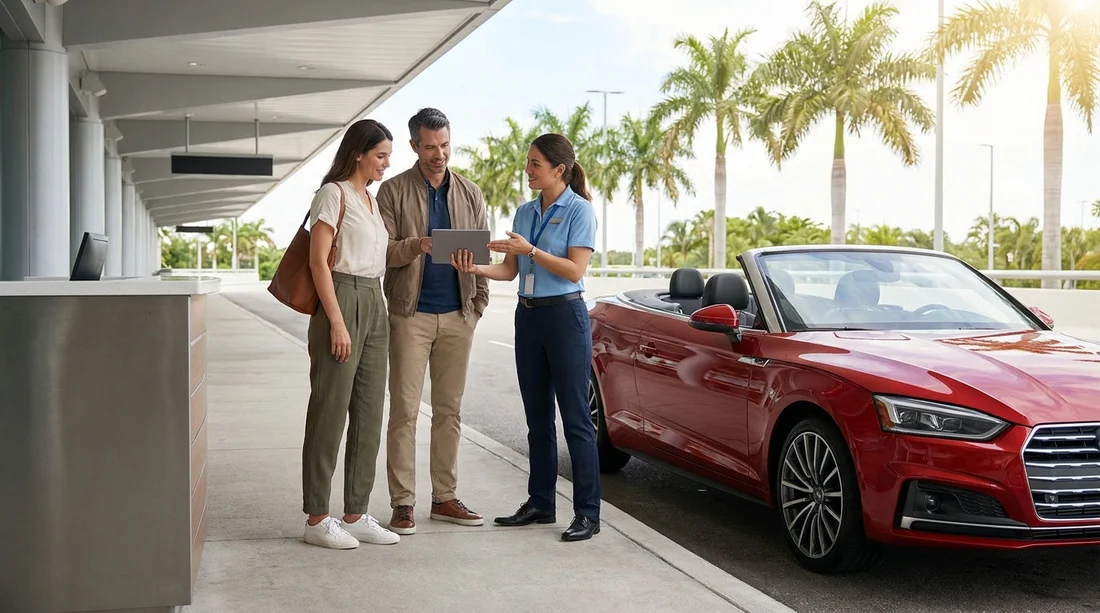
Quick Summary:
- A class upgrade can change LDW/SCDW excess, even if price barely changes.
- Ask for the updated rental agreement showing vehicle class, excess, and cover.
- Confirm whether your third-party policy or credit card cover still applies.
- Do not sign until excess amount and exclusions match your expectations.
Upgrading your rental car at the pick-up desk in Florida can be convenient, but it can also change the insurance excess you will be responsible for if the vehicle is damaged or stolen. Because car hire insurance is priced and underwritten around risk factors such as vehicle value, repair costs and theft exposure, a different vehicle class can trigger different Loss Damage Waiver (LDW) or similar damage cover terms, including a higher excess.
The key point is that an upgrade is not only a change in daily rate. It can also be a change in the product you are renting, and many suppliers tie their LDW or damage waiver conditions directly to the car class shown on the agreement. If you accept an upgrade verbally but do not verify the updated paperwork, you can accidentally agree to a different excess amount or different exclusions.
If you are collecting in Miami or nearby, it is common to be offered an SUV or premium upgrade due to availability. Even where the desk agent describes it as a small add-on, you should treat it like a new quote that needs re-checking. For reference, travellers using options such as Miami car hire may see several vehicle classes offered at the counter depending on season and fleet mix.
Why an upgrade can change the excess
The insurance excess (sometimes described as a deductible) is the amount you may pay if damage or theft is covered but not fully waived. In Florida car hire, LDW is often the relevant product affecting physical damage to the rental vehicle, while third-party liability is handled differently and can vary by supplier and package.
When you upgrade, the supplier may apply a different LDW tier. Here are common reasons the excess can change:
Higher vehicle value and repair costs. A larger SUV, convertible or premium model can cost more to repair, so the supplier may set a higher excess.
Different risk category. Some car classes are treated as higher risk for theft or damage. That can affect both excess and exclusions.
Different coverage bundles. The upgrade might be packaged with different inclusions. Sometimes it adds extra cover, sometimes it resets the cover to a default tier.
This is especially relevant when upgrading to an SUV in busy airport locations. If you are comparing classes around Orlando, it helps to understand that an SUV category may have different terms than an economy saloon, even when collected from the same desk, such as options shown on SUV rental in Orlando.
LDW, SCDW and what the desk is really changing
Terminology varies by supplier, but the underlying idea is similar. LDW may reduce or remove your financial responsibility for damage to the rental car, subject to an excess and exclusions. Some suppliers use additional products or names that resemble Super CDW (SCDW) where the excess is lowered further.
A pick-up upgrade can affect the following parts of the insurance arrangement:
Excess amount. The contract might show a new excess figure for damage and a separate one for theft.
Scope of cover. Glass, tyres, keys, towing, undercarriage, roof, interior or misfuelling are areas that can be excluded or treated differently by class.
Deposit and pre-authorisation. Even if the excess stays the same, the required security deposit can increase with a higher class.
For example, if you collect at Fort Lauderdale and accept an upgrade to a larger vehicle, it is sensible to check whether the deposit and excess rise at the same time. Supplier-specific terms can differ, so when comparing desk experiences, travellers sometimes review location pages like Enterprise at Fort Lauderdale to understand what is typical for that pick-up point.
What to confirm before signing the updated agreement
To avoid surprises, treat an upgrade as a change that must be confirmed in writing. Ask the agent to show you the revised rental agreement or the screen details before you sign. In Florida, the document you sign at the counter is usually the controlling record if there is a dispute later.
Focus on these checks:
1) Vehicle class and rate line. Make sure the class printed matches what you are being given, not just the model name the agent mentions.
2) Excess for damage and theft. Look for separate figures. If it only shows one, ask what applies for theft.
3) What cover is included, and what is optional. Ensure you understand if LDW is included, declined, or upgraded to a lower-excess option.
4) Exclusions and special notes. If you plan to drive on toll roads, park in public garages, or visit beaches, pay attention to keys, wheels, glass and underbody exclusions, which are frequent claim triggers.
5) Deposit amount and payment method. A higher class often requires a higher pre-authorisation on the card. If your credit limit is tight, this can matter as much as excess.
These checks apply whether you are picking up downtown or at an airport desk. Visitors starting a trip from central Miami can use references such as Miami airport and downtown car hire to compare pick-up styles, but the key is always the signed agreement in your hand.
How upgrades interact with third-party excess cover and card benefits
Many UK travellers rely on separate excess reimbursement insurance (bought independently) or credit card benefits to cover the excess they might owe to the rental supplier. An upgrade can affect whether that protection still works as expected.
Common pitfalls include:
Vehicle category restrictions. Some standalone policies exclude luxury, premium, large SUVs, vans, or certain high-value categories. An upgrade can push you into an excluded class.
Maximum vehicle value caps. If the upgraded vehicle exceeds the policy cap, claims can be reduced or refused.
Requirement to take supplier LDW. Many excess reimbursement policies assume you have the supplier’s LDW in place and only reimburse the excess charged by the supplier. If you decline LDW and rely on card cover, your third-party policy might not apply.
So, if you are offered an upgrade, it is not enough to ask “will the excess change?” You also need to ask “does my existing protection still apply to this class?” If you cannot confirm, it may be safer to keep the original class.
Practical checklist to protect yourself
Take a photo of the signed agreement. Ensure it clearly shows excess amounts, cover type, and the vehicle class.
Inspect the car and document condition. Upgraded cars can still have existing marks. Photograph wheels, glass, bumpers and the interior before leaving.
Ask for clarity on excluded damage areas. If glass and tyres are excluded, know what that means in costs.
Confirm toll device and admin fees. Upgrades sometimes come with different toll device setups or daily fees, which can affect overall cost more than expected.
Handled carefully, an upgrade can be a sensible comfort choice for Florida driving. The safest approach is simply to treat it as a contract change that can alter excess and conditions, then verify those details before you sign.
FAQ
Can my excess increase even if the upgrade is described as free? Yes. A no-charge upgrade can still move you into a higher-risk class with a higher excess or deposit. Always check the printed agreement.
Will LDW automatically transfer to the upgraded car class? Not always. Some suppliers apply LDW tiers by class. Confirm that LDW is still included and what excess applies for the new category.
If I have separate excess insurance, will it cover an upgraded SUV or premium car? It depends on your policy wording. Many policies exclude certain vehicle categories or values, so verify eligibility before accepting the upgrade.
What should I ask the counter agent to show me before I sign? Ask for the revised agreement showing vehicle class, damage and theft excess, LDW status, exclusions, and the new deposit or pre-authorisation amount.
Does upgrading affect liability cover in Florida? It can, but liability arrangements are often separate from LDW. Review the contract section covering liability and any supplemental liability products to confirm what you have.






























































































