


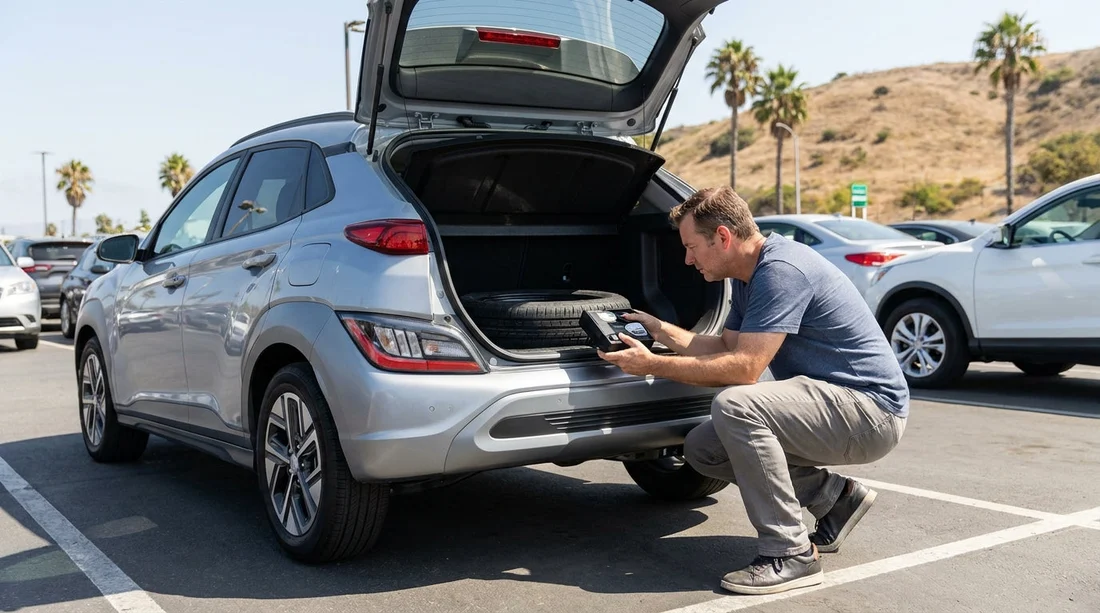
Quick Summary:
- Confirm whether you have a spare tyre, space-saver, or inflator kit.
- Locate the jack, wheel brace, locking key, and tow hook.
- Check spare pressure, sealant expiry, and compressor operation before leaving.
- Ask what roadside assistance covers for punctures and any call-out fees.
When you pick up car hire in California, a puncture is one of the most common disruptions to a road trip, yet the support you receive varies widely by vehicle type, rental brand, and even airport location. Some cars still carry a full-size spare, others have a space-saver, and many newer models rely on a sealant-and-compressor inflator kit. Your job at the counter is to work out what you have, where it is, and whether you can realistically use it on the roadside.
This counter-side checklist helps you confirm the essentials in a few minutes. If you are collecting at a major hub like Los Angeles LAX or heading north after San Francisco SFO, knowing your puncture plan can save hours, especially if you are driving into areas with patchy mobile coverage.
1) First question: spare tyre, space-saver, or inflator kit?
Before you load luggage, ask the agent to confirm what puncture equipment is supplied with that specific vehicle. Do not assume a spare exists because you see a boot well, and do not assume the inflator kit is present because the model usually has one.
Full-size spare: Best for longer distances because you can keep normal speeds and avoid handling issues. You still need to confirm it is inflated and accessible.
Space-saver spare (temporary): Common in car hire. It is narrower and designed for short distances only. Check the speed and distance limits printed on the tyre sidewall, then decide if it is workable for your route.
Sealant and compressor inflator kit: Often supplied when there is no spare. It can work for simple tread punctures, but it may not work for sidewall damage, larger holes, or a tyre that has come off the bead. Sealant also contaminates the tyre, and some repair shops will refuse to patch a tyre filled with sealant.
If your trip includes remote stretches, such as long desert drives or late-night arrival, you may prefer a vehicle that has a real spare. That can be easier to arrange when choosing categories like SUVs, for example when comparing options around San Diego SAN or other major airports.
2) Locate where everything is stored, and check you can access it
Many problems happen because the equipment exists but is buried under luggage, stuck beneath a cargo floor, or secured with fasteners you cannot open. At the vehicle, ask to see the storage locations and confirm you can reach them quickly.
Common storage places to check:
In the boot under the floor panel, in side compartments, under the rear cargo tray, beneath a third-row seat (SUVs), or in a foam insert that holds the compressor and sealant bottle. Some vehicles store the spare externally under the rear of the car, which can be awkward on dirty or uneven ground.
Also confirm: if the spare is clamped or chained, whether a key or special tool is required to lower it. If you cannot identify how it is released, have staff demonstrate it before you leave.
3) Tools checklist: jack, wheel brace, locking key, and tow hook
A spare tyre is only useful if you have the correct tools. Do a quick visual check that the following are present and look serviceable.
Jack: Confirm it is the correct jack for the vehicle and not missing parts. Some cars have a scissor jack, some have a bottle jack, and some provide an emergency jack only suitable for specific lifting points.
Wheel brace or lug wrench: Check it fits the wheel nuts. If the car has wheel covers, see whether you have a tool to remove the cover without snapping it.
Locking wheel nut key: Many cars have locking nuts. If the key is missing, you cannot remove the wheel. Ask where it is stored, often in the glovebox, centre console, or with the jack kit.
If you are picking up through a specific provider location, such as Hertz at LAX, you can still do the same checks, even if the counter is busy. It is normal to ask for a moment to confirm safety equipment.
4) Condition checks you can do in under two minutes
You are not performing a workshop inspection, but there are a few quick checks that reduce the chance of being stranded.
Spare tyre pressure: Spares often sit unused for months and can be under-inflated. If there is no reading available, ask staff whether they can verify pressure. A flat spare is a common and frustrating surprise.
Sealant expiry date: Sealant bottles have a printed expiry date. Expired sealant may not flow correctly or may fail to seal. If it is expired or missing, ask for a replacement bottle or different vehicle.
Compressor operation: Confirm the compressor is present and that the power connector matches the car’s sockets. Ask staff to show where the 12V socket is, as some are inside the centre console or load area.
5) Clarify roadside assistance for punctures, and potential costs
Policies differ, so it is worth clarifying the practicalities at the counter. Ask in plain terms: “If I get a puncture, do you send help, and is there a fee?” Make sure you understand what applies during opening hours and after hours.
Key points to confirm:
Whether puncture call-outs are covered by roadside assistance, whether you pay a service fee, whether you are expected to fit the spare yourself if one is supplied, and whether towing is included if there is no spare.
If you are collecting from a smaller airport or planning a one-way route, for example after arriving via Sacramento SMF, you should also confirm where you can exchange the vehicle if the puncture cannot be resolved quickly.
FAQ
Do all car hire vehicles in California come with a spare tyre?
No. Many modern vehicles provide only a sealant and compressor kit, and some carry a space-saver spare. Always confirm what your specific vehicle includes before departing.
Is a sealant inflator kit safe to use on the roadside?
It can be safe for small tread punctures if you follow the kit instructions and the tyre is not badly damaged. Do not use it for sidewall damage, large holes, or a tyre that has come off the rim.
What tool is most commonly missing or overlooked?
The locking wheel nut key. Without it, you cannot remove the wheel even if you have a spare. Check for it in the glovebox, console, or tool kit before leaving.
Can I drive long distances on a space-saver spare?
It is designed for temporary use only. Follow the speed limit printed on the tyre and keep distance short, then arrange a proper repair or replacement as soon as possible.
What should I do if the spare is flat or the sealant is expired?
Raise it immediately at the pickup location and request a replacement spare, new sealant bottle, or a different vehicle. It is best resolved before you leave the car park.






























































































