


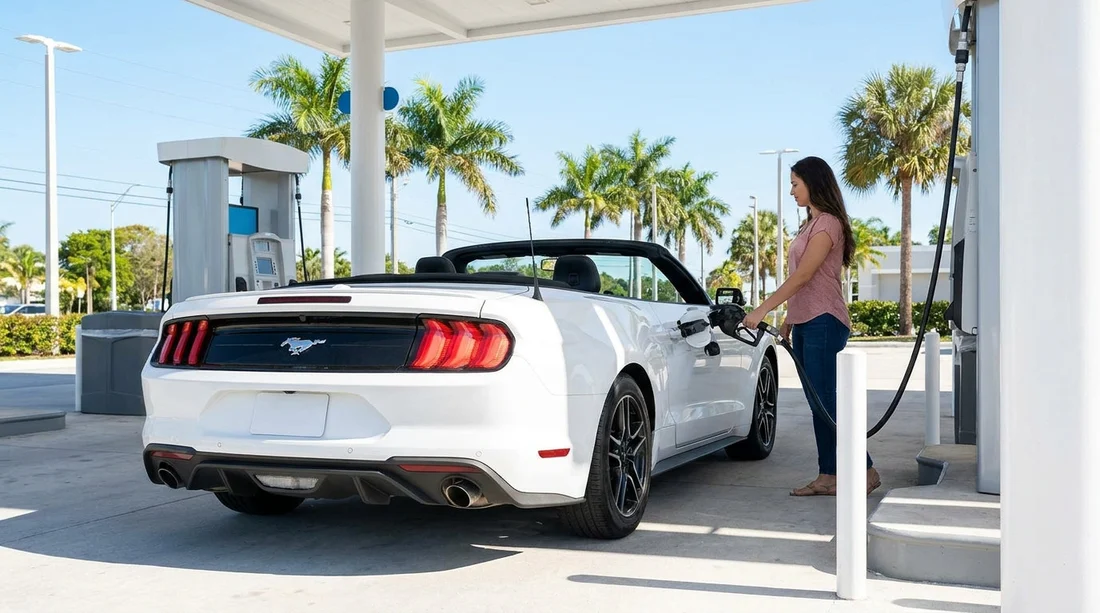
Quick Summary:
- Collect the car with a full tank and return it full.
- Refuel within five to ten miles of your return location.
- Keep a fuel receipt showing time, location, and gallons purchased.
- Check the gauge at pickup and report anything under full.
A full-to-full fuel policy is one of the simplest options on a Florida car hire booking. It means you receive the vehicle with a full tank of fuel, and you bring it back with a full tank. If you return the car with less fuel than you started with, the supplier may add refuelling charges, usually based on the missing fuel plus a service fee. Understanding what “full” looks like in practice, and how to prove you refuelled, is the best way to avoid surprises.
If you are arranging car hire around Miami International Airport, you will usually see full-to-full presented clearly in the booking terms, including what happens if the tank is not full at return. For location details and practical pickup planning, you can check car hire Miami MIA.
What counts as a “full tank” at pickup and return
In real-world terms, “full” should mean the fuel gauge is on the full mark, or the digital indicator shows all bars. Some vehicles will also estimate range, but range is not used to determine fullness because it changes with driving style and recent conditions.
Here is what typically counts as “full” on return:
Needle gauge: the needle should sit on or fractionally above the full line. If it is even slightly below, the system may read it as not full.
Digital bars: all bars should be lit. If you have one bar missing, even if the car seems fine, you could be charged.
Fuel warning lights: any warning light means you are nowhere near full, and charges are very likely.
What if the tank is not full at pickup? Do not assume you must absorb it. If the gauge shows less than full when you collect the car, note it with the desk agent before leaving, and take a time stamped photo of the dashboard. If the supplier uses a check-out report, ask for it to be updated so your return obligation matches what you received.
How refuelling charges are calculated and why they feel expensive
When a car comes back less than full, suppliers often charge in two parts: the cost of the missing fuel and a refuelling service fee. The per-gallon price can be higher than local pump prices, and the service fee can make small shortfalls disproportionately costly.
Costs and methods vary by location and supplier, so always read the specific fuel section of your rental agreement. If your trip includes Orlando, it helps to plan your return route and time, because queues and toll roads can change your last refuel plan. Location guidance can be found on budget car rental Orlando MCO.
Best practices to avoid refuelling charges in Florida
1) Refuel close to the return point. A good rule is to refuel within 5 to 10 miles of where you are returning. This limits fuel burn after filling up, especially with Florida traffic, stop lights, and airport access roads.
2) Keep your receipt. A receipt is not always required, but it is your simplest evidence if there is a dispute. Ensure it shows the station address, date, time, and gallons purchased. If the receipt is digital, keep the email or app record until the final invoice is settled.
3) Take a photo of the fuel gauge at return. Take it at the return lot, with the car powered on so the gauge is visible. This can support you if the return inspection is rushed or happens later.
4) Allow time for the last fill and return process. If you are late and rushing, you are more likely to skip the final top-up or choose an awkward station. Build in a buffer for finding fuel, traffic, and the return queue.
Common Florida scenarios that catch people out
Airport return loops and one-way roads. Around major airports you may be forced into one-way loops where it is difficult to exit for fuel. Decide on your refuelling station before you enter the airport approach roads.
Long idling in heat. In Florida, air conditioning use and idling can consume fuel. If you fill up, then sit in a long return queue with the AC running, the gauge can drop slightly, especially on smaller cars.
Different vehicle types. Bigger vehicles can burn more fuel on the final approach than you expect. If you are travelling with family and luggage, you might be looking at a people carrier. For trip planning and vehicle sizing, see minivan hire Florida.
What to check at pickup so the policy is fair
Before you drive away, take two minutes to confirm the basics on the agreement and the car:
Fuel level recorded: It should say “Full” or the correct fraction if not full.
Fuel type: Confirm whether the car takes regular unleaded, mid-grade, premium, or diesel. Putting the wrong fuel in is a different issue and can be extremely costly.
Location instructions: Know exactly where returns happen. Downtown and neighbourhood branches can have different return lanes than you expect. If you are staying near central Miami neighbourhoods, car rental Brickell can help you understand local pickup and return logistics.
What if you cannot return it full?
Sometimes it is genuinely difficult to refuel, for example if you are returning very early, or you are unfamiliar with the area. If you cannot return full, expect a charge. In that situation, it can still help to refuel as much as possible, because the charge is often based on the missing amount plus the fee.
If you believe you were charged incorrectly, gather your evidence first: receipt, photos, and the return time. Then compare what was charged to the terms on your agreement. Disputes are easier to resolve when you can show you refuelled close to return and the gauge read full.
Why full-to-full is usually the best fuel option for car hire
Full-to-full tends to be the most transparent because you control the fuel purchase and pay pump prices. It also encourages good habits that reduce extra fees: checking the car at pickup, planning your return route, and keeping receipts. For most Florida itineraries, from quick city stays to longer drives, it is a straightforward way to keep costs predictable.
FAQ
Q: Does full-to-full mean I will definitely get a completely full tank at pickup?
A: It should, and the contract normally states the recorded fuel level. If the gauge is below full, ask for it to be noted before you leave and take a photo.
Q: How close to the return location should I refuel in Florida?
A: Aim for within 5 to 10 miles. This reduces the chance the gauge drops due to traffic, idling, or detours on airport approach roads.
Q: What if the gauge shows full but I still get charged?
A: Use your fuel receipt and a photo of the gauge at return to query it. Charges can happen if the supplier records the level later or uses a strict reading.
Q: Is it enough to top up a small amount just before returning?
A: Often yes, if it brings the gauge back to full. A small top-up can be cheaper than a refuelling fee, even if it feels inconvenient.
Q: Can I return the car with more fuel than I collected?
A: Yes, but you are unlikely to be refunded for extra fuel. Full-to-full is designed so you pay for what you use, not to profit from overfilling.






























































































