


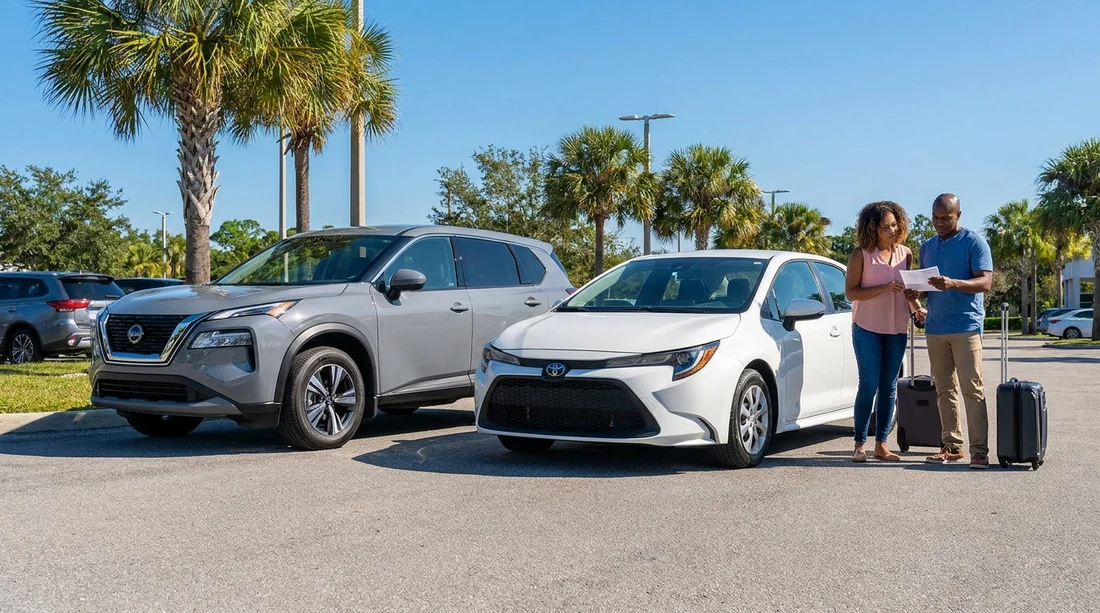
Quick Summary:
- Match class to passengers plus bags, not just the label.
- Compact suits light luggage, intermediate fits larger suitcases comfortably.
- Florida heat and highways make comfort, boot space, and power matter.
- Choose SUVs or minivans for car seats, beach gear, or longer drives.
US rental categories can feel confusing because the names are broad and the exact model is not guaranteed. When you arrange car hire in Florida, the label is best treated as a guide to cabin space, boot volume, and general comfort rather than a promise of a specific car. Two different “intermediate” cars can look quite different, but they should fit a similar number of people and bags.
Florida trips also have predictable demands. You may be driving at motorway speeds for long stretches, carrying beach chairs and coolers, or squeezing into tight parking in Miami Beach. Using the category labels in practical terms helps you avoid the two most common issues, a boot that will not take your luggage, and rear seats that feel cramped for adults.
If you are collecting near South Florida hotspots, you can cross check location pages while planning, such as car hire at Miami Beach Airport and car hire at Fort Lauderdale. The category guidance below stays the same whichever airport or neighbourhood you use.
How US category labels work, and why they vary
US fleets are grouped into size bands. The band name, such as compact or intermediate, is tied to a rough footprint and interior capacity. Within that band, rental companies may supply any model available that day. That means you should plan for the “or similar” part of the description. Focus on what you need to carry, then choose a band that typically delivers that capacity.
Another detail is that US cars are often offered as automatic by default, and many newer models are hybrid. That can affect boot shape and rear legroom. If you are travelling with tall adults, bulky pushchairs, or multiple large suitcases, prioritise a category up. The price difference is often smaller than the inconvenience of repacking in the car park.
Compact, practical for two adults and light luggage
Compact usually means a small saloon or hatchback sized car with enough space for two adults in comfort, and a third passenger for shorter journeys. The boot is the limiting factor. Expect room for about one large suitcase plus a cabin bag, or two small suitcases if they are not deep. If four adults are sharing, compact can feel tight, especially with luggage.
Typical models in this band include cars similar to a Toyota Corolla or Nissan Sentra depending on supplier and availability. In Florida, compact is a sensible choice for solo travellers, couples doing city breaks, or anyone who is prioritising easy parking and lower fuel spend. It is also a good option if you will mostly use the car for short hops and plan to pack light.
Intermediate, the sweet spot for many Florida holidays
Intermediate is a step up in cabin width and boot capacity. For car hire in Florida, it is often the most balanced choice for a couple with beach gear, or a small family. You typically get a slightly larger saloon that sits comfortably at highway speeds and offers better rear legroom.
Boot space is the big advantage. Intermediate commonly takes two large suitcases, or a mix of large and medium cases, plus a few soft bags. Typical examples are similar to a Toyota Camry or Hyundai Sonata. If you are doing an Orlando plus Gulf Coast itinerary, or you simply want breathing room, intermediate is a reliable baseline.
Full size and premium, comfort for longer drives and taller passengers
Full size generally means more shoulder room, a wider rear bench, and a boot that is easier to load without creative packing. If you have three adults in the back at any point, or you are doing longer drives like Miami to Tampa, the extra space reduces fatigue. Premium tends to add more features, but the key practical change is often comfort rather than pure capacity.
For airport collections where you might be arriving with several suitcases, moving up to full size can remove stress. If you are comparing brands, you can also review provider and location information, such as Avis car hire in Florida via Miami and Alamo car hire in Tampa, then apply the same size logic to the category list you see.
Standard, midsize SUV, and full size SUV, what changes in real life
SUV labels often cause the most disappointment because people assume every SUV is huge. In US rental terms, a standard or midsize SUV is frequently a two row SUV. It sits higher, can feel easier to drive in heavy rain, and usually has a square boot opening that suits coolers and folded pushchairs. However, third row seating is not guaranteed unless the category explicitly states it.
For luggage, a midsize SUV can be excellent for two adults and two children, and typically handles two large suitcases plus extras. The trade off is that if all seats are occupied by adults, you may not gain much room over an intermediate saloon, depending on the model. Full size SUVs are larger and can handle more gear, but parking and fuel costs rise accordingly.
Minivans and passenger vans, best for families and groups
If you need real people carrying ability, a minivan is often the most practical choice. They are designed for car seats, wide doors, and flexible seating. With the third row in use, luggage space can shrink, but the overall packaging is still very family friendly. If you have multiple car seats, the easier access can be worth more than the “cool” factor of an SUV.
For larger groups, you may be looking at a passenger van category. That is most useful when you truly need more seats and accept that the vehicle is larger to handle in city traffic. If you are staying around central Miami, it can help to check local options like van hire in Brickell and then confirm how many seats and how much luggage you can realistically carry on the days you will be driving.
Convertibles, fun in Florida, but plan around the boot
Florida is famous for convertible driving, but the practical limitation is luggage. When the roof is down, boot space can become shallow or partially blocked. If you are arriving with large cases, a convertible may require you to pack softer bags or plan to keep the roof up until you have dropped luggage at your accommodation.
Convertibles can also be noisier at speed and hotter at traffic lights. For short scenic drives they are great, but for long motorway days, a standard saloon or SUV can be more comfortable.
Choosing the right class, a simple Florida checklist
Start with passengers and suitcases. If you have two large suitcases for a couple, intermediate is usually the first category that feels effortless. Add children and beach gear and a midsize SUV or full size saloon becomes more comfortable. For three or four adults with luggage, consider full size or a larger SUV so nobody ends up with bags on laps.
Next, think about your route. City heavy plans in Miami Beach reward smaller footprints, while long intercity drives favour comfort and stability. Finally, consider what you will carry day to day. A cooler, foldable chairs, and shopping can quickly exceed a compact boot even if your airport luggage fits.
FAQ
Is “intermediate” bigger than “compact” for car hire in Florida? Yes. Intermediate generally offers more rear space and a larger boot, making it easier for two large suitcases and more comfortable on highways.
Will I get the exact model shown for a category? Usually not. You book a category, and the supplier provides a model in that category or similar, depending on fleet availability.
How many suitcases fit in a compact vs intermediate? Compact often fits one large suitcase plus a cabin bag comfortably. Intermediate typically fits two large suitcases, plus a few soft bags.
Do midsize SUVs always have seven seats? No. Many midsize SUVs are two row vehicles with five seats. Seven seats are more common in specific “seven passenger” or full size SUV categories.
What category is best for a family with car seats? A minivan is often the easiest for fitting and accessing multiple car seats, with flexible seating and wide doors for day to day stops.






























































































