


Quick Summary:
- Choose to pay in USD unless your card guarantees fee-free conversion.
- Decline dynamic currency conversion at pick-up to avoid hidden margins.
- Check your card’s FX fee, some add 2–3 percent.
- Keep receipts and note the chosen currency before signing any slip.
Travellers arranging car hire in Florida often face a last-minute question at the rental desk or card terminal: pay in USD, or let the machine convert the amount into your home currency. It can look convenient, especially when you see a familiar currency and a “guaranteed” exchange rate. In practice, that convenience can cost more than you expect.
This article breaks down what is happening behind the scenes when you are offered dynamic currency conversion (DCC) at pick-up, how that differs from your card issuer’s exchange rate, and when paying in USD is usually the safer option for predictable costs.
What “paying in USD” actually means
When you pay in USD, the rental company charges your card in the local currency. Your card network and issuer then convert the transaction to your billing currency on your statement. The conversion rate typically comes from Visa or Mastercard daily rates, plus any foreign exchange (FX) fees your card issuer adds.
For most UK and EU travellers, paying in USD is the default and usually the most transparent route, because you can separate the exchange rate from any issuer fees and you can compare them against your card’s published terms.
What dynamic currency conversion (DCC) is at the rental desk
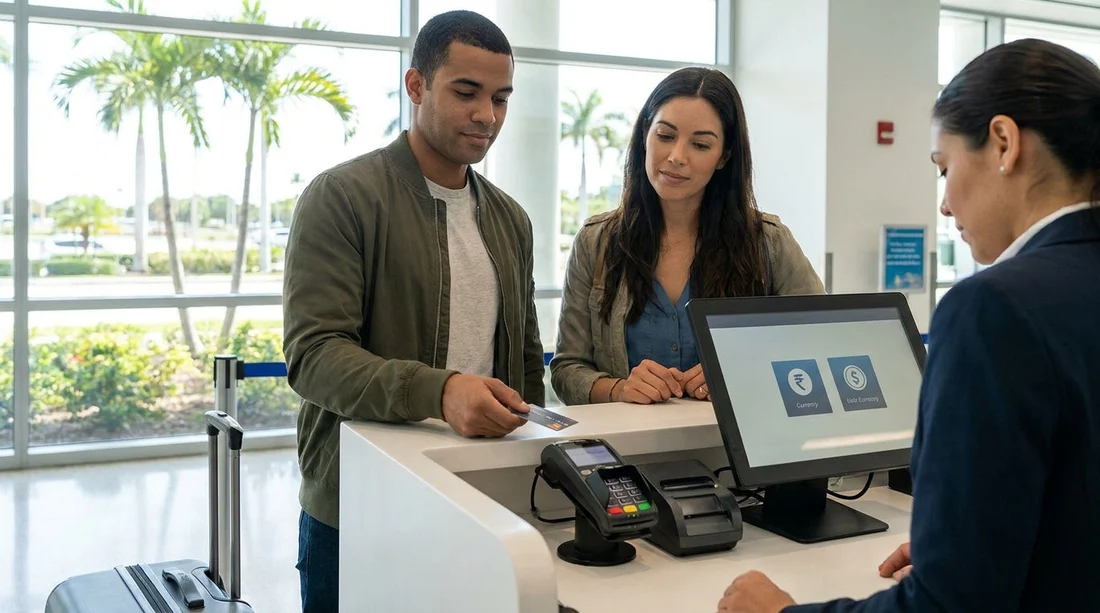
DCC is when the payment terminal or agent offers to charge you in your home currency instead of USD. You may see prompts like “Pay in GBP/EUR?” or “Convert now?”. If you accept, the conversion is done by the DCC provider, not your bank.
DCC rates often include an extra markup, sometimes presented as a “service” or bundled into the offered exchange rate. The screen might show a rate and a converted total, which feels reassuring, but that rate can be worse than your bank’s, and you may still pay card fees depending on your issuer’s rules.
Because DCC is decided at the point of sale, the choice is usually yours. The key is to recognise it quickly and understand that “guaranteed rate” does not mean “best rate”.
Why DCC can make Florida car hire more expensive
With DCC, the conversion spread is typically built into the exchange rate offered on the terminal. Even a small difference matters on higher totals, and car hire charges can be chunky once you include local taxes, optional extras, and deposits or pre-authorisations.
There are three common ways DCC increases your total cost:
1) Exchange rate markup. The DCC provider sets a rate that may be less favourable than the network rate your bank would have applied.
2) Confusing fee stacking. Some travellers assume DCC avoids card fees, but many card issuers still treat it as a foreign transaction, or the DCC markup simply outweighs any fee savings.
3) Deposit implications. If a deposit or pre-authorisation is converted using DCC, you can see bigger temporary holds in your home currency, and any release timing can complicate budgeting.
When letting your card convert can be the better choice
Although paying in USD is often the right default, there are situations where letting your card do the conversion still matters most, and those situations depend on your card, not the rental desk.
Paying in USD and letting your card issuer convert is usually best if:
Your card has low or zero FX fees. Many travel-focused cards charge 0 percent FX fees and use near-market conversion.
You want clearer dispute handling. Chargebacks and disputes can be simpler when the original transaction currency is USD and the merchant paperwork matches the rental agreement.
You want consistent pricing across locations. Whether you pick up near the airport or downtown, paying in USD keeps the currency decision consistent.
If you are collecting at Orlando International, it helps to know the basics in advance so you are not rushed. See practical pick-up context for car hire at Orlando MCO, where desk interactions are often fast-paced.
When paying in your home currency could make sense
Accepting DCC is rarely the cheapest, but it can make sense in limited cases where cost certainty is more important than optimising exchange rate.
Consider paying in your home currency only if:
You must lock the exact amount for expense claims. Some employers want a home-currency receipt amount at the time of purchase.
Your bank has unusually high FX fees. If your card charges 3 percent and your DCC markup is clearly lower, DCC might be competitive. You would need the DCC markup disclosed and comparable, which is not always clearly shown.
You are using a card with strict foreign-transaction controls. Some cards decline foreign currency charges more often, though this is less common today.
Even then, read the screen carefully. If the prompt says “I accept conversion” versus “I decline”, choose only after you have checked your issuer’s FX fee and the rate shown.
How to spot DCC at pick-up in Florida
DCC can appear in several places during car hire pick-up and drop-off. Look out for:
Card terminal prompts offering GBP, EUR, or another home currency. The safest choice for most travellers is selecting USD.
Verbal questions such as “Do you want to pay in pounds?” asked while the terminal is being prepared.
Receipts showing two totals, one in USD and one in your home currency, with wording like “DCC” or “converted amount”.
Email confirmations for extra charges after return, sometimes processed by a different terminal setting.
If you are travelling via Miami, where many visitors arrive from abroad and DCC offers can be common, it helps to be familiar with local collection patterns for car rental in Miami.
A simple decision framework for travellers
Use this quick framework before you arrive in Florida:
Step 1: Check your card’s FX fee. Look in your banking app or terms. If it is 0 percent, paying in USD is almost always preferable.
Step 2: Check your card type and network. Visa and Mastercard rates are usually competitive. Some prepaid cards have less favourable conversion or extra fees.
Step 3: Decide your priority. If you prioritise the best expected rate, choose USD. If you prioritise a fixed home-currency amount for paperwork, consider DCC only if the rate is clearly displayed and acceptable.
Step 4: Repeat the choice for extras. Fuel, toll products, upgrades, and late fees may be charged separately. Make the same currency choice each time to avoid confusion.
This is relevant across Florida, from Fort Lauderdale to downtown pickup points. If you are comparing options near Fort Lauderdale airport, you can see provider-specific pages such as Budget car hire at Fort Lauderdale FLL and Dollar car rental at Fort Lauderdale FLL, then apply the same currency logic at the desk.
Extra charges and deposits, where surprises often happen
Many complaints about unexpected costs are not about the daily rate itself, but about how additional amounts are presented and processed. Currency choice can amplify that confusion.
Deposits and pre-authorisations: A deposit may be held in USD. If DCC is applied, the converted amount might look larger than expected, and your bank may show a different final settled amount when the hold is released.
Tolls and admin fees: Florida routes often involve toll roads. If a toll product or admin fee is added later, it may be processed as a separate transaction, and DCC settings can differ from your original payment.
Upgrades and add-ons: If you change vehicle class or add a driver, confirm the currency choice again before you approve the updated charge.
The best protection is consistency. Pay in USD whenever you can, track what you agreed to, and keep itemised receipts so you can match charges to your rental agreement.
FAQ
Q: Is it always cheaper to pay for car hire in USD in Florida?
A: Not always, but it usually is. Paying in USD lets your card issuer apply its own exchange rate, which is commonly better than DCC, especially with low-fee travel cards.
Q: What should I press on the card machine to avoid DCC?
A: Choose USD as the transaction currency, or select the option to decline conversion. If unsure, ask the agent to process the charge in USD.
Q: Will my bank still charge an FX fee if I accept DCC?
A: Sometimes, yes. Even if the transaction shows in your home currency, your issuer may apply fees based on merchant location or processing rules, so check your card terms.
Q: Does DCC affect deposits or pre-authorisations?
A: It can. If a hold is converted at the terminal, the home-currency amount may include a markup, and the released or settled figures can be harder to reconcile on your statement.
Q: Can I change my mind after I have paid with DCC?
A: Usually no. Once processed, the currency choice is locked into that transaction. The practical approach is to decide in advance and watch for conversion prompts each time you pay.






























































































