


Quick Summary:
- Always request an itemised receipt showing every charge, waiver, and tax.
- Confirm the deposit, authorisation amount, and expected release timeframe in writing.
- Check toll, fuel, and added extras lines match what you agreed.
- Photograph the receipt and contract before leaving the Orlando counter.
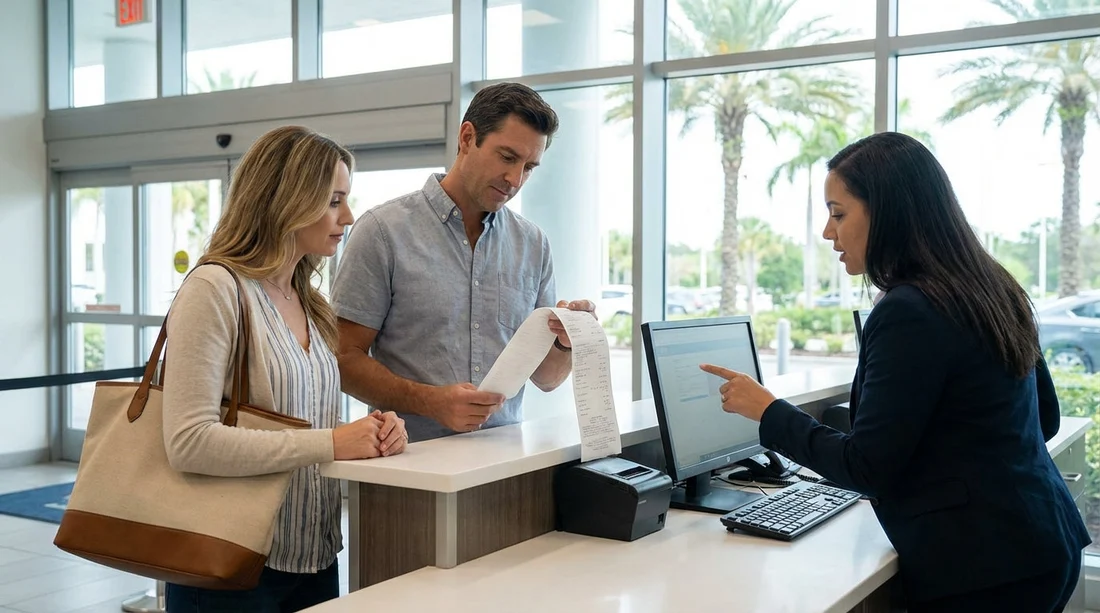
Yes, you should ask for an itemised receipt before leaving the car hire counter in Orlando. It is the simplest way to confirm what you are actually paying, what is only a temporary hold, and which optional products have been added. Many rental disputes are not about the driving at all, they start with a misunderstanding at the desk about waivers, toll programmes, fuel choices, and extras such as child seats.
An itemised receipt is different from a booking confirmation. The confirmation usually shows an estimated total, while the counter receipt shows the live charges created at pickup, including local taxes, counter-sold products, and any security deposit authorisation. If something is wrong, the best moment to fix it is before you walk away from the counter.
If you are collecting at the airport, the pace can be fast and the paperwork can feel rushed. For pickup at Orlando International Airport (MCO), it helps to know what should appear on the receipt and what language to look for. If you want to compare your desk paperwork with your original plan for car rental at Orlando airport, keep your confirmation handy and match each line item, not just the headline price.
What “itemised” should mean at the Orlando car hire counter
A proper itemised receipt should list every component separately, rather than one bundled figure. You want to see the daily rate, number of days, any weekly rate conversion, taxes and fees, and each optional product with its own price. It should also show the payment method used and whether any amount is an authorisation hold instead of a completed charge.
Ask for a printed copy or a clearly downloadable email receipt before you leave. If the agent says it will be emailed later, request it now anyway, because you need to spot issues immediately, while you are still at the desk and changes are easy.
The exact line items to check, and what they should look like
Below are the key categories that most often create surprises. Your receipt wording can vary by supplier, but the function is the same. If any line is unclear, ask the agent to explain it and show you where it appears in the contract.
1) Base rate, rental period, and “rate code”
Start with the fundamentals. Check the pickup and return dates and times, because even a small time difference can create an extra day charge. Confirm the vehicle class you booked, not just the model name, since “or similar” applies within a class. If you booked a smaller class and were upgraded, make sure the upgrade is clearly marked as free, not as a paid category change.
Typical receipt lines include daily rate, weekly rate, extra day, and sometimes “rate code”. Ensure the number of days charged matches your actual rental duration. This is especially important for Orlando trips where flight arrival and theme park schedules can shift.
2) Deposit and payment authorisation (security hold)
This is one of the most misunderstood receipt items. A deposit is usually an authorisation hold on your card, not money taken permanently. The receipt may show it as “Deposit”, “Security deposit”, “Auth”, or “Pre-authorisation”. You should check:
The amount, and whether it matches what you were told at the desk.
The currency, because your bank may show a pending amount in GBP converted from USD.
Whether it is separate from the rental total, or included as part of a larger authorisation.
Release timing, ask for the expected timeframe after return. The supplier initiates release, but your bank controls how fast it disappears.
If the deposit looks unusually high, it can be linked to waiver choices, age policies, or paying with a debit card. Get the amount confirmed in writing on the receipt or contract notes.
3) Waivers and insurance-related products
Receipts often include waiver lines that sound similar, but the costs and coverage differ. You should check what you have actually accepted, and what is included in your booking price versus added at the counter.
Common lines include Collision Damage Waiver (CDW), Loss Damage Waiver (LDW), Supplemental Liability Insurance (SLI), Personal Accident Insurance (PAI), and Personal Effects Coverage (PEC). Some suppliers bundle items under a package name. The key checks are:
Are any waivers optional? If you declined, the receipt should show them as “Declined” or not list a charge.
Is there a deductible or excess? Sometimes the receipt references it in small print or the rental agreement, not the price lines.
Does the daily cost match what was quoted? Even a small daily figure multiplies quickly.
Do you need the waiver given your situation? For example, if you already arranged coverage separately, you do not want duplicate products added by default.
If you are comparing options around Orlando, looking at your expected inclusions on a car rental Orlando MCO page can help you know what you planned to have before you arrived at the desk. The receipt is the final check that the plan and the counter paperwork match.
4) Toll options, toll transponders, and “convenience” fees
Central Florida toll roads are common, and toll products are a frequent source of counter confusion. Your receipt might show:
Toll programme (sometimes called Toll Pass, Toll Package, PlatePass, SunPass programme, or similar wording).
Daily toll fee plus taxes.
Per-toll convenience fee if you do not buy the package and use pay-by-plate billing.
Administrative fee for toll processing.
What to check: whether you opted into an unlimited style package, a daily fee programme, or a pay-per-use approach. Also confirm whether the toll device itself is an extra. If you will mainly be driving around Orlando and to theme parks, you might use toll roads often, but not everyone needs the same option. The crucial point is to ensure the toll line item reflects your choice, not the counter’s default.
5) Fuel policy and refuelling charges
Fuel is another area where a receipt saves you money. The receipt should state the fuel policy clearly, and any prepaid fuel product you accepted. Watch for these lines:
Prepaid fuel or “Fuel service option”, often a flat amount.
Refuelling service charge, a separate service fee if you return with less fuel than required.
Fuel per gallon/litre rate, which is often higher than local pump prices.
If you chose a full-to-full policy, the receipt should not include prepaid fuel. If there is a prepaid fuel amount and you did not agree to it, ask for it to be removed before you leave. Also confirm what fuel level is recorded at pickup, and check that it matches the gauge when you reach the car. If it is not correct, return to the booth or counter immediately and have it adjusted in writing.
6) Extras and add-ons (the items most often “accidentally” added)
Extras can be useful, but they are also easy to accept without noticing, especially after a long flight. Your receipt may list:
Additional driver, often per day.
Child seat or booster, typically per day, sometimes with a maximum cap.
GPS, less common now, but still offered.
Wi-Fi hotspot or “mobile hotspot”.
Roadside assistance or “road safe” packages.
Vehicle upgrade charge.
Return location fee if dropping off elsewhere.
Check each extra line against what you requested. If you did not ask for roadside assistance or a tech package, ask why it is there. If you need more space for family luggage, you might genuinely want a larger vehicle, but confirm that the vehicle class on the receipt matches what you are paying for. If you are comparing larger options, the pricing expectations for SUV hire in Orlando MCO or a van rental for Disney-area trips can help you sense-check whether an “upgrade” line makes sense.
7) Taxes, airport fees, and local surcharges
Orlando airport rentals often include multiple mandatory fees. These are not optional, but you should still review them because they affect the total, and because they can reveal that the contract is set up for a different location than you expected.
Look for lines such as airport concession recovery, facility charge, tourism or state taxes, and other local surcharges. The names vary, but the important point is consistency. If you are picking up at MCO, fees should align with an airport rental. If a line suggests a different pickup point, ask the agent to confirm the location code on the contract.
How to ask for the receipt, and what to do if something is wrong
Keep it simple and polite: ask for an itemised receipt that shows each line item before you finalise the agreement. Then read it, slowly, before you sign. You are looking for surprises, not just the total.
If you find an issue:
Ask for the line to be removed and reprint the receipt. Do not rely on verbal assurances.
Ask what you will see on your card today, versus what is only a hold.
Keep evidence. Photograph the printed receipt and the signed agreement, and keep the email version too.
If you feel rushed, remember that a few minutes at the counter can save hours of follow-up later. The agent can normally void and reissue paperwork immediately, but it is much harder once the rental has started.
A quick checklist to run through before you leave the counter
Use this mental checklist after you receive the itemised receipt:
Rental dates and times match your plan, including return time.
Vehicle class is correct, and any upgrade is clearly free if promised.
Deposit amount is understood, and you know release expectations.
Waivers match what you accepted, no unexpected daily add-ons.
Toll option is the one you chose, and fees are clear.
Fuel policy is what you intended, no prepaid fuel added unintentionally.
Extras only include what you requested, nothing else.
Total due today matches your understanding, separate from any authorisation.
FAQ
Do I always get an itemised receipt at an Orlando car hire counter?
Not always by default. You can and should request one that lists each charge separately, including any deposit authorisation and optional products.
Is the deposit on my receipt a real charge or just a hold?
Usually it is a pre-authorisation hold on your card. The receipt may show it as an authorisation or security deposit, and it should be released after return, subject to your bank’s processing time.
What toll line items are most important to check in Orlando?
Confirm whether you are enrolled in a toll package, a daily toll fee programme, or pay-by-plate billing. Check for additional administrative or convenience fees that can apply per toll or per day.
What should I do if prepaid fuel appears but I did not agree?
Ask the agent to remove the prepaid fuel line and reprint the paperwork before you leave the counter. Also confirm the fuel policy on the revised receipt and agreement.
Why does my total differ from my original quote?
Differences often come from added waivers, toll programmes, fuel options, extras, or local taxes and airport fees. The itemised receipt is the best way to identify the exact cause immediately.






























































































