


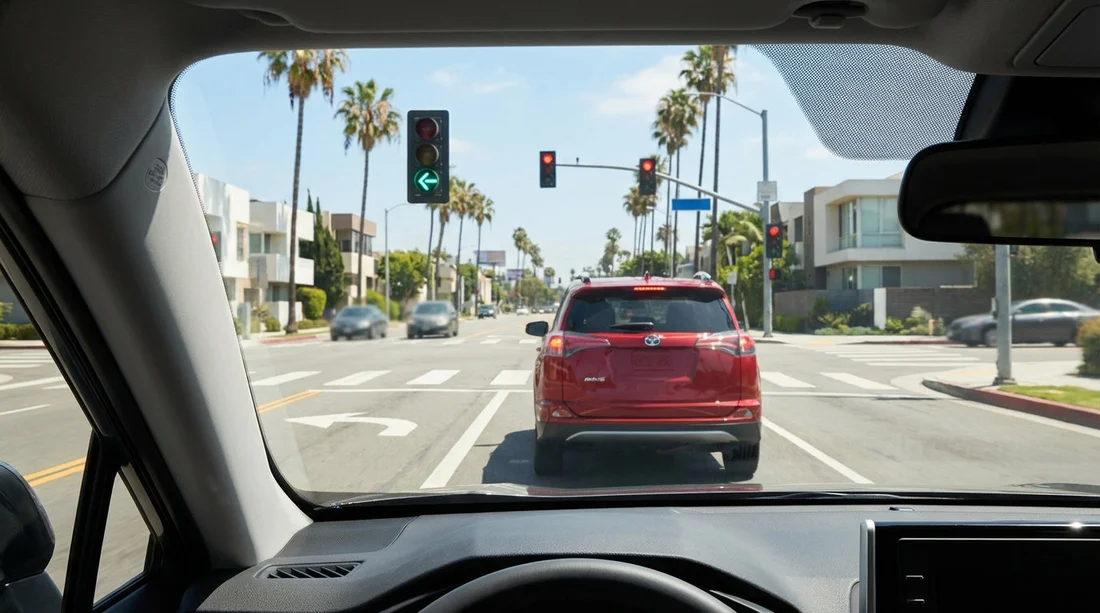
Quick Summary:
- A green arrow means a protected left turn, go when clear.
- A solid green is a permitted left, yield to oncoming.
- A flashing yellow arrow allows turning after yielding, no full stop.
- In LA, you may wait in the junction only when safe.
If you are new to Los Angeles roads, left turns can feel like the hardest part of driving. Between multiple signal heads, wide junctions, and fast oncoming traffic, it is easy to hesitate or move at the wrong moment. For anyone using car hire in Los Angeles, understanding the difference between protected and permitted left turns is one of the simplest ways to avoid near misses, horns, and tickets.
In plain terms, a protected left turn gives you a specific signal phase that stops oncoming traffic, so you can turn without yielding to opposing vehicles. A permitted left turn is the opposite: you are allowed to turn, but you must yield to oncoming traffic and pedestrians. Los Angeles uses several signal types to communicate which one you are dealing with, including the green arrow, solid green, and the flashing yellow arrow.
Many visitors pick up a vehicle at the airport and immediately face complex junctions on the way to the motorway. If that sounds familiar, information pages like Los Angeles LAX car rental can help you plan the pick-up and departure route, but once you are on city streets, signal knowledge matters more than route planning.
What does “protected left turn” mean in Los Angeles?
A protected left turn means you have the right of way to turn left because opposing traffic is being held by a red light. The signal that usually indicates this is a green arrow pointing left. When you see that left green arrow, you may proceed into the turn, but you still must check for pedestrians in the crosswalk and for any vehicles or cyclists unlawfully entering the junction.
Protected phases are common at busy Los Angeles arterials, near shopping areas, and at junctions with multiple lanes in each direction. Sometimes the protected phase is “leading” (it happens before the through traffic gets a green), and sometimes it is “lagging” (it happens after). You do not need to know the label, just watch what the signal is telling you right now.
Key point: protected does not mean careless. You still need to scan for pedestrians stepping off late, and for vehicles trying to beat their yellow or running a red.
What does “permitted left turn” mean in Los Angeles?
A permitted left turn means you are allowed to turn left, but only after yielding to oncoming traffic and pedestrians. In Los Angeles, this is commonly shown by a solid green circle (not an arrow). The solid green means you may go straight, turn right, or turn left, but the left turn is not protected. You must wait for a safe gap in oncoming vehicles.
This is where many visitors get confused: if you have a green light, it can feel like you have priority. You do not. On a permitted left, oncoming traffic also has a green and can legally proceed straight through the junction. Your left turn must fit into a safe opening.
Another common permitted scenario is where the signal gives oncoming traffic a green, and you are in a left-turn pocket with no arrow at all. You still follow the same rule: yield, then turn when it is safe.
Flashing yellow arrow: allowed, but you must yield
The flashing yellow arrow (FYA) is widely used in California and appears at more and more Los Angeles junctions. It means the left turn is permitted, not protected, and you must yield to oncoming traffic and pedestrians. The difference from a solid green is clarity: the signal is explicitly addressing the left turn lane.
When the yellow arrow is flashing, you do not treat it as a stop sign. You roll forward to a sensible waiting position, assess oncoming traffic, and complete the turn when there is an adequate gap. If you cannot safely turn, you continue to wait.
Be careful not to confuse a flashing yellow arrow with a steady yellow arrow. A steady yellow arrow means the protected phase is ending and you should not enter the junction unless you are already committed and cannot safely stop.
So when can I wait in the intersection in Los Angeles?
This is the question that causes the most uncertainty for drivers using car hire. In Los Angeles, it is generally normal driving practice to pull forward into the junction to wait when making a permitted left turn, but only when it is safe and only when you can complete the turn without blocking the junction. The idea is that you position yourself to turn as soon as a suitable gap appears, or as the light changes and oncoming traffic stops.
Here is the practical approach most local drivers follow at a typical junction:
1) If the light is green and you are turning left on a permitted signal, you may creep forward into the junction, keeping your wheels mostly straight while waiting. Keeping wheels straight reduces the risk of being pushed into oncoming lanes if you are rear-ended.
2) Yield to oncoming vehicles and pedestrians. Pedestrians can have the walk signal at the same time you have a green, and they have priority in the crosswalk you are turning into.
3) Turn when there is a safe gap. If no gap appears, you may still complete the turn at the end of the cycle after oncoming traffic stops for yellow then red, provided you entered the junction legally during green and the crosswalk is clear.
4) Do not enter if you cannot clear. If traffic is backed up beyond the junction, do not pull into the intersection and block it. Los Angeles enforces “do not block the box” behaviour, and blocking a junction can also create dangerous side impacts.
If you are first in line in a left-turn lane and the signal is solid green or flashing yellow arrow, waiting slightly forward is common. If you are not the first car, you usually wait behind the limit line until the car ahead moves. Trying to squeeze two cars into the junction on a single permitted phase is a classic near-miss scenario.
What you should do at each signal type
Green left arrow (protected): Proceed when the route is clear of pedestrians and any vehicle that might run the red. Keep your speed controlled, as some LA junctions have long crossings and late pedestrians.
Solid green circle (permitted for left): Yield to oncoming traffic and pedestrians. You may move into the junction to wait if you can still clear it safely. Turn only when there is a safe opening.
Flashing yellow arrow (permitted): Yield, then turn when safe. Expect oncoming traffic to be moving quickly. The flashing signal is telling you to judge the gap, not to assume protection.
Red arrow or red circle: Stop behind the limit line. A red left arrow specifically prohibits the left turn. Do not inch forward into the crosswalk, as this is a common ticket reason and puts pedestrians at risk.
Common mistakes in LA that lead to tickets or near-misses
Turning left on a stale yellow without enough space. Los Angeles drivers can be assertive, but the safest rule is simple: if you cannot complete the turn without forcing others to brake hard, do not go. Late acceleration on yellow is a frequent collision trigger.
Blocking the crosswalk while “waiting”. Wide junctions can make it hard to judge where the crosswalk begins. Stop behind the limit line, and if you pull forward to wait, ensure you are not sitting on the crosswalk markings.
Assuming a solid green is protected. This is the biggest visitor error. A solid green does not stop oncoming traffic. Treat every solid green left as a yield situation unless you have a green arrow.
Not scanning for pedestrians on the far side. In Los Angeles, pedestrians may start crossing late, and there can be two crosswalks involved in your turn. Your turn must not cut across people who have the right of way.
Overcommitting from the second position. Only the lead vehicle should typically be in the junction waiting for a permitted left. If you are second and you nose in as well, you may end up stuck when the signal turns red, increasing the risk of being side-swiped.
How LA junction design affects your left turn
Los Angeles has a mix of older, tight junctions and very wide multi-lane crossings. Width matters because it changes how long you are exposed to cross traffic, and how far you need to travel before you are out of the junction. It also affects how fast oncoming vehicles feel, especially on six lane boulevards.
Watch for these LA-specific patterns:
Dual left-turn lanes. If there are two left-turn lanes, stay in your lane through the entire turn. Cutting across the lane line mid-turn is a common cause of sideswipes. Choose your lane early based on where you need to be after the junction.
Dedicated left-turn pockets. Many major roads have a separate pocket so through traffic can continue. When the pocket is short, queues spill into through lanes. Be cautious with last-second lane changes.
Signals placed far forward. Some lights are on the far side of the junction, which can confuse first-time drivers. Focus on the signal that controls your lane at the stop line, not a distant signal meant for another approach.
Practical tips for car hire drivers in Los Angeles
If you are arriving after a long flight, your first hour of driving is often your most error-prone. Building a simple “left turn routine” helps.
Use a calm approach speed. Rolling in too fast makes it harder to judge gaps and pedestrians. A steady approach gives you time to read the signals, lane markings, and signs.
Leave extra space when waiting. If you pull into the junction to wait, leave space so you can adjust if a pedestrian steps off, or if an emergency vehicle appears.
Know your vehicle size. A larger SUV or van may need more turning radius and more time to clear the junction. If you are choosing a bigger vehicle for luggage or a group, bear in mind how it feels in tight turns. Hola Car Rentals provides options like SUV rental at LAX in California or van rental in California at LAX, and it is worth adjusting your driving margins accordingly.
Expect lane lines to guide you. Many LA turns have dotted or curved lane lines through the junction. Follow them rather than aiming for the quickest path.
Plan your first route to avoid repeated lefts. If you can, choose an initial route with more right turns or protected lefts while you acclimatise. This is a comfort tip rather than a rule, but it reduces stress.
If you are comparing providers for car hire, Hola’s Los Angeles and California pages can help you understand pick-up locations and typical vehicle categories, such as car rental in California at LAX and the UK-facing car hire in California at LAX.
One last scenario: “left on green, oncoming is stopped, can I go?”
Sometimes you will have a solid green circle, but oncoming traffic happens to be stopped due to congestion or a bus. That does not make your left turn protected, but it may still be safe to go if the oncoming lanes are truly stationary, you have clear sight lines, and the crosswalk is clear. The danger is that a motorbike or an accelerating car can appear from behind the stopped vehicles. If you cannot see, you cannot safely commit.
In Los Angeles, patience at permitted lefts is normal. Waiting through an extra cycle is frustrating, but it is better than forcing a turn that someone else has to avoid.
FAQ
What is the difference between protected and permitted left turns in Los Angeles? A protected left turn gives you right of way, usually via a green left arrow. A permitted left turn is allowed on a solid green or flashing yellow arrow, but you must yield to oncoming traffic and pedestrians.
Can I wait in the intersection for a left turn on a solid green? Typically yes, if you entered on green, are not blocking the crosswalk, and you can clear the junction safely. Do not enter if traffic ahead is stopped and you would be stuck in the box.
What does a flashing yellow arrow mean for a left turn? It means you may turn left after yielding. Oncoming traffic has the right of way, so you turn only when there is a safe gap and the crosswalk is clear.
Who has priority when I turn left and pedestrians are crossing? Pedestrians in the crosswalk have priority. Even with a green arrow, you must yield to people crossing the road you are turning into.
Is it legal to turn left when the light turns yellow or red? If you entered the junction legally on green while waiting to turn, you may complete the turn when it becomes safe as the cycle ends. Do not enter the junction on red, and do not accelerate into a late yellow without space.






























































































