


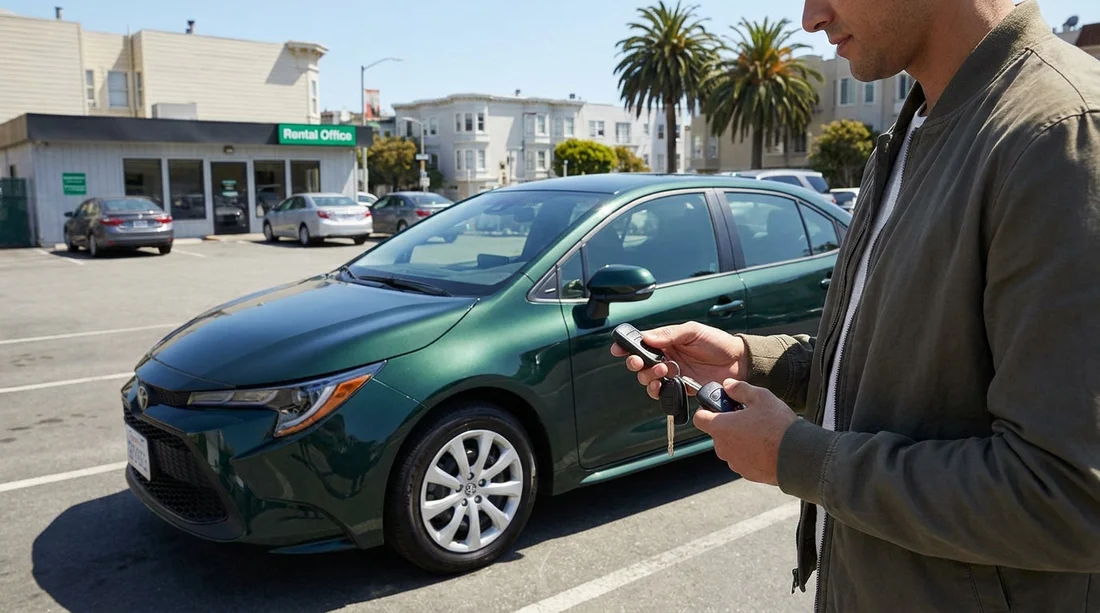
Quick Summary:
- Ask the agent to confirm the total keys and fobs issued.
- Test lock, unlock and boot release on every remote.
- Confirm keyless start works, and locate the emergency blade key.
- Photograph keys and paperwork, then store the spare separately.
In San Francisco, a missed spare key or an untested fob can turn a smooth pick-up into a stressful day. Lockouts often happen when a keyless fob battery is weak, when an emergency blade is missing, or when you only received one key and it ends up locked in the boot. The fix is simple, do a two minute “keys and remotes” check before you leave the car hire facility, while staff can still swap a faulty fob or correct paperwork.
If you are collecting at the airport, build this check into your routine alongside fuel level and damage photos. Many travellers pick up at San Francisco SFO, where it is easy to feel rushed by queues, shuttles and jet lag. A calm checklist is faster than returning later to sort missing items.
Step 1: Confirm exactly what the rental should include
Before you even walk to the car, ask the desk agent a specific question: “How many keys and how many remotes are included with this vehicle today?” Listen for a clear count. Some vehicles have two identical fobs, some have one fob plus a separate physical key, and some have a single fob only. You are trying to avoid assumptions like “one key is standard”, because standards vary by fleet, model year and supplier.
Then match the count to the paperwork. Your rental agreement may note “keys: 1” or similar, but not always. If the document is silent, ask for a written note on the check-out sheet or a quick update in the system. If you are comparing suppliers or locations, you might notice differences between car rental at San Francisco SFO and other Bay Area pick-up points, so treat the count as a pick-up specific detail.
Finally, ask whether there is an emergency key blade inside the fob, and whether any separate remotes exist, for example, a remote for an alarm, a remote start fob, or a separate boot remote. You are not being difficult, you are preventing the most common “I did not realise there was a second piece” scenario.
Step 2: Lay everything out and do a quick visual inspection
Stand by the car, out of the traffic lane, and place all received items in your hand or on the driver’s seat for a moment. Look for: condition issues (cracked casing, missing back cover, loose ring, or bent physical key), labels that should match the vehicle, and true duplicates if you were told you have two keys.
If anything looks fragile, ask for a replacement before leaving. A fob that is taped together may work now, then fail after a day in your pocket or bag.
Step 3: Test every button on every remote, twice
Do not assume a remote works because the LED lights up. Stand near the vehicle and test lock, unlock, and boot or trunk release on each fob. You do not need to set off an alarm in a crowded area, but you should know where the panic button is and avoid pressing it accidentally later.
Repeat with the spare fob if you have one. This is important because spare fobs are sometimes out of sync, have depleted batteries, or were never paired after maintenance. Testing now avoids discovering the spare is dead when the main fob is lost.
Step 4: Confirm keyless entry and keyless start behaviour
Modern rentals often use proximity keys. With the fob in your pocket, test keyless entry at the door handle, then sit in the driver’s seat and confirm keyless start works without warnings such as “Key not detected” or “Replace key battery”. If the car has a fob backup placement spot for low battery, ask staff to show you where it is.
In hilly parts of San Francisco, you may need to restart frequently after brief stops, so you want confidence the fob is reliable and recognised quickly.
Step 5: Locate and test the emergency blade key, and know the lock cylinder
Many key fobs contain a hidden physical key blade used to unlock the driver door if the fob battery dies. Pull it out and confirm it exists. Then locate the physical lock cylinder on the driver door. On some models it is hidden behind a small cap on the handle, and it is better to learn this now than during rain or at night.
You do not need to fully lock yourself out to test the blade, but you can insert it gently into the cylinder to confirm it fits and turns slightly. If the blade is missing, ask for it immediately. Without it, a flat fob battery can become a recovery call.
Step 6: Ask about add-ons that involve remotes or extra keys
Some extras change what you should receive. If the vehicle includes a transponder or parking gate remote, ask where it is mounted and whether you should remove it. Keep it separate from the keys so it is not lost.
For larger vehicles, the risk of locking keys in the boot during luggage loading is higher. If you are hiring a people carrier, check procedures carefully, especially with minivan hire at SFO, where sliding doors and powered tailgates add extra locking behaviours.
Step 7: Document what you received in a way that helps later
Take a quick photo of all keys, fobs and any tags next to the rental agreement or the vehicle’s stock number. This helps if you later need to explain that you only received one key, or if a tag goes missing. Photograph both sides of each fob if there are labels or codes.
Also note the fob battery warning status on the dashboard if it appears. If a “low key battery” warning shows at pick-up, ask for a new battery or replacement fob before you go. It is faster to fix at the counter than during a day trip.
Step 8: Store keys to prevent lockouts, especially during San Francisco stops
Once you have confirmed everything works, separate the spare from the primary fob, and never place keys in the boot while it is open. Some vehicles auto-lock when you walk away, so test whether your car does this and do not leave the fob on the seat while you step out.
If you are travelling beyond San Francisco, the same habits help at other Bay Area locations. Pick-ups near San Jose SJC can involve busy car parks too, so it is worth standardising your routine wherever you collect.
Step 9: What to do if you only have one key
Sometimes only one key is available. If that happens, ask the agent to note in your reservation that only one key was issued, understand who to call if it is lost or locked inside, and adjust your plan so one person keeps the key at all times.
Different suppliers handle key policies differently, so if you are comparing options for future trips, reading location pages such as Enterprise car hire in San Jose can help you understand pick-up expectations across the region.
FAQ
Q: Should I insist on a spare key for my car hire in San Francisco? A: You can ask, but availability depends on the fleet and supplier. If only one key is issued, make sure it is noted and store it carefully to avoid lockouts.
Q: How do I know if the fob battery is weak before leaving? A: Test lock and unlock from a short distance, then check for dashboard warnings during start-up. If range is poor or warnings appear, request a replacement fob or battery.
Q: What is the emergency key blade, and why does it matter? A: It is a hidden physical key inside many fobs that can unlock the driver door if the battery dies. Confirm it is present and locate the door lock cylinder before driving away.
Q: Can the boot lock with the keys inside on keyless cars? A: Yes, some vehicles will still lock, especially if the fob is in luggage or shielded. Keep the fob in a pocket and never place it in the boot during loading.
Q: If a remote does not work at pick-up, what is the quickest fix? A: Return to the desk or attendant immediately and request another fob or a different vehicle. It is much easier to resolve on-site than after you have left the facility.






























































































