


Quick Summary:
- Stronger waivers can lower the deposit hold taken at pick-up.
- Declining LDW or SCDW often leads to a higher pre-authorisation.
- Holds are temporary, but they reduce available credit for days.
- A named credit card speeds checks and helps prevent counter delays.
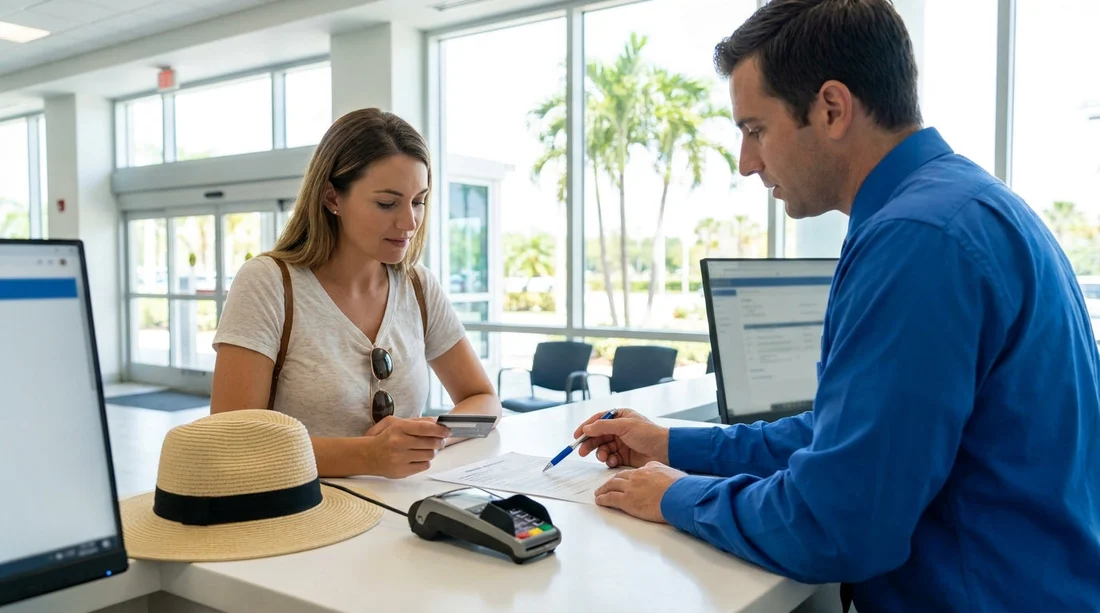
When you arrange car hire in Florida, the price you see online is only one part of the payment flow. At pick-up, the rental company normally places a temporary pre-authorisation, also called a deposit hold, on the main driver’s payment card. This hold is not a charge, but it reduces your available credit limit until it is released after the rental ends.
Two of the biggest factors that can change that hold are the waiver choices you make, especially LDW (Loss Damage Waiver) and SCDW (often an additional or “super” level of collision damage waiver offered by some suppliers). Understanding how those options change risk for the supplier helps explain why the hold can rise or fall, and why Hola asks for a credit card to keep pick-up smooth.
What a credit-card deposit hold is, and why it exists
A deposit hold is the supplier’s way of managing potential costs that could arise during your rental, such as damage responsibility, theft exposure, fuel, extra days, tolls, and administrative fees. In Florida, where rentals often involve airports, highways, toll roads, and higher utilisation fleets, suppliers are particularly consistent about taking a pre-authorisation.
Because a pre-authorisation uses your credit limit, it is easiest to manage on a credit card. Debit cards can work in some situations, but they can require extra checks, higher holds, or additional documentation. That is why Hola emphasises a credit card for the main driver, to reduce the risk of queueing, re-processing, or even having to amend the rental conditions at the counter.
LDW explained in practical terms
LDW is commonly described as a waiver that limits what you pay if the vehicle is damaged or stolen. It typically reduces your financial exposure to an excess, rather than making it unlimited. Importantly, LDW is not always included by default in every offer, and it can be bundled differently depending on supplier and station rules.
From a deposit perspective, the key point is this, if you have less protection, the supplier is exposed to a higher potential claim against you. To balance that risk, they may increase the pre-authorisation. If you have stronger cover, your expected maximum liability is lower, so the hold can sometimes be lower too.
What SCDW usually changes compared with LDW
SCDW, where offered, is generally an added layer that reduces your excess further, sometimes close to zero for damage, subject to terms and exclusions. If LDW takes you from unlimited risk to a capped excess, SCDW often takes you from a higher excess to a much smaller one.
Because the hold is often aligned with your maximum likely out-of-pocket exposure, selecting SCDW can reduce the amount the supplier needs to block on your card. That does not mean it always will, because some suppliers apply a fixed deposit regardless, or keep a separate fuel and toll buffer. Still, waiver level is one of the most common reasons two travellers with the same vehicle category see different hold amounts at the same counter.
How waiver choices affect the pre-authorisation amount
Although each supplier sets its own policy, deposit holds are commonly influenced by a combination of vehicle value, rental length, driver profile checks, and waiver level. Waivers matter because they change the remaining financial exposure. Here is how it typically plays out in Florida car hire scenarios:
1) Declining LDW or taking minimal cover
When LDW is declined, or when only a basic package is accepted, the supplier may treat your liability as higher. That can lead to a larger pre-authorisation, sometimes aligned to a higher maximum claim, or a policy-defined “no waiver” deposit level.
2) Taking LDW only
With LDW accepted, the supplier can generally cap your exposure at an excess amount. The deposit hold may reflect that excess plus a buffer for fuel, tolls, or incidentals. In many cases, this is the standard, mid-range hold level.
3) Taking LDW plus SCDW
When SCDW reduces the excess substantially, the supplier may only need to hold a smaller amount for damage liability, while still holding a separate buffer for fuel and toll processing. The result is often a lower total hold, although the final amount still depends on station rules and the vehicle group.
4) Premium vehicles and larger groups
For SUVs, people carriers, or higher-value vehicles, holds can be higher even with strong waivers, because incidentals and policy minimums scale with value and risk.
If you are comparing options for arrivals near Miami, the station conditions can differ between downtown and airport locations, and those differences can affect both waiver availability and deposits. For an overview of local options, see car rental at Miami MIA and the broader guide to car hire in Florida.
Why Hola requires a credit card, and how it prevents pick-up delays
At the counter, the supplier must confirm three things quickly, identity, licence eligibility, and payment capability for the pre-authorisation. A credit card in the main driver’s name is the most straightforward way to do this, because it supports pre-authorisations reliably and provides a clear credit limit for the temporary hold.
When a traveller arrives with only a debit card, prepaid card, or a card not in the main driver’s name, several delays can happen. The agent may need additional checks, alternative deposit methods, or may need to adjust the waiver choice to meet station rules.
Florida locations that handle high volumes, such as major airports, are often strict because consistency keeps queues moving. If your itinerary includes Miami or nearby urban pick-ups, it can help to review the station-specific information provided during the booking flow. You can also browse options by area, such as car hire near Brickell or SUV hire in Miami Beach.
Timing, releases, and why the hold can feel bigger than expected
Even when the hold amount is reasonable, it can affect your trip budget because it reduces available credit immediately. The release timing is not controlled solely by the supplier. After the vehicle is returned and the final charges are closed, the supplier sends a release, but your card issuer decides when the available balance updates. That can take a few days, and sometimes longer after weekends or bank holidays.
This is another reason waiver choices can matter. If SCDW reduces the hold, it can free up more available credit for hotels, flights, and incidental spending during your Florida holiday. On the other hand, if you decline waivers and the hold increases, you might find your card limit becomes tight even though no extra charge has been taken.
Practical ways to reduce surprises with Florida car hire deposits
First, decide what level of financial exposure you are comfortable with, then look at waiver choices accordingly. If you prefer predictable out-of-pocket risk, LDW plus SCDW, where offered, often leads to a lower liability figure and can reduce the hold.
Second, check your card’s available credit limit before travel, and remember it needs to cover both the rental cost and the pre-authorisation. If you are travelling as a couple or group, ensure the card belongs to the main driver named on the rental, as third-party cards commonly cause delays.
If you are collecting on the Gulf Coast, note that some station policies vary by region and supplier brand. For Tampa-area options and local conditions, see Payless car hire in Tampa.
FAQ
Does choosing SCDW always reduce the deposit hold in Florida? Not always. It often reduces the damage-related portion of the hold by lowering your excess, but some suppliers use fixed deposits or keep separate buffers for fuel, tolls, or incidentals.
What happens if I decline LDW and rely on my own insurance? The supplier may still apply a higher pre-authorisation because their own waiver is not in place. Your separate insurance can help with reimbursement later, but it may not change the counter deposit policy.
Why does Hola insist the main driver brings a credit card? Credit cards support pre-authorisations consistently and are widely accepted for deposits. This avoids extra verification steps that can slow pick-up or lead to changed terms at the counter.
How long does the pre-authorisation stay on my card after return? The supplier typically releases the hold after closing the rental, but your bank controls when your available balance updates. It can take several days, especially around weekends.
Can the deposit be higher for an SUV even with LDW and SCDW? Yes. Higher vehicle value and category rules can increase minimum deposits and buffers. Larger vehicle groups may carry higher holds even when waiver levels are strong.






























































































