


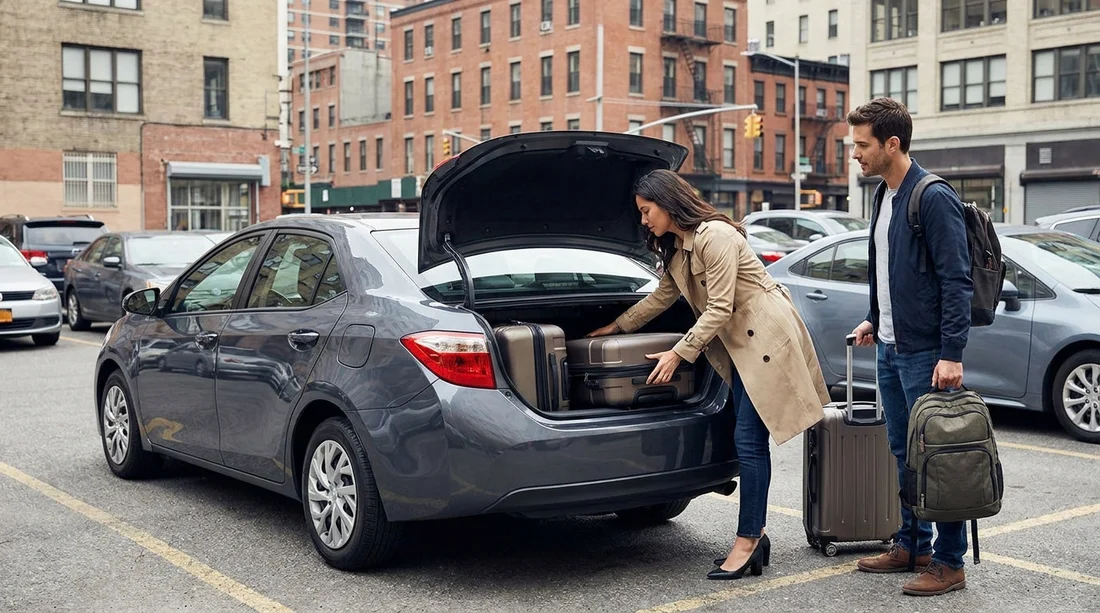
Quick Summary:
- Measure your largest suitcase and compare it with the boot opening.
- Open the boot and check depth, height, and wheel arch space.
- Confirm rear seats fold and the luggage cover removes quickly.
- Do a two-minute load test, then repack for safe rear visibility.
Picking up a car hire in New York often happens when you are tired, in a hurry, and juggling bags on a busy forecourt. That is exactly when a boot that looks fine in photos turns into a problem, especially with large hard-shell suitcases, pushchairs, or multiple carry-ons. A few simple checks at the desk and at the vehicle can prevent an awkward repack in the car park or, worse, driving off with luggage wedged unsafely in the cabin.
The goal is a quick sanity-check, not a perfect geometry lesson. You want to answer three questions before accepting the keys: will the biggest items physically pass through the boot opening, will everything fit without blocking the rear view, and can you load it in a way that stays stable during stop-start city driving.
If you are collecting near the airports, your options can vary a lot by provider and vehicle group. For location specifics and typical fleets, you can compare pick-up points such as car hire at New York JFK or nearby alternatives like car hire at Newark Airport (EWR), where the mix of saloons, SUVs, and people carriers can differ.
Step 1: Know your luggage dimensions before you arrive
The fastest way to confirm boot fit is to stop guessing. Before you travel, note the length, width, and depth of your largest suitcase, plus one awkward item like a stroller, instrument case, or oversized backpack. Many travellers only think in litres, but boots are limited by openings, wheel-arch intrusions, and sloping tailgates.
Record the biggest bag dimensions in centimetres. A quick phone note like “Large case 78 x 50 x 30 cm” is enough. Include the wheels and handles.
Identify non-stackable items. A pram, rigid cooler, or golf bag often dictates the entire packing strategy. If one item must lie flat, note its longest side.
Consider how many people are in the car. A boot that fits four cases with the rear seats folded will not help if you need five seats in use.
If you suspect you need extra space, comparing vehicle categories in advance can help set expectations. For larger loads, it can be useful to look at options like van hire at New York JFK or, if you prefer ride height and a more squared-off cargo area, SUV rental at Newark (EWR).
Step 2: At the counter, confirm the exact vehicle, not just the class
Vehicle classes are broad. Two cars in the same group can have very different boots due to battery placement (hybrids), sloping saloon boots, or a compact spare wheel bulge. Before you walk to the car, ask for the model and whether it is a hatchback, saloon, or SUV. You are not being difficult, you are avoiding a mismatch.
Is it a hatchback or a saloon? Hatchbacks typically have wider openings and more flexible loading. Saloons can have deep boots but small openings.
Is it a hybrid or plug-in? Some have reduced boot depth due to battery packs.
Can the rear seats fold? Some vehicles have fixed rear seats or limited split-fold functions depending on trim.
If you are selecting by supplier at JFK, pages like Avis car rental at New York JFK can help you understand likely vehicle types you might be offered, which makes your boot expectations more realistic.
Step 3: Do a fast boot opening and shape check at the vehicle
Once you are at the car, open the boot before you load anything. You are looking for the real constraints: the narrowest point of the opening, the height under the parcel shelf, and the usable depth before the back seats. City cars can have deceptively shallow floors, while some SUVs lose height due to sloping tailgates.
Boot opening width: Look at the tightest point, often where the tail lights protrude. If your largest suitcase is wide, this is the first pass-or-fail measurement.
Boot lip height: A high lip makes heavy cases harder to lift and can force you to angle bags awkwardly.
Wheel arch intrusion: Some boots look big until you notice the arches take up the sides, limiting rectangular cases.
Parcel shelf or luggage cover: Check whether it can be removed easily. Leaving it in place can cut usable height for stacked bags.
Spare wheel tools and warning triangle: Make sure these are secured, so they do not rattle into your luggage.
Step 4: Verify seat-fold options and how they affect your passengers
Seat folding is the difference between “fits easily” and “does not fit at all”. However, the detail matters. A 60/40 split lets you carry long items while still seating one passenger in the back. A full-fold only might force you to choose between luggage and a rear seat passenger.
Split configuration: Confirm whether it is 60/40, 40/20/40, or a single-piece fold.
Folding mechanism: Some cars fold from the boot using levers, others require releasing from inside the cabin.
Flatness of the load floor: A flat floor is easier to pack tightly. A stepped floor leaves gaps that let bags slide.
Headrests and seatbelts: Make sure headrests do not block the fold, and seatbelts are not trapped where they could fray.
If you are travelling with more than two people, aim to keep all luggage in the boot area where possible. Bags in the cabin can become projectiles during sudden braking, which is common in New York traffic.
Step 5: Do a two-minute load test before you accept the car
A load test is the most reliable method, and it does not need to be messy. Load your two biggest pieces first, because they dictate the packing geometry. Then add medium bags, then soft items that can fill gaps. If it does not work quickly, it probably will not work later when you are on-street in Manhattan with cars honking.
1) Place the largest suitcase flat, wheels first. Try both orientations, and note whether the boot will close without compressing the lid.
2) Add the second-largest case beside it. If wheel arches block side-by-side placement, try stacking only if the parcel shelf is removed.
3) Test closing the boot gently. Do not slam. If you have to force it, the fit is not safe.
4) Check rear visibility. With the boot closed, sit in the driver’s seat. You should still have a usable rear mirror view, even if the back window is partially obstructed.
5) Shake test for stability. With luggage packed, gently rock a bag. If it shifts easily, repack tighter or use the boot’s tie-down points if available.
If you cannot fit luggage without blocking essential visibility, ask for a different vehicle before you drive off. It is usually easier to change in the pick-up area than after you have exited the facility.
What to do if the boot is too small
If the luggage does not fit during the load test, stay calm and keep it practical. First, confirm you have removed any parcel shelf and checked the underfloor storage. Next, try a safer re-pack: heavy cases low and forward, soft bags on top, nothing loose. If it still fails, request a different vehicle type at the location.
Doing these checks takes minutes, but it can save an entire trip from starting with frustration. With a little preparation, you can accept a car hire in New York knowing your luggage will fit safely and sensibly before you drive off.
FAQ
How can I estimate boot space if I do not know the exact car model? Note your largest bag dimensions, then prioritise vehicles with hatchback-style openings or SUVs. At pick-up, confirm the body style and do a quick load test before accepting.
Is boot opening size more important than boot volume? Often, yes. A deep boot with a narrow saloon opening can block large hard-shell cases. The opening’s narrowest width is a common limiting factor.
Can I rely on “one large bag per passenger” claims? Treat them as rough guidance. Bag shapes vary, and wheel arches or a sloped tailgate can reduce usable space. Always check with your actual luggage.
What if my luggage only fits with rear seats folded? Only accept that solution if you still have enough seats for your group and the load is stable. A split-fold seat can be a good compromise, but confirm it works in practice.
Should I place any luggage in the passenger cabin? Ideally keep luggage in the boot. If you must use the cabin, put soft items low on the floor behind a front seat, never on seats where they can slide forward during sudden braking.






























































































