


Quick Summary:
- Check the booking inclusions for “charging cable”, “EVSE”, or “adaptor”.
- Message the supplier to confirm cable type, connector, and any deposit.
- At the counter, request the equipment list and inspect the boot.
- Photograph cable details, then note missing items before leaving the bay.
When you arrange EV car hire in San Francisco, the biggest practical worry is simple: will the charging cable be in the car when you arrive. Some rentals include a portable charging cable as standard, others provide it only on request, and a few may not supply one at all because they expect drivers to use public fast chargers.
The best way to avoid surprises is to confirm the cable situation twice: once during booking, and again at the counter and pick-up bay. That double-check matters in San Francisco because your first driving day may include steep hills, traffic, and a hotel without charging. Knowing whether you have a cable, and which one, helps you plan charging stops and avoid paying for an unnecessary add-on.
Understand what “charging cable” can mean for EV rentals
Before you try to confirm anything, it helps to know the typical equipment categories. Rental staff may use different terms, and your voucher may be brief.
A “charging cable” can refer to a portable AC cable (often called an EVSE) that plugs into a wall outlet, or a Type 1 or Type 2 cable used for AC charging at destination chargers. In the US, most EVs use a J1772 connector for AC charging (Tesla can use an adaptor). For DC fast charging, you normally use the charger’s built-in cable, so the rental does not need to supply one.
Ask yourself how you plan to charge. If you rely on fast charging in the city, a missing cable might not stop you immediately. If you plan to charge overnight at an Airbnb, a workplace, or a hotel with AC sockets, having the correct cable or adaptor matters.
What to check in your booking confirmation and rental voucher
Your first confirmation point is the booking flow and the post-booking voucher. Look for a section labelled “Included”, “Inclusions”, “What’s in the car”, or “Equipment”. Some systems list EV items under “Special equipment” even if there is no extra fee.
Scan for keywords such as “charging cable”, “charge cable”, “EV cable”, “EVSE”, “portable charger”, “J1772”, or “adaptor”. If the booking simply says “Electric vehicle” or “EV”, do not assume that means a cable is included.
If you are collecting at the airport, it can help to compare supplier details on a location page while you review your reservation. For example, the Hola Car Rentals page for San Francisco SFO car hire is a useful reference point for pick-up planning, hours, and where questions are typically handled.
Also check for any mention of “optional extras”. Some suppliers list a charging cable as an optional paid item with a per-day price, a flat fee, or a refundable deposit. If it appears there, you should treat it as not included unless your order summary clearly shows it selected at zero cost.
Questions to ask before you arrive at the counter
If your documents are unclear, confirm in writing before travel. Most suppliers can answer via email or their customer messaging system. Keep the reply, as it can help at pick-up.
Use precise questions that force a clear yes or no:
Ask whether the specific vehicle category you booked comes with an AC charging cable or EVSE in the boot. Ask which connector is provided (J1772, Tesla adaptor, or other). Ask whether the cable is guaranteed or “subject to availability”. Ask whether there is a separate charge for the cable, and whether any deposit applies.
Finally, ask what happens if the cable is missing at collection, such as whether they can swap you to another EV that includes one, provide a cable at no cost, or document a “missing accessory” so you cannot be charged later.
At the counter in San Francisco, confirm the equipment on the contract
When you reach the desk, treat the cable like you would a child seat or sat-nav: it should appear on paperwork if it is supplied. Ask the agent to check the vehicle’s accessory list and to note the cable on the rental agreement or check-out sheet.
Be careful with vague statements like “it should be in there”. Ask them to confirm whether it is included in your rate, or whether you are being offered a paid extra. If it is paid, ask them to show the price and return conditions in writing. This is where confusion can creep in, especially at busy times.
If you are using Hola Car Rentals to compare options, it can help to look at supplier-specific pages for context on how pick-up works. For example, Budget car hire at San Francisco SFO may have different desk procedures than other brands, even when the vehicle class appears similar.
Do a physical check at the pick-up bay before you drive away
Even if the counter says the cable is included, you still need to verify it is actually in the car. Do this before you exit the garage, while staff are nearby and it is easy to log an issue.
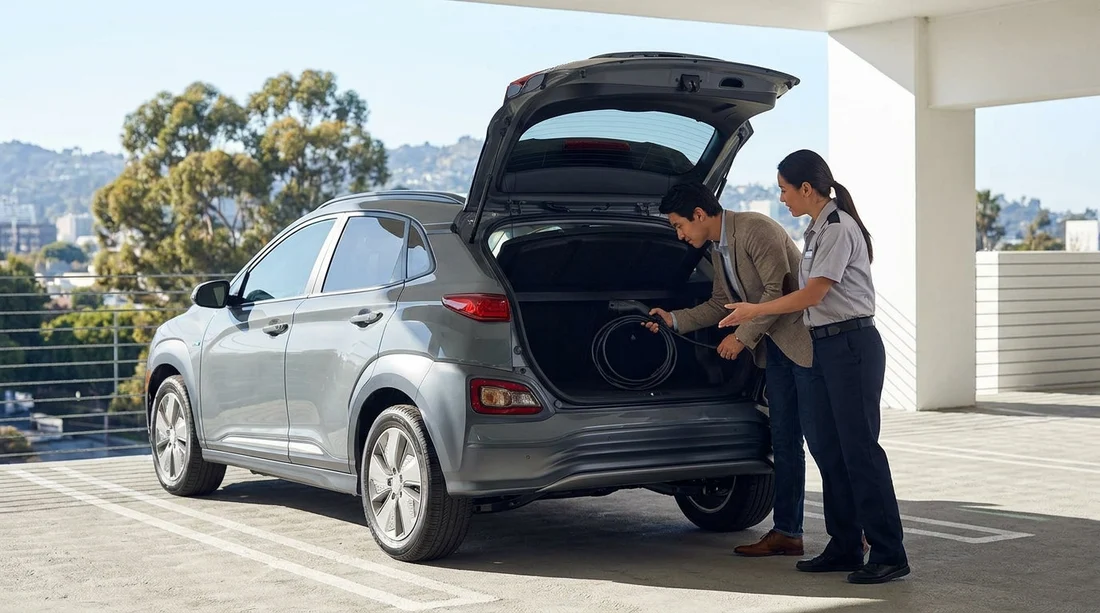
Open the boot and look under the floor panel and in the side compartments, which is where cables are commonly stored. Check for two things: the cable itself, and any adaptor that might be needed for the car’s charging port. If the car is a Tesla, ask explicitly whether a J1772 adaptor is included, as this can be essential for many AC charging stations.
Inspect the cable for obvious damage and confirm the plug type matches what you will use. If you are unsure, photograph the connector ends and the label on the cable bag. If there is any doubt, return to the booth immediately rather than dealing with it later in the city.
Document everything to prevent return-time disputes
Accessory disputes often appear at return. A cable is easy to misplace, and some suppliers charge for missing equipment. The simplest protection is documentation taken at pick-up.
Take a timestamped photo of the cable in the boot, plus a photo showing the cable bag label or part number if visible. If there is an accessory checklist on the contract, photograph that too. If the cable is missing and the supplier says they will “note it”, ask to see the note on your agreement, or request a printed or emailed addendum.
If you are travelling beyond San Francisco, you may also pick up or drop off in the wider Bay Area. Planning pages like car hire in San Jose SJC and car hire at San Jose airport SJC can help you think through where you will have time to check accessories properly.
Know when a cable is less critical, and when it is essential
In San Francisco, many EV drivers depend on DC fast charging, which uses the station’s tethered cable. If your itinerary is mostly urban and you have easy access to fast chargers, a missing portable cable is inconvenient but not always trip-ending.
A cable becomes essential if you plan to use Level 1 charging from a standard socket, if your accommodation provides AC charging without a tethered lead, or if you expect to park at a destination charger that requires you to bring your own cable. If that describes your trip, confirm cable inclusion before you land, and build in time at pick-up to verify it.
Also think about compatibility. A cable that is technically “included” is only useful if it fits the car and your charging options. Confirmation is not just about presence, it is about the right connector and any adaptors.
FAQ
How do I know from my booking whether the EV charging cable is included? Look for an inclusions list on your confirmation or voucher. If “charging cable”, “EVSE”, or “adaptor” is not explicitly listed, treat it as unconfirmed and request clarification in writing.
Is a charging cable always required to charge an EV rental in San Francisco? Not always. DC fast chargers have their own cable. You typically need a cable or adaptor for AC charging at some hotels, rentals, or destination chargers.
What should I ask the counter agent to write on my paperwork? Ask them to note that a charging cable and any adaptor are provided, or to note that the vehicle was collected without them. Written notes reduce the risk of being charged later.
Where is the charging cable usually stored in the vehicle? Common places include the boot under the floor panel, side storage compartments, or a dedicated cable bag. Check these areas before leaving the pick-up bay.
What if the cable is missing when I collect the car? Report it immediately and request a replacement cable, a different EV, or a written note confirming the accessory was not supplied. Do not leave until the situation is documented.






























































































