


Quick Summary:
- LDW usually covers collision damage costs, not roadside assistance charges.
- Towing after a covered accident may be included, but many limits apply.
- Lockout help and replacement keys are typically charged, even with LDW.
- Flat tyres, wheel damage, and tyre replacement are commonly excluded items.
When arranging car hire in California, it is easy to assume that Loss Damage Waiver (LDW) will handle anything that goes wrong with the vehicle. In reality, LDW is designed to limit your financial responsibility for damage to the rental car bodywork after a covered incident. Assistance-related costs, such as towing, lockouts and flat tyres, often sit in a different bucket. They may be excluded, capped, or covered only in specific circumstances.
This matters because roadside events are common on long drives, especially if you are exploring coastal highways, desert routes, or busy city parking. The key is to separate three ideas: damage coverage (LDW), roadside assistance (a separate product or service), and administrative or service fees (which can apply regardless of coverage).
If you are comparing options through Hola Car Rentals for different California pick-up points, the practical checks are the same whether you collect near San Francisco Airport or Los Angeles LAX. Read the policy wording for what counts as “damage”, what counts as “assistance”, and what is charged as a “service call”.
What LDW typically covers on a California rental
LDW is not insurance in the traditional sense, it is usually a contractual waiver offered by the rental company. If the vehicle is damaged or stolen and the situation is covered, LDW reduces or removes the amount you must pay, sometimes leaving an excess depending on the package.
In typical California car hire terms, LDW is mainly focused on physical damage to the rental vehicle from a collision, vandalism, or other covered loss. It may also address theft of the vehicle itself. However, it often excludes damage to particular components such as tyres, wheels, glass, roof, underbody, interior, and accessories unless you have an enhanced waiver or a separate protection product.
Another important point is that even when LDW applies, some costs can still remain. Examples include loss of use charges, diminished value, administrative fees, or towing/storage costs. Some packages include these, some do not. You need to check the wording, not just the headline “LDW included”.
Towing: when it might be covered, and when it usually is not
Towing is one of the most misunderstood areas. Many renters hear “LDW covers damage” and assume “LDW covers towing”. In practice, towing can be treated in two very different ways depending on why the vehicle needed to be towed.
Towing after a covered accident: If the car is not drivable after a collision and the incident is covered under LDW, the towing that results from that accident may be included, or it may be charged then reimbursed depending on the provider and documentation. The deciding factors are often whether the accident is reported properly, whether you were driving in permitted areas, and whether the damage is covered.
Towing due to mechanical issue, misuse, or being stuck: If the car needs towing because the battery is flat, the vehicle is stuck in sand, a warning light appears due to driver error, or you have used the wrong fuel, LDW usually does not help. This is not “damage from a covered loss”, it is an assistance or misuse scenario. Even where the breakdown is not your fault, towing may be handled under roadside assistance terms, not LDW.
California road trips sometimes include remote areas where towing costs are higher. Before you travel far from cities, check whether you have 24/7 roadside help, what the call-out rules are, and whether towing is covered only to the nearest authorised location. If you are collecting through San Jose Airport for a Silicon Valley start then heading to national parks, these details can make a big difference.
Lockouts and keys: typically excluded from LDW
Lockouts are rarely treated as vehicle damage. A locksmith call-out, roadside dispatch, or replacement key is generally classed as a service fee. LDW normally does not cover it, even if you have comprehensive damage protection.
Key-related charges can include the cost to send help, the cost of a new key or fob, and time-based fees if the vehicle is immobilised. Some modern keys are expensive and may require programming. If the key is lost, some companies also charge for towing the vehicle to a location that can supply or code a replacement.
To reduce risk, confirm whether the rental includes roadside assistance that covers lockouts. Also check any rules about leaving keys in the vehicle, some contracts treat that as negligence, which can invalidate waivers for any related loss. If you are travelling with family and lots of stops, a simple routine helps: keep the key on your person, and avoid locking the car while it is running.
Flat tyres and wheel damage: one of the most common exclusions
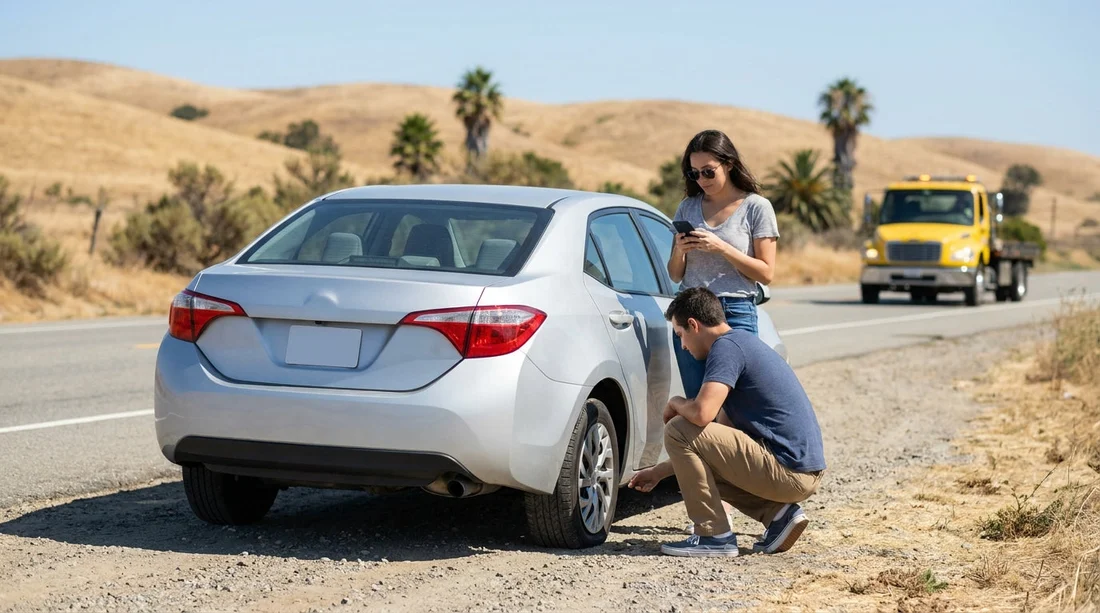
Flat tyres are a frequent pain point on California car hire because they can involve several different charges: repair or replacement of the tyre, damage to the wheel, towing, and the service call to fit a spare or bring a replacement vehicle.
In many rental terms, LDW excludes tyres, wheels, and rims. That means you can still be charged for a tyre replacement even if you have LDW. If the flat tyre also damages the rim, that may be excluded too, or treated separately. Even where the tyre itself might be covered under a premium package, the labour or roadside dispatch may not be.
Some cars have no spare tyre and rely on an inflator kit. If you get a puncture that cannot be sealed, you may need towing or a vehicle swap, which returns you to the towing question. This is why it is worth checking what equipment the vehicle provides and what the roadside process is.
Roadside assistance versus LDW: how to separate the products
Think of LDW as protection against the cost of damage to the rental vehicle, and roadside assistance as help with getting you moving again. They are related but not the same, and they are often sold separately.
Roadside assistance programmes may cover lockouts, jump starts, flat tyre service, and towing for mechanical issues, sometimes with limits. The limits matter, for example, “towing up to 10 miles”, “one service call per rental”, or “only for manufacturer defects”. If you only have LDW, you could still pay for each roadside event out of pocket.
When reviewing options, consider the kind of driving you will do. City-based trips with secure parking have different risks than long highway drives between Santa Ana and coastal areas. Your best approach is to line up the likely problems, then see which product addresses them, rather than assuming LDW handles everything.
What to check before you finalise your California car hire
Before you confirm your car hire, focus on the wording for LDW and any roadside cover, and ask yourself a simple question: “If I need towing, if I am locked out, or if I get a flat, who pays and who sends help?” Then verify the answer in the documentation.
Key items to verify include: whether tyres and wheels are covered, whether towing is covered only after an accident, whether lockouts are covered, the phone number and process for roadside calls, limits on towing distance, and any requirements for police reports after accidents. Also check permitted driving areas, because off-road or beach driving can invalidate cover and lead to costly recovery fees.
If you are choosing between vehicle types, remember that larger vehicles can have higher tyre and towing costs. If you are considering a people carrier option such as a minivan from LAX, make sure you understand the spare tyre situation and any roadside limits.
FAQ
Does LDW cover towing on a rental car in California? Sometimes, but usually only when towing results from a covered accident. Towing for breakdowns, being stuck, or misuse is commonly excluded and handled under roadside assistance or charged to you.
If I lock the keys in the car, is that covered by LDW? Typically no. Lockouts are usually treated as a roadside service and charged as a dispatch or locksmith fee, even when LDW reduces your liability for collision damage.
Are flat tyres covered by LDW in California car hire? Often they are excluded, along with wheels and rims. You may be charged for repair or replacement, and roadside assistance may cover the service call only under certain limits.
What should I do if I get a flat tyre or need towing? Use the rental company’s official roadside number and follow their instructions. Unauthorised towing or repairs can lead to unreimbursed costs, even if you have protection products.
Is roadside assistance the same as LDW? No. LDW focuses on damage liability for the vehicle, while roadside assistance covers help such as towing, jump starts, lockouts, and tyre service. They may be sold separately and have different exclusions.






























































































