


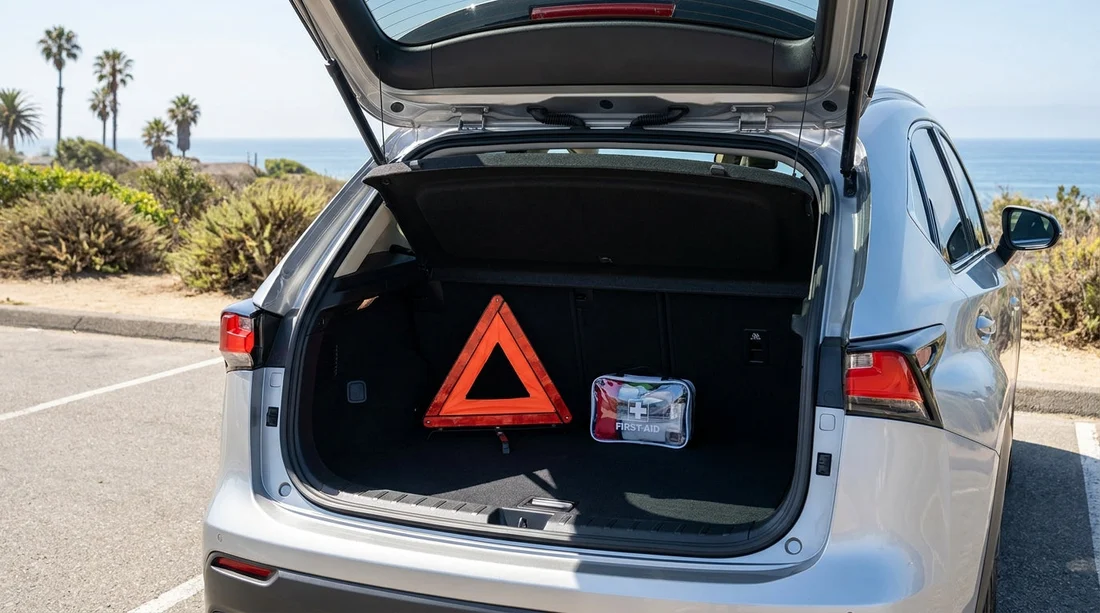
Quick Summary:
- Assume triangles and first-aid kits are not standard in California.
- Check the boot and glovebox before leaving the car hire lot.
- Ask the counter to note missing safety items on your agreement.
- Consider buying a basic kit locally if your trip is remote.
Many travellers arrive in California expecting a rental car to come with the same mandated safety gear found in some other countries. In practice, California car hire policies are different. A warning triangle or a first-aid kit might be available in certain fleets, but they are not universally included, and you should not rely on them being in the vehicle by default.
This guide explains what safety items are typically provided with a hire car in California, what is usually optional, and what to check at the counter and in the vehicle before you drive away. The aim is simple, reduce surprises, avoid inconvenience on the roadside, and make sure your trip meets your own comfort level for preparedness.
Are warning triangles or first-aid kits required in California?
In California, passenger vehicles are not commonly required to carry a warning triangle or a first-aid kit as standard equipment for private driving. That is the key reason many car hire vehicles do not automatically include them. Rental companies generally focus on supplying legally required equipment and items needed to operate the car safely, rather than providing extra roadside gear unless it is part of a specific programme or vehicle type.
That said, requirements can vary by vehicle category and use case. Commercial vehicles may have different obligations, and some companies choose to include warning devices in certain models or locations. For a typical holiday rental, treat triangles and first-aid kits as optional extras you may need to source yourself.
What safety items are typically included with car hire in California?
While triangles and first-aid kits are uncertain, most California car hire vehicles will include the basics you would expect for normal operation and everyday safety. You should still verify these items before leaving, because missing gear can turn a minor issue into a major delay.
Commonly included items are the vehicle’s standard spare tyre or a tyre inflator kit, a jack and lug wrench if a spare is provided, and the manufacturer’s owner information. Some vehicles use run-flat tyres or sealant kits instead of a full spare. This matters if you are planning long drives outside major cities.
You should also expect working hazard lights, functional seat belts in every seating position, and adequate lighting. These are part of the vehicle condition rather than loose equipment, but they are crucial for roadside visibility if you have to stop unexpectedly.
If you are collecting a vehicle near a major airport, the turnaround between rentals can be quick. Whether you are picking up near Los Angeles LAX or San Francisco SFO, it is worth building a few extra minutes into your pick-up time for a proper walkaround and cabin check.
What is usually optional or not provided?
In California, warning triangles and first-aid kits are often not provided at all, or they may be available only on request. Other items that are commonly optional include reflective vests, battery jump starters, tyre pressure gauges, and emergency blankets. Even when a hire car contains one of these items, it can be missing after the previous renter used it and did not replace it.
Child seats, booster seats, satellite navigation devices, and toll tags are also typically optional and arranged separately. Those are not “safety items” in the strict roadside sense, but they affect safety and compliance. If you need them, confirm availability at the counter and check that what you receive matches what is written on your agreement.
What to check at the counter before leaving
Start with your rental agreement and the condition report. If the counter agent states that emergency gear is included, ask what that means in practical terms, warning triangle, reflective device, or first-aid kit, and where it is stored. If they cannot confirm, assume it is not included and plan accordingly.
Next, ask about roadside assistance coverage, what number to call, and whether it applies to tyre damage, lockouts, and towing. Knowing the process ahead of time is more useful than having an extra item in the boot that you are unsure how to use.
If your trip involves long highway drives, desert routes, or rural areas, mention your itinerary and ask whether your vehicle has a spare tyre or an inflator kit. This is particularly relevant if you are picking up in Silicon Valley via San Jose SJC and heading towards more remote destinations.
Finally, make sure any promises about included accessories are written on the agreement. Verbal assurances are hard to rely on if you later need to dispute a missing item.
What to check in the car before you drive away
Do a quick, systematic check while you are still in the car park. Open the boot and locate the spare tyre or inflator kit. If a spare is present, verify the jack and lug wrench are there too. Check that the spare does not look visibly flat.
Look in the glovebox and centre console for the registration and insurance documents as provided by the hire company, plus any roadside assistance card. Confirm you can find the hazard light button and that it works.
If you hoped for a warning triangle or first-aid kit, check the boot side compartments and underfloor storage areas, since these items are sometimes tucked away. If they are not there, you have your answer. Return to the counter promptly if you want to request an alternative vehicle or ask whether one can be supplied.
If you are renting a larger people carrier, you may have more boot storage compartments where equipment can be placed. This can be useful if you are collecting through van rental at San Jose SJC for group travel and want to carry your own safety kit neatly.
If your rental does not include them, what are your options?
If you decide you want a warning triangle or a first-aid kit, the most straightforward approach is to buy your own. In California, it is easy to find basic roadside safety kits at supermarkets, pharmacies, automotive stores, and big-box retailers. A compact kit can cover essentials like bandages, antiseptic wipes, adhesive tape, and gloves, plus a reflective triangle or LED flare alternatives.
For a warning device, many drivers prefer LED beacons or reflective triangles designed for motorway use. If you choose flares, consider where and how you will store them, especially in hot weather. Also check any restrictions where you plan to travel, for example, fire risk areas where flares may be a poor idea.
When you buy your own kit, you can keep it for future trips and you do not need to worry about returning it at drop-off. It also avoids disputes about whether an item was present in the car at pick-up.
Practical tips for staying safe on California roads
Even without a triangle or first-aid kit, you can improve safety by planning for common scenarios. Save the hire company’s roadside assistance number in your phone before you leave the lot. Carry water, especially if you will drive in hot inland areas. Keep your phone charged and consider a car charger.
If you break down, prioritise visibility and distance from traffic. Use hazard lights immediately and, if it is safe, move the vehicle out of traffic lanes. Stay inside the vehicle if you are on a fast road and it is unsafe to stand outside near moving traffic. Call roadside assistance rather than attempting risky repairs close to the carriageway.
Lastly, do not assume every car in the fleet is identically equipped. Budget options and premium models can differ. If price is your main driver, compare inclusions carefully, particularly for longer trips, such as when reviewing budget car rental options in California at LAX.
FAQ
Do California car hire vehicles normally come with a warning triangle? Usually not. Some vehicles may have one, but it is not a standard inclusion you should count on.
Is a first-aid kit included with a rental car in California? Often no. First-aid kits are typically considered an optional item, so check the boot and ask at the counter.
What should I do if the counter says it is included but I cannot find it? Return to the counter immediately, ask staff to confirm, and request it be noted on your agreement if missing.
Will I be penalised for buying my own safety kit during the trip? No. Personal safety items are yours to keep, and they do not need to be returned with the vehicle.
What is the most important safety check before leaving the car hire lot? Confirm the spare tyre or inflator kit, locate the hazard lights, and save the roadside assistance number.






























































































