


Quick Summary:
- Confirm whether your hire EV uses NACS or CCS before arrival.
- Do not assume adapters are included, confirm what is supplied.
- Supercharger access depends on vehicle type, app setup, and connector.
- Plan key routes around reliable fast chargers near your main stops.
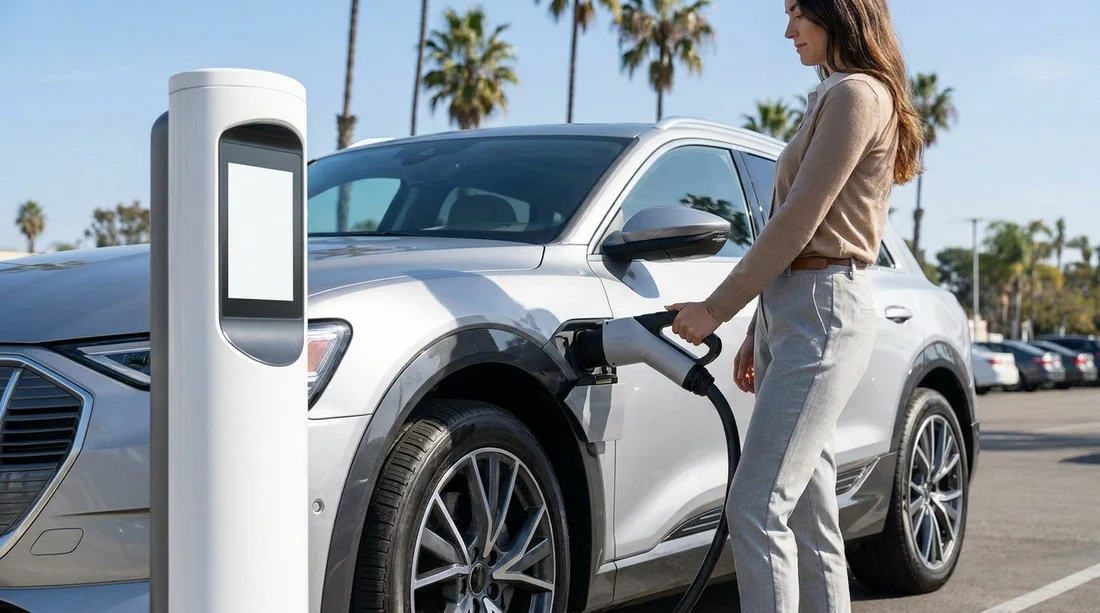
When arranging electric car hire in California, connector type matters more than many travellers expect. The two labels you will see most are NACS and CCS. They influence which rapid chargers you can use, whether you need an adapter, and how much time you will spend charging on busy travel days. The good news is you can plan this in a simple, practical way, without becoming an EV expert.
NACS vs CCS, what is the real difference for travellers?
NACS is the connector used by Tesla vehicles in North America. It is compact and widely supported at Tesla Superchargers. CCS is common on many other brands, and it is the default plug type at many non Tesla rapid charging sites in the US.
For a traveller, the difference is mostly about access and availability. Superchargers are often placed in convenient locations, have many stalls, and generally deliver consistent speeds. CCS rapid charging is widespread too, but site quality and uptime vary more. That is improving each year, yet it is still worth planning for.
Which connector will your electric car hire actually have?
Start by identifying the likely EV class you are choosing. Many rental fleets group EVs by size or “electric compact” rather than by port type. The same booking category can sometimes be fulfilled by different models depending on availability. That is why travellers can be surprised at the kerb, even if they researched one model online.
A practical approach is to treat connector type as part of your pre trip checklist, alongside luggage space and range. If you are collecting at a major hub such as Los Angeles Airport LAX, turnover is high and substitute models can happen. If your itinerary depends on rapid charging convenience, you want to know whether you will receive NACS or CCS, and what adapters are in the boot.
If you are landing in Northern California, collection points like San Francisco SFO or San Jose SJC put you near dense charging corridors, but you will still benefit from matching the car to the networks you expect to use.
Do you need to plan for NACS vs CCS? Usually yes, for one reason
Most California itineraries include at least one day when you will rely on rapid charging. That could be a coastal day trip, a theme park run, or a multi city drive with luggage and passengers. On those days, the question is not whether chargers exist, but whether the chargers you reach are compatible and working.
If you get a Tesla with NACS, you are generally set for Superchargers, which can simplify planning. If you get a CCS vehicle, you will use CCS networks for rapid charging. That can still be straightforward, but it adds a bit more app and site selection work. In either case, you should plan with realistic charging time in mind, not brochure range.
Adapter expectations, what to assume, what to confirm
Adapters change the story, but only if they are actually included and if you understand what they do. Some adapters support slow AC charging only, others enable DC fast charging at specific networks, and a few are designed for one direction only.
For electric car hire, do not assume you will be given every adapter you have read about. Instead, assume the car comes with the basic equipment needed for typical use, and anything extra should be confirmed.
1) AC charging at hotels. If your accommodation offers EV charging, it is commonly J1772. A Tesla may need a small J1772 to NACS adapter, while most CCS cars plug in directly. If you plan to rely on overnight charging, confirm your vehicle can use the hotel plug.
2) DC fast charging on the road. If you want to use Superchargers in a non Tesla vehicle, you need both access and the right connector setup. Some Supercharger locations have “Magic Dock” style CCS support, but not all. Conversely, if you have a Tesla and want to use a CCS fast charger, you may need a specific adapter, and availability in rental fleets can vary.
Charging network access, what changes with NACS or CCS
Network access is more than physical plugs. It includes payment methods, app sign ups, and whether the charger will authorise your session. For travellers, a sensible strategy is to set up at least one major charging app before you fly, then add a second as backup once you know your connector type.
If your hire car is NACS (often Tesla). You typically have broad access to Superchargers, and the in car navigation can route you through charging stops. That reduces planning time. It can also help if you are arriving after a long flight and collecting a car at a busy location such as San Diego Airport, where you may want the simplest possible first charge on the way to your accommodation.
If your hire car is CCS. You will use CCS rapid chargers, and you will want to prioritise newer sites with multiple stalls. In California, these are common near motorways and shopping areas, but queues can happen at peak times. Building a small buffer into your schedule helps, especially if you plan to return the car with a certain battery level or need to reach an early morning flight.
How to choose the right EV class for your California trip
To choose well, think in terms of how you will use the car, not just which model you hope to get.
Family travel with luggage. Heavier loads, motorway speeds and air conditioning all reduce range. Choose an EV class with extra buffer so you are not forced into inconvenient charging stops. This can be relevant if you are picking up near Sacramento for regional drives, for example at Sacramento SMF, where you might head out quickly towards wine country or the foothills.
Practical planning checklist before you collect the keys
Use this simple checklist to avoid connector surprises:
Confirm port type: NACS or CCS, and whether the model is likely to vary.
Confirm included adapters: J1772 for AC, and any CCS or NACS fast charge adapter if relevant.
Plan your first charge: Know the nearest compatible rapid charger from the pick up point.
Set up payments: Install at least one charging app, add a payment card, and test login.
Allow time buffers: Add extra time on days with long drives or tight check in windows.
FAQ
Do I need to choose NACS or CCS when booking electric car hire in California? It is worth planning for it, especially if you expect to use DC fast charging. Connector type affects which rapid chargers you can use without extra adapters and how simple your charging stops will be.
Are adapters always included with an electric hire car? Not always. Many vehicles will have the basics for common charging, but optional adapters for specific networks may not be supplied. It is sensible to confirm what comes with the vehicle you receive.
Can a CCS car use Tesla Superchargers in California? Sometimes, but not universally. Access depends on the specific Supercharger site, whether it supports CCS connections, and the car or network permissions. Do not assume every Supercharger will work for CCS.
Is CCS charging unreliable in California? Not necessarily, but reliability varies by site and network. Choosing newer, multi stall locations and having a backup option nearby reduces the risk of delays.
What is the easiest approach if I am unsure which EV I will receive? Plan for flexibility. Set up one major charging app in advance, then once you collect the car, confirm its connector type and map two compatible rapid chargers near your accommodation and along your main route.






























































































