


Quick Summary:
- Many Miami rentals provide an inflator kit rather than a spare tyre.
- Check the boot before leaving, confirm tools and sealant are present.
- Ask staff whether they can allocate a car with a spare.
- For longer drives, save roadside numbers and allow extra time.
If you are planning car hire in Miami and wondering whether your rental will include a spare tyre or an inflator kit, the honest answer is: it depends on the vehicle and fleet policy, and you should not assume either one is guaranteed. In the US, many newer cars are supplied by manufacturers without a full-size spare, and rental fleets often follow that specification. Some cars have a temporary space-saver spare, some have a sealant and compressor inflator kit, and some rely mainly on roadside assistance.
This matters more than most travellers expect. A puncture can turn into a major delay if you are driving out to the Keys, heading across Alligator Alley, or keeping a tight schedule for meetings. The good news is that you can usually confirm what is included before you leave the rental lot, and you can plan around it if a spare tyre is important for your route.
What US rental fleets typically provide
In Miami car hire fleets, three common setups appear:
1) No spare tyre, but an inflator kit. This is increasingly common in compact, mid-size, and some SUVs. The kit is usually a small 12V compressor and a sealant bottle. It is designed for simple tread punctures and small leaks. It may not work for sidewall damage, a blowout, or a large tear.
2) Temporary spare tyre (space-saver) plus tools. Some models still include a small spare wheel, jack, and lug wrench. This is helpful, but temporary spares have speed and distance limits. They are for getting you to a tyre shop, not for continuing your trip normally.
3) Full-size spare tyre. This is less common in mainstream passenger cars. You are more likely to see it in certain SUVs, larger vehicles, or specific trims, but it is not reliable enough to assume.
It is also normal in the US for rental companies to prioritise roadside assistance rather than encouraging customers to change wheels themselves. Even when a spare is present, some renters prefer not to use it, especially at night or in unsafe roadside conditions.
How to confirm at the counter and on the lot
If a spare tyre or inflator kit matters to your trip planning, confirmation should happen in two steps: ask, then verify physically.
Step 1, ask before you accept the keys. Use clear wording such as, “Does this vehicle have a spare tyre and jack, or only an inflator kit?” If you need a spare, ask whether they can allocate a vehicle that definitely has one. Sometimes the staff can switch you to a different model on the spot, depending on availability.
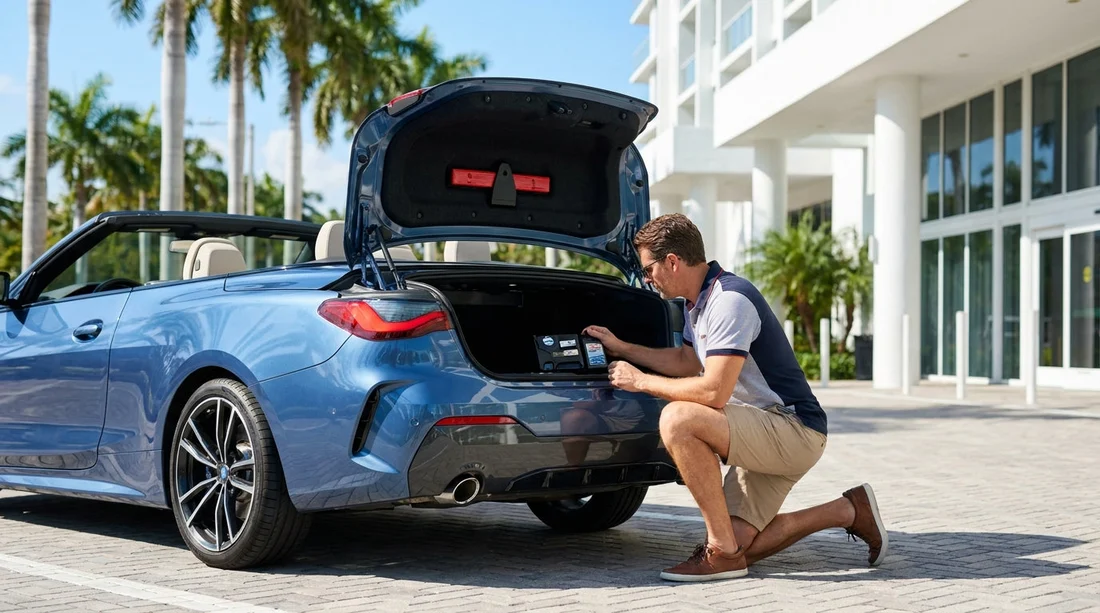
Step 2, check the boot yourself before you drive away. Open the boot, lift the floor panel, and look for: spare tyre (or tyre well), jack, lug wrench, tow hook, wheel lock key (if fitted), and the inflator kit. If there is an inflator kit, check it looks complete and unopened. A missing or used sealant bottle is a common surprise that you can catch early.
When you pick up a vehicle at a busy location, it is easy to skip this inspection. In practice, a two-minute check can save hours later.
If you are arranging Miami pickup, the local information on car rental in Miami can help you understand typical collection flows and what to review before leaving.
What to do if you need a spare tyre for your route
Some trips make a spare more important: longer drives with fewer service options, tight schedules, or travelling with children. If you prefer a spare tyre, focus on confirming equipment at pickup rather than relying on assumptions about vehicle class.
Choose a vehicle class more likely to have one. Larger SUVs and vans sometimes have better odds than compact cars, although there is no universal rule.
Request the feature, not just the vehicle type. A request for “SUV” does not guarantee a spare. Ask for confirmation of spare tyre presence.
Save contact numbers before you need them. Store the rental company’s roadside assistance number and the local branch number in your phone. If you are collecting near business districts, locations such as Hertz car hire in Brickell can be convenient reference points for where you might get help or guidance if you are staying nearby.
If you are picking up around suburban areas and plan to drive west or north quickly, it can also help to note where you collected from, for example car rental in Doral, because returns or swaps are usually easiest at or near the original network.
If your rental has only an inflator kit, know its limits
An inflator kit can be very useful when it is the right kind of puncture. You attach the compressor to the 12V socket, connect the hose to the tyre valve, and either inject sealant then inflate, or just inflate if it is a slow leak. After that, you typically drive a short distance and re-check pressure.
However, there are limitations that matter for Miami car hire planning:
Sealant is not a universal fix. Sidewall damage, large holes, and blowouts generally cannot be repaired with sealant.
Sealant can complicate repairs. Some tyre shops may charge more to clean sealant out before patching, or they may recommend replacement.
Heat and speed matter. South Florida roads can be hot, and driving far on an under-inflated tyre can destroy it quickly.
So, if you only have an inflator kit, your main plan should still be to reach a safe location and then a tyre professional, rather than treating it as a long-term solution.
Roadside assistance, swapping vehicles, and cost expectations
Rental companies usually offer roadside assistance options, sometimes included, sometimes as an add-on. Even if you decline extras, there is often still a base level of support for safety-related incidents, but coverage and any fees vary by supplier and contract terms.
If you get a puncture, the likely outcomes are:
They send help to fit a spare or tow you. This is common when a spare exists or when the car cannot be safely driven.
You drive to a tyre shop for repair or replacement. This is common for slow punctures. Keep all receipts and document the tyre condition with photos.
They swap the vehicle. Sometimes the simplest solution is a replacement car, particularly if a tyre is out of stock or damage is significant.
If you are travelling with a larger group and need space for luggage, you may be comparing vehicle types such as van rental in Miami Beach, where the spare situation can differ by model and seating configuration. The key is to confirm on the specific vehicle you are given.
FAQ
Do rental cars for car hire in Miami usually include a spare tyre? Many do not. It is common to receive an inflator kit instead, especially in newer compact and mid-size vehicles. Always verify on the specific car you collect.
How can I tell whether my rental has a spare or just a compressor? Open the boot and lift the floor panel. Look for a spare wheel and jack, or a sealant bottle and 12V compressor. If anything is missing, return to the desk before leaving.
Can I request a spare tyre when I pick up the car? You can ask, and staff may be able to switch you to a vehicle that has one, depending on availability. Request the feature explicitly, not only the vehicle category.
What should I do if I get a puncture and there is no spare? Move to a safe location, then call the rental company’s roadside assistance or visit a nearby tyre shop if the tyre is holding air. Take photos and keep receipts in case reimbursement is needed.
Is an inflator kit safe for driving to Key West or long distances? It can be safe for a minor tread puncture as a temporary measure, but it is not reliable for major damage. For long drives, plan for roadside support and allow extra time for delays.






























































































