


Quick Summary:
- Check the fuel door label first, it states permitted ethanol blends.
- Avoid pumps labelled E15 or Unleaded 88 unless the car allows it.
- If unsure, use regular Unleaded 87 (E10) or Premium as specified.
- If E15 is the only option, move stations rather than risk misfuelling.
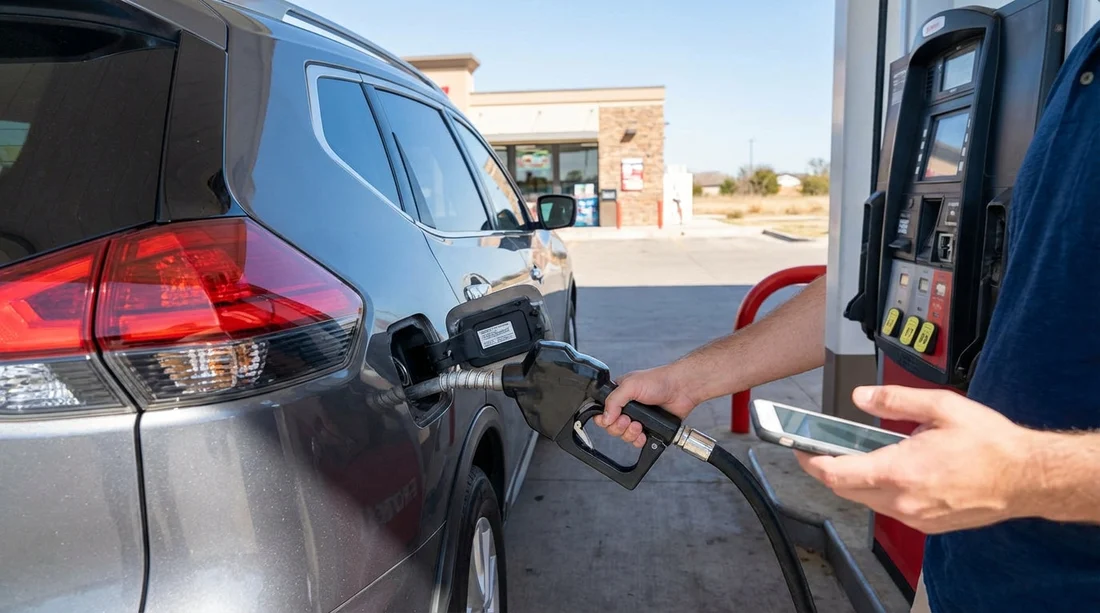
Pulling into a Texas petrol station with a hire car, you may see options labelled E15, Unleaded 88, Regular Unleaded, or Premium. The confusing part is that “Unleaded 88” often sounds like a normal octane choice, but it is typically E15 fuel, meaning up to 15% ethanol. Many vehicles can use E10 (up to 10% ethanol) without issue, but E15 suitability depends on the car’s approval and age. Because misfuelling can cause running problems and may not be covered if it is clearly against the manufacturer’s guidance, it is worth taking one minute to confirm what your specific car hire vehicle allows.
This guide explains how to check safely using the fuel door and handbook, which pumps to avoid, and what to do if the station only has E15 available. The advice applies whether you picked up your car around Austin, Dallas, San Antonio, or Houston. If you are collecting near Austin-Bergstrom, car hire at Austin airport listings often include a range of models, so always check the individual vehicle label rather than assuming.
What E15 and “Unleaded 88” mean in Texas
In the US, the “E” number refers to ethanol percentage. E10 is up to 10% ethanol and is the common baseline for regular petrol in many states. E15 is up to 15% ethanol. “Unleaded 88” usually describes E15 that is sold at a lower price and marketed as a high-octane alternative, but the key point is ethanol content, not the octane number.
Octane in the US is shown as AKI (Anti-Knock Index). Regular is often 87 AKI, mid-grade about 89, and premium 91 to 93 depending on station and region. Unleaded 88 is not “premium” fuel. It is typically 88 AKI paired with E15 ethanol content. That ethanol blend is the main reason some vehicles should not use it, particularly older cars, some small engines, and certain manufacturer recommendations.
Flex-fuel vehicles (often marked “E85” compatible) can use a wide range of ethanol blends, but do not assume your hire car is flex-fuel unless it is clearly labelled. Most modern mainstream petrol cars in the US can use E10, and many 2001 and newer vehicles are approved for E15, but you should still verify on the vehicle itself because there are exceptions.
The safest places to confirm fuel requirements
When you are standing at the pump, use a simple order of checks that does not rely on memory or guesswork.
1) The fuel door and filler neck label
This is the quickest, most reliable check. Open the fuel door and look for a sticker that says something like “Unleaded gasoline only”, “Ethanol up to 10%”, “E15 compatible”, or “Do not use E15”. Some vehicles explicitly state “E0-E15” or similar. If the label says “E10 max”, then Unleaded 88 (E15) is not appropriate.
2) The owner’s manual or quick guide in the glovebox
Most hire cars include a manual pack. Look for the “Fuel” section and check for “E15” or “15% ethanol”. If the manual indicates E15 is acceptable, you can use it. If it states E10 maximum, avoid E15 even if it is cheaper.
3) The instrument cluster messages and fuel type reminders
Some cars show a fuel type reminder in the settings screen. This is helpful but should be secondary to the fuel door label and manual.
4) The hire paperwork
Occasionally, the rental agreement or vehicle info sheet includes a fuel type note, but it is not always specific about ethanol limits. Treat it as supplementary.
If you are collecting a vehicle at a major hub like Dallas Fort Worth, you will likely see many similar-looking models in the pickup lanes. Do not rely on what you drove last time. Confirm on your specific car. If you are comparing suppliers for car hire at Dallas DFW, note that vehicle make and trim can vary, which can affect fuel guidance.
Which pumps to avoid, and how to spot E15 quickly
In Texas, stations often place E15 next to regular options, sometimes with prominent “88” branding. Use these practical steps to avoid accidental E15 fill-ups.
Read the grade button area, not just the big sign
The large sign might say “Unleaded 88” in bright colours. The small label near the selection button often includes “E15” or “Contains up to 15% ethanol”. Focus on the ethanol statement.
Look for the EPA-style warning label
Many E15 pumps carry a label stating it is for 2001 and newer vehicles and is prohibited for motorcycles and certain engines. If you see that label and you have not confirmed approval, do not select it.
Be wary of “blender pumps”
Some pumps dispense multiple ethanol blends from the same unit, such as E15, E30, E85. They often have multiple yellow labels. If you are in any doubt, choose a standard pump offering regular 87 and premium 93 without E15 branding.
Do not confuse “88” with “87”
Regular 87 is normally E10. Unleaded 88 is often E15. The numbers are close, but the ethanol difference matters more than the single AKI point.
What to do if E15 is the only option at that station
Sometimes you pull in with a low tank and the forecourt only advertises Unleaded 88, or the regular 87 nozzle is bagged out of service. Here is the safest decision path.
Step 1, confirm the car allows E15
If the fuel door label or manual clearly states E15 is permitted, you can use Unleaded 88. Keep your receipt, just in case you later need to document what you used.
Step 2, if E15 is not confirmed, choose another grade only if allowed
If the station has Premium (91 or 93) that is not labelled E15, it is often E10 or ethanol-free depending on the retailer, but you must not assume ethanol-free. Still, premium is typically not sold as E15. If your car requires regular, using premium for one fill is generally acceptable in most petrol engines, but the better rule is to follow the vehicle guidance. If the label says “Unleaded only” with no ethanol limit, that does not automatically mean E15 is fine. Look for the explicit ethanol statement.
Step 3, if only E15 is available and approval is unclear, leave and find another station
This is the lowest-risk option. In Texas metros you are rarely far from another station. Even in more rural stretches, it is safer to buy a smaller amount of a confirmed suitable fuel at the next stop than to risk misfuelling.
Step 4, if you are truly near empty, prioritise getting to the next station safely
If you are close to running out, reduce speed, avoid rapid acceleration, and head to the nearest alternative station. If you are on a toll road or a long highway segment, take the next exit to search for fuel. Avoid driving until the tank is fully empty, as that can draw sediment and may cause additional issues unrelated to ethanol.
If you are travelling with a larger vehicle, availability can vary by station layout. Those arranging a people carrier or cargo vehicle via van rental at Dallas DFW should be especially careful about confirming the correct fuel, as some vans are petrol while others are diesel, and diesel misfuelling is a bigger problem than E15 alone.
If you accidentally put E15 in a car that should not use it
Mistakes happen, especially when grades are unfamiliar. What you do next depends on how much was added and whether the engine has been started.
If you have not started the engine
Do not turn the ignition on. Inform the station attendant if you are blocking a pump, then contact the rental company roadside assistance number from your agreement. They may advise a tow and tank drain. This is inconvenient, but starting the engine circulates the fuel.
If you already started and drove
Stop somewhere safe as soon as you can. If the car seems normal and you added a small amount, the rental company may advise topping up with E10 regular as soon as possible to dilute the ethanol content. Do not keep driving long distances without guidance. Document what happened, keep the receipt, and contact the rental provider for instructions.
Watch for symptoms
Possible signs include rough idle, hesitation, a check-engine light, or reduced performance. These do not prove damage, but they are a reason to stop and call for advice.
For travellers picking up in Houston, policies and support numbers can vary by provider. If your reservation is through a supplier listed on Hertz car rental in Texas IAH, use the documentation provided at pickup for the correct assistance contact details and follow their guidance on misfuelling reporting.
Common Texas pump labels and what they usually indicate
Use this as a quick translation guide while still relying on your vehicle label for the final decision.
“Regular Unleaded 87”
Usually E10. This is the most common safe choice for many petrol vehicles unless premium is required.
“Mid-grade 89”
Usually a blend, often still E10. Not typically E15, but check the ethanol label.
“Premium 91 or 93”
Often E10. Some stations may offer ethanol-free premium, but only trust a clear “ethanol free” label.
“Unleaded 88” or “88”
Commonly E15. Treat as E15 unless the pump label clearly says otherwise.
“E85”
High ethanol fuel for flex-fuel vehicles only. Never use unless the vehicle is explicitly E85 compatible.
How this affects returning your car hire vehicle
Most car hire agreements in Texas require you to return the vehicle with the same fuel level as provided, commonly full-to-full. Using the correct grade is part of normal operation, but using an incorrect fuel can create complications if it triggers warnings or drivability issues before return. Even if the car seems fine, it is sensible to keep fuel receipts, especially if you had to use an unfamiliar pump option while travelling.
If you are flying out of San Antonio and refuelling near the airport, stations can be busy and labels easy to miss. Take an extra moment at the pump. Provider options differ, for example National car hire at San Antonio SAT may supply different model years than another desk on the same day, so the fuel door label remains the best reference.
FAQ
Is “Unleaded 88” the same as regular unleaded in Texas?
No. In most cases Unleaded 88 is E15, meaning up to 15% ethanol, while regular unleaded is usually 87 AKI and typically E10. Always read the pump’s ethanol label.
Where is the fastest place to check if my hire car can use E15?
Open the fuel door and read the sticker on the inside of the fuel door or near the filler neck. It often states the maximum ethanol percentage allowed.
If my car hire says “Unleaded fuel only”, can I use E15?
Not necessarily. “Unleaded” refers to petrol versus leaded fuel, not ethanol content. You still need confirmation that E15 is permitted, ideally stated as E15 compatible or ethanol up to 15%.
If only E15 is available, is it safer to buy premium instead?
If premium is available and not labelled E15, it is often E10 and may be a safer temporary choice. However, you should still follow the vehicle’s fuel guidance and check for any ethanol statements on the pump.
What should I do if I accidentally filled with E15 and my vehicle is not approved?
If you have not started the engine, do not start it, contact the rental company for assistance. If you already drove, stop safely, keep the receipt, and call the rental provider for advice on next steps.






























































































