


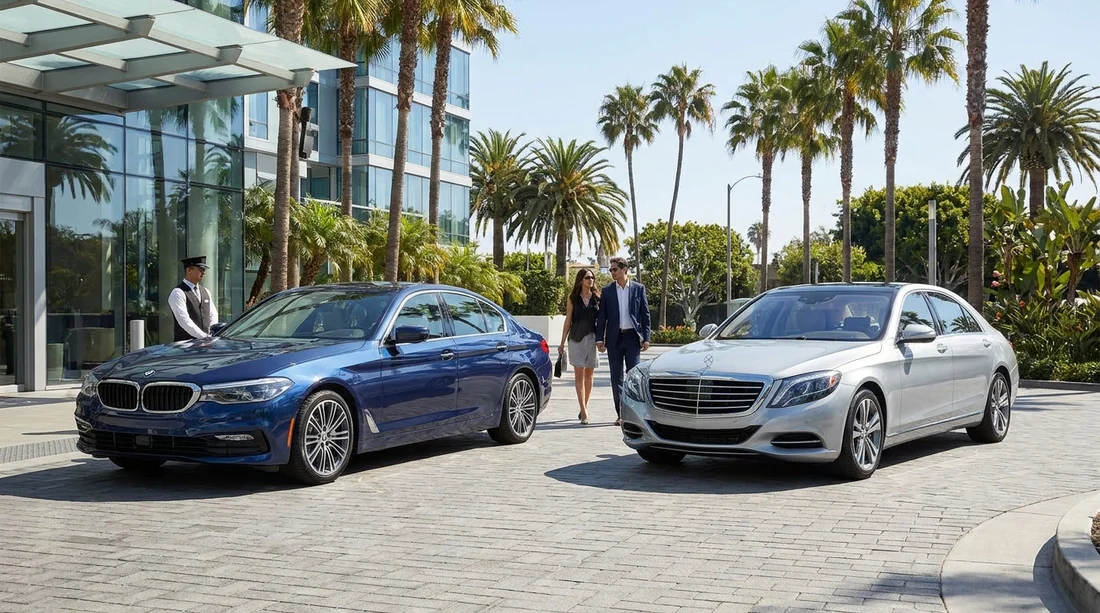
Quick Summary:
- Premium prioritises roomy cabins, easy driving, and useful luggage capacity.
- Luxury prioritises prestige brands, richer materials, and higher-end technology.
- Pick premium for practical trips, pick luxury for comfort and image.
- Upgrades vary by fleet availability, so confirm luggage needs at pick-up.
When you are comparing car hire options in Los Angeles, the labels “premium” and “luxury” can look similar on a booking page, yet they usually describe different priorities. Premium tends to emphasise space and comfort in a well-equipped, often mainstream vehicle. Luxury usually shifts the focus toward prestige branding, higher-end interiors, and a more refined driving feel. Both can be excellent, but they suit different trips and budgets.
This guide breaks down what these classes typically include, what to expect for luggage and passenger space, and what can change if you are offered an upgrade at pick-up. As with any car hire, exact models vary by supplier and fleet, but the class description is a useful shortcut once you know what it is trying to tell you.
What “premium” car hire typically means in Los Angeles
In Los Angeles, premium is usually the step above standard “full-size” or “intermediate” categories. Think larger cabin, quieter ride, more supportive seats, and a few convenience features that make long drives easier. The badge on the bonnet is often less important than overall comfort and practicality.
Size and seating: Premium vehicles are commonly large saloons or roomy crossovers. They typically seat five adults, with noticeably more shoulder and leg room than mid-size categories. If you are doing longer motorway drives, this extra space matters as much as engine performance.
Luggage space: Premium often provides a bigger boot opening and deeper cargo area. For airport runs, it can mean fitting two larger suitcases plus a couple of smaller bags without forcing luggage into the rear seats.
If you are flying into LAX and want to compare categories by location, Hola Car Rentals has guidance for the area on car rental Los Angeles LAX and car rental California LAX.
What “luxury” car hire typically means in Los Angeles
Luxury usually signals a focus on brand prestige and premium materials, plus a more refined cabin and stronger specification. In Los Angeles, luxury categories often include marques associated with executive travel and high-end image, and you may notice a step up in cabin insulation and ride quality.
Brand and trim expectations: Luxury commonly points to premium-brand vehicles rather than upgraded mainstream models. You are more likely to see recognisable prestige badges and higher trim lines, which can translate to better seat materials, stronger audio systems, and more polished design details.
Technology and safety: Luxury cars more often include advanced driver assistance and more comprehensive sensor packages. Depending on the model, this can mean adaptive cruise control, lane-keeping support, 360-degree cameras, and enhanced parking aids.
Luggage space caveat: Luxury does not always mean more luggage room. Some luxury saloons have less boot space than a premium large saloon, and sporty luxury models may prioritise design over cargo capacity. If luggage is central to your trip, check the class description for suitcase estimates, and consider whether a large car class is more practical than a prestige badge.
Premium vs luxury, a practical comparison that actually helps
Because class names can vary slightly by supplier, it helps to compare what you will feel day-to-day rather than only the label.
Choose premium if: you want comfortable space for five, dependable luggage capacity, and a straightforward drive. Premium is often ideal for families and travellers who value practicality over prestige.
Choose luxury if: brand and cabin finish matter, you want a more premium driving experience, or you are arriving for an occasion where the vehicle’s image plays a role.
Running costs and deposits: Luxury categories can come with higher deposits and, sometimes, stricter requirements around insurance options or additional documentation. Premium can be slightly simpler in terms of expected wear tolerance, although rules depend on the supplier’s policies.
How luggage space and passenger comfort typically differ
Travellers often assume luxury equals bigger, but that is not always true. Here is the common pattern in car hire fleets:
Premium: More likely to be a larger-body vehicle with a boot designed for everyday usability. That usually means better capacity for multiple suitcases and a rear seat that can accommodate adults more comfortably.
Luxury: More likely to give you premium materials and features, yet the boot may be narrower or shallower, especially in sleeker saloons. Luxury SUVs can offer both prestige and space, but the class label alone does not guarantee you will receive an SUV.
If you are travelling with a larger group or lots of baggage, a people carrier may be more suitable than either category. For reference, Hola Car Rentals covers that option on minivan rental California LAX.
What changes with an upgrade at pick-up
An upgrade at pick-up can mean different things depending on availability, your reserved class, and how the supplier manages its fleet on the day. In general, upgrades are not a guaranteed promise of a specific model, but they can shift what you drive in meaningful ways.
Like-for-like within the same class: You may receive a different model than expected but with similar size and features. This is common in both premium and luxury categories.
Upgrade to a higher class: If the supplier is short on the class you reserved, you may be offered a higher class at no extra charge. This might move you from premium to luxury, or from luxury to a larger luxury vehicle.
Upgrade with trade-offs: Sometimes an upgrade improves brand and features but reduces luggage capacity. For example, a sleek luxury saloon may feel more premium but fit fewer large suitcases than a roomy premium crossover. If luggage space is critical, ask to confirm suitcase capacity before accepting.
Pick-up experiences can vary by airport and provider. If you are also comparing fleets outside Los Angeles, you can see supplier information around nearby airports, such as car hire airport Santa Ana SNA, which can help when planning routes across the wider area.
FAQ
Is a premium car always bigger than a luxury car in Los Angeles? Not always. Premium is often bigger than standard classes, but luxury can be a sleek saloon with less boot space. Compare luggage estimates and body style, not just the label.
Will a luxury car hire include leather seats and navigation? Often, yes, but it is not guaranteed because fleets vary by model year and availability. Luxury classes are more likely to include higher-end materials and more tech, but check the listed features.
If I book premium, can I be given a luxury car instead? It can happen if your reserved class is unavailable, and the supplier moves you to a higher category. It depends on fleet availability at pick-up, and it still may not be a specific model.
Does upgrading from premium to luxury increase luggage space? Sometimes, but not reliably. Luxury SUVs may offer more space, while luxury saloons can have smaller boots than premium large cars. If you have multiple large suitcases, confirm capacity before accepting an upgrade.
Which is better for Los Angeles traffic, premium or luxury? Premium is usually a practical choice for comfort and easy driving. Luxury can be better if you value quieter cabins and extra driver-assistance features, especially for parking and long motorway stretches.




























































































