


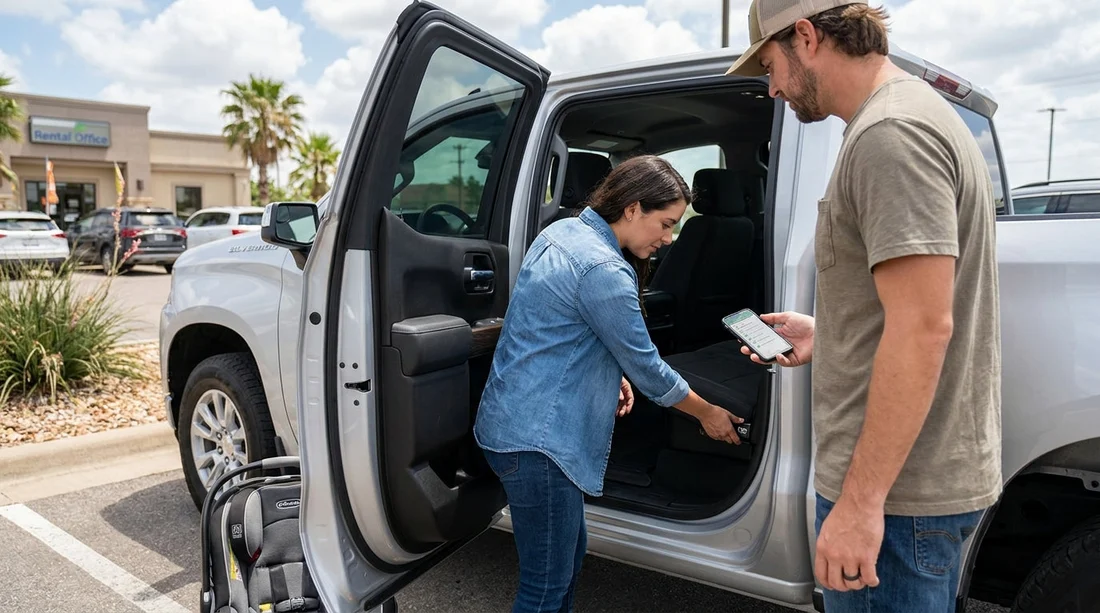
Quick Summary:
- Locate lower anchors and confirm spacing, depth and access in rear seats.
- Find top-tether points, check label arrows, and verify strap path clearance.
- Test seat-belt routing, locking mode, and buckle position for secure installation.
- Inspect anchor hardware and trim for damage before leaving the car hire lot.
Hiring a car in Texas with children in tow adds one non-negotiable task before you drive off, confirm the child seat can be fitted safely in that specific vehicle. In the US you will usually see LATCH (Lower Anchors and Tethers for Children) rather than ISOFIX labelling, but the principle is the same. You need two lower anchors in the seat bight and a top tether point for forward-facing seats, plus a workable seat-belt route when LATCH cannot be used.
This counter-to-car checklist is designed for the pick-up moment, when you can still change the vehicle if something does not add up. It focuses on three things you can verify quickly: rear-seat lower anchors, top-tether points, and belt routing. If you are collecting at a major hub such as Austin Airport or Dallas DFW, the car park can be busy, so having a repeatable order helps.
1) Start with the rear-seat position you will actually use
Before you hunt for anchors, decide where the seat will go. Many families prefer the second row outboard position for daily use, while the centre can be safest in some vehicles if you can achieve a tight fit. In a rental, practicality matters too: can you access the tether point, can another passenger still buckle up, and is there enough room to load a pushchair?
In Texas you will often be offered SUVs and pickup-based vehicles. Some have a steep seat angle, thick cushions, or raised bolsters that can make anchors hard to reach. If you are weighing options, you can compare larger cabins such as a minivan rental in Fort Worth versus a mid-size SUV, and then check the anchor access at pick-up.
2) Confirm lower anchors are present, usable and correctly spaced
Lower anchors are metal bars fixed to the vehicle structure, typically found in the seat bight where the seat back meets the seat cushion. At pick-up, do not assume every rear seat has them. Some vehicles have LATCH only in the two outboard positions, and others provide it in the centre but with restrictions.
Find the markings. Look for LATCH symbols or small fabric tags on the seat upholstery. If there are no marks, use your hand to feel in the bight for the bars. In some rentals the tags are tucked in, missing, or covered by protective seat covers.
Check access depth. If the anchors are buried deep, some connectors can be difficult to attach without scraping your hand or failing to click fully. You should be able to attach both sides and hear or feel a positive engagement.
Check spacing and position. Standard US spacing is about 11 inches between anchors. Problems arise when you attempt a centre installation using anchors intended for the outboard seats. If the vehicle manual does not explicitly allow borrowing, do not do it.
Inspect the anchor area. Look for bent bars, cracked plastic trim, or seat fabric that has been cut. While rare, heavy cleaning or previous misuse can damage the area. If anything looks off, ask for another vehicle.
3) Find the top-tether point and ensure a clean strap path
For forward-facing child seats, the top tether reduces head movement in a crash. In many states it is strongly recommended, and some seats require it to meet their installation instructions. In rentals, tether points can be easy to miss because they vary by body style.
Match the seating position to the correct anchor. Some vehicles have multiple anchors clustered together. Make sure you use the one labelled for your seat position. Crossing tethers or using the wrong anchor can change the angle and performance.
Check the routing. The strap should run over or under the head restraint exactly as your child seat manual specifies. If the head restraint pushes the strap forward or pinches it, adjust or remove the restraint only if the vehicle allows.
Look for sharp edges or moving parts. Ensure the strap does not rub on exposed metal, hinge mechanisms, or a folding seat latch. In a rental, rear seats may have been folded frequently, so check nothing is misaligned.
4) Verify seat-belt routes and locking behaviour, even if using LATCH
Many child seats have lower-anchor weight limits, and you may switch to seat belt installation as your child grows. Also, some rental vehicles have limited anchor positions, so you may need the belt from day one. Either way, check the belt system before leaving the lot.
Identify the correct belt path. Rear-facing seats have a different route than forward-facing seats, and boosters require the lap belt to sit low across the hips with the shoulder belt crossing the chest.
Check that the belt can lock. Most modern US vehicles have switchable retractors. Pull the shoulder belt all the way out, then feed it back in. You should hear clicking and feel it ratchet, indicating it is locked.
Confirm buckle accessibility. Buckles that sit too far forward or are mounted on long, flexible stalks can end up inside the belt path, making it hard to tighten. If you cannot get a tight install without odd twists or buckle interference, try another seating position or another vehicle.
If you are picking up around Houston, you may have several car classes available. When comparing options at Houston IAH, it helps to prioritise vehicles with flatter rear benches and easily reached tether points, not just boot space.
5) Do a two-minute installation test before you leave
You do not need a perfect, final install at the counter, but you do need confidence that the anchors and belts allow one. Clip both lower connectors or route the belt through the correct path and buckle it, then tighten while pressing down where the child’s bottom will be.
Grip the seat at the belt path and tug side-to-side and front-to-back. If it moves more than about an inch, reassess routing, tension, and whether you are truly connected to anchors.
For forward-facing seats, attach the tether and tighten until snug. Do not use it to compensate for a loose lower install, it is an extra layer of restraint.
6) Spot rental-specific issues that affect child-seat points
Car hire vehicles see frequent seat folding, valeting, and luggage loading. Watch for missing tether anchor covers or labels, aftermarket seat covers that block access, and stiff belts that twist and will not tighten smoothly.
If you are collecting from a branded fleet, vehicle consistency can help, but it varies by model year. Pages such as National at Houston IAH can be useful for planning where you will pick up, then you can focus on the on-the-spot checks that matter most.
7) What to do if something does not check out
If you cannot find a top tether for a forward-facing seat, cannot achieve a tight install with either LATCH or the seat belt, or the anchor area appears damaged, do not accept the vehicle as-is. Return to the booth and explain that you need a different model because the child restraint cannot be installed correctly.
Also consider adjusting the plan: a different seating position, using the seat belt method if allowed by your child seat instructions, or choosing a roomier vehicle class where anchors are easier to access. If you are choosing between desks, Enterprise at Houston IAH may help you confirm your pick-up point in advance.
FAQ
Is ISOFIX the same as LATCH in a Texas car hire vehicle? They are closely related. ISOFIX is the international term, while LATCH is the US system name. The lower anchors function similarly, but always follow your child seat instructions and the vehicle’s labels or manual.
Do all rear seats in rentals have lower anchors and top tethers? No. Many vehicles have lower anchors only in the outboard seats, and top tethers only for certain positions. Check each intended seat location individually at pick-up.
Can I use the inner anchors from two seats to fit a child seat in the centre? Only if the vehicle explicitly permits centre LATCH using borrowed anchors. If you cannot confirm that permission, use an outboard LATCH position or a centre seat-belt install if it fits securely.
How do I know if the seat belt locks for a child seat installation? Pull the shoulder belt all the way out and let it retract. If it clicks and will not pull back out freely, it is in locking mode and can hold a child seat tightly.
What is the quickest sign that I should swap the rental car? If you cannot locate a usable top tether for a forward-facing seat, or you cannot get a tight fit at the belt path after re-checking routing and tension, swap to another vehicle before leaving.




























































































