


Quick Summary:
- “Or similar” means a car category, not a guaranteed exact model.
- Expect similar seats, doors, luggage space, and transmission in the class.
- Check fuel policy, mileage, deposit, and included cover on the voucher.
- Inspect the allocated car, record damage, and take photos before driving.
When you see “or similar” on a car hire booking in Florida, it is describing the vehicle class you have reserved, not a promise of a specific make, model, trim, or colour. The rental desk aims to provide a car that matches the quoted category, but the exact vehicle depends on what is available in the fleet at that time. Understanding what can, and cannot, vary helps you avoid surprises at pick-up, especially after a long flight.
Florida is a high-volume rental market, with busy airport locations and constant vehicle turnover. That makes “or similar” particularly common on vouchers and comparison sites. The good news is that class-based bookings are designed to be predictable. If you know what defines the class, and what to double-check on your voucher, you can make your car hire outcome much more certain.
What “or similar” actually guarantees
“Or similar” means the supplier will provide a vehicle that is equivalent in class. Equivalency is usually based on practical characteristics, rather than branding. Depending on the supplier, the class definition can include:
Size and body type: economy, compact, intermediate, full-size, SUV, minivan, convertible, and so on.
Passenger capacity and doors: for example, five seats and four doors for many compact classes.
Luggage capacity: typically expressed loosely, but the intention is comparable boot space.
Transmission and drivetrain: automatic versus manual, and sometimes two-wheel drive versus four-wheel drive or AWD for SUV categories.
Air conditioning: in Florida, A/C is effectively standard, but the class still assumes it.
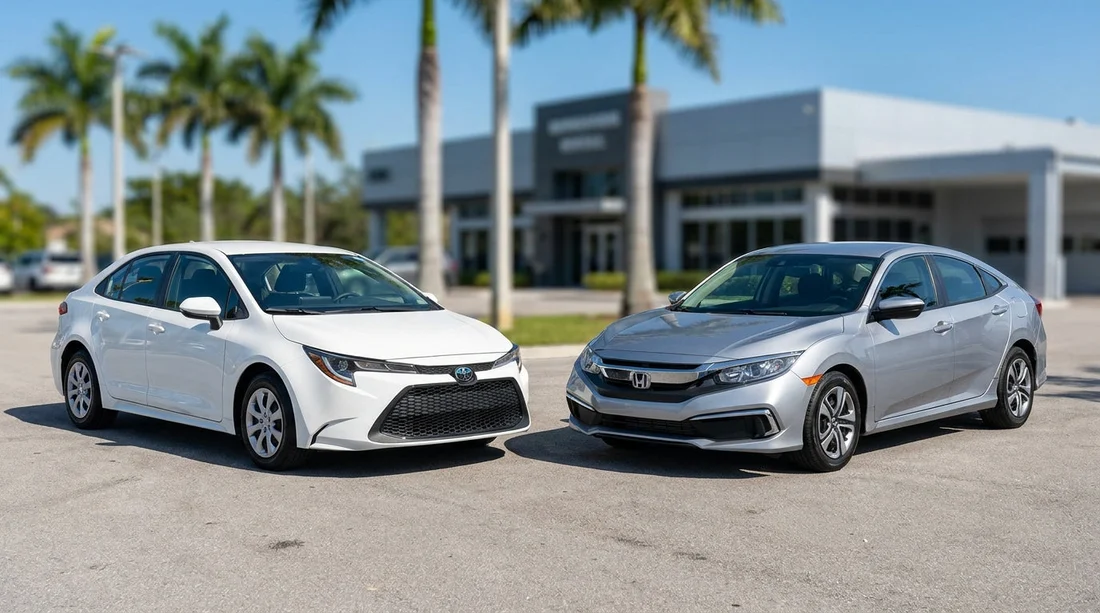
What it does not guarantee is the exact model shown in the photo. Images are marketing references, and the “or similar” text is a reminder that the photo is only illustrative.
Why rental companies use classes instead of specific models
Car hire fleets change daily. Vehicles return late, go into cleaning or maintenance, get upgraded, or are moved between branches. If every reservation promised a specific model, suppliers would cancel far more bookings whenever the fleet shifted.
Class-based booking gives the supplier flexibility while still giving you a predictable outcome. It also helps keep pricing consistent: an intermediate saloon or “or similar” is priced based on the value of that category, not on whether you receive one model or another on the day.
What can vary at pick-up, even within the same class
Even when the class is honoured, you can see meaningful differences between “similar” cars. Common variations include:
Boot shape and real-world luggage fit: two vehicles may both be “intermediate”, but one may have a shallower boot opening that makes large suitcases harder to load.
Engine performance and fuel economy: small differences are normal, especially between petrol engines and hybrid variants.
In-car technology: Bluetooth, Apple CarPlay, Android Auto, and USB ports vary by model year and trim. If you rely on phone navigation, plan for the possibility that a feature is missing and bring a vent mount or cable.
Safety and driver assistance: reversing cameras, blind spot monitoring, and lane assist are not guaranteed unless explicitly stated.
Colour and interior: never guaranteed, and not a service issue unless it affects functionality.
If you are picking up at an airport with heavy demand, availability can be tighter. For example, travellers arranging car hire at Orlando MCO may see frequent substitutions within the same class during peak arrival periods.
Upgrades, downgrades, and what you can reasonably expect
Upgrades: If the reserved class is unavailable, the supplier may provide a higher class at no additional charge. This is usually positive, but consider practicalities. A larger SUV can mean higher fuel costs and more challenging parking in crowded beach areas.
Downgrades: A downgrade should not happen without your agreement and a price adjustment. If the desk suggests a smaller class, ask how it compares on seats, doors, luggage, and transmission, then confirm the revised price before accepting.
If you are arriving into South Florida and want to minimise uncertainty, it helps to understand the pick-up process at major airports such as Fort Lauderdale airport, where fleet availability can shift quickly across the day.
What to confirm on your voucher to avoid surprises
Your voucher is the best tool for turning “or similar” into something concrete. Before travel, review it for these key items, because they affect the total cost and your experience more than the badge on the bonnet:
Vehicle class description: Look for notes like “Compact (Group C)” and verify transmission type. If it says “automatic”, you should receive an automatic or an equivalent automatic category.
Fuel policy: “Full to full” is usually easiest to manage. If it is “pre-purchase” or “return empty”, understand how you are charged and whether refunds apply.
Security deposit and payment method: Confirm the deposit amount, whether a credit card is required, and whose name must be on the card. Debit card rules vary widely by supplier.
Insurance and cover inclusions: The voucher should clearly state what is included, such as collision damage waiver, theft protection, and any excess amount. If windscreen, tyres, or roadside assistance are excluded, that is important to know upfront.
Tolls and toll devices: Florida has many toll roads. Check whether a toll programme is optional, how daily fees work, and how plate billing is handled.
When reviewing options across South Florida, comparing pick-up terms for Avis at Fort Lauderdale FLL versus other desks can help you spot differences in deposit rules and counter processes that matter more than a specific model.
How to assess the car you are offered at the counter
Once the desk assigns a vehicle, take a moment to compare it to your voucher’s class and essentials. Focus on functional requirements:
Space: If you have multiple large suitcases, ask to see the boot before finalising. Florida trips often involve beach gear, prams, or golf clubs, and “similar” can feel tight depending on the model.
Transmission and features you depend on: If you require automatic, confirm it before you leave the garage. If you need built-in sat nav, confirm whether it is included or an extra.
Condition: Walk around the car, photograph any existing damage, and ensure it is recorded on the check-out report. Check tyres and windscreen too.
For travellers landing into Miami with a larger group, considering a people-carrier category can reduce the chance of a last-minute squeeze. Reviewing what is typical for van rental at Miami MIA can be useful when luggage volume is the main constraint.
How to reduce uncertainty when you need a specific feature
If you truly need a non-negotiable feature, “or similar” means you should take extra steps:
Choose the correct class: If you need three rows, do not rely on a large SUV category, select a minivan or 7-seater class.
Prioritise transmission and seating on the voucher: Those are the most enforceable points at the counter.
Allow time at pick-up: Rushing increases the chance you accept a poor fit, especially when queues are long.
When collecting on the west coast of Florida, supplier policies can still differ by desk. Checking the terms associated with Payless at Tampa TPA can help you anticipate deposit amounts and what documents will be required.
FAQ
Does “or similar” mean I will get the exact car shown in the photo? No. The photo is illustrative, and “or similar” means you will receive an equivalent class vehicle, not that specific model.
If I booked an automatic, can they give me a manual “similar” car? They should not, unless the voucher allows it or you agree to a change. Transmission type is a core part of most class definitions.
What should I do if the offered car is smaller than expected? Ask how it matches the booked class on seats, doors, and luggage, and request an alternative. If only a lower class is available, confirm any price adjustment before accepting.
Is an SUV always guaranteed to be AWD or 4x4 in Florida? Not necessarily. Many SUV categories are two-wheel drive unless AWD or 4x4 is explicitly stated on the voucher.
What matters more than the model name when checking my voucher? Focus on class, transmission, fuel policy, mileage, deposit, and what cover is included, as these determine cost and suitability.




























































































