


Quick Summary:
- Bring your own seat for trusted history, familiar fit, and comfort.
- Hire a seat to reduce luggage, but confirm type and condition.
- Check compatibility with belts, LATCH anchors, headrests, and tether points.
- Confirm California restraint rules, plus airline and taxi plans.
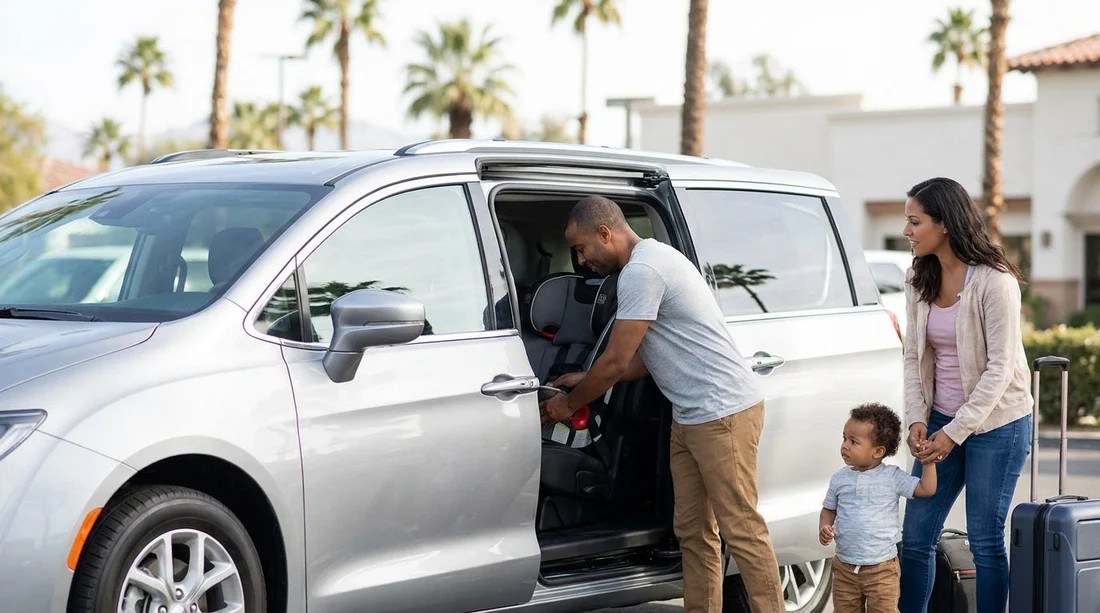
When you are organising car hire in California with children, the child seat decision can feel surprisingly high stakes. Do you pack the seat you already trust, or add one to the rental booking and travel lighter? The best choice depends on your child’s age and size, how you are travelling (fly, road trip, or city breaks), and how confident you feel installing seats in unfamiliar vehicles.
This guide helps families compare both options in practical terms, focusing on fit, standards, what rental companies typically provide, and what to confirm before you collect the vehicle.
What California expects for child restraints
California generally requires children to be secured in an appropriate child restraint system until they are old and tall enough for an adult belt to fit properly. Many families also follow best practice, which is to keep children rear facing as long as the seat allows, then forward facing with a harness, and only then move to a booster.
The key point for travellers is that you should plan for your child’s current height and weight, not just their age. If your child still needs a harness or booster, that need does not change because you are using car hire. If you are unsure, check your child seat manual for weight and height limits, and aim for a setup that keeps the lap belt low on hips and the shoulder belt crossing the chest, not the neck.
Option 1: Bringing your own child seat
Bringing your own seat is often the simplest way to maintain consistent safety and comfort. You know the seat has not been in a crash, you know it fits your child, and you likely already know how to install it correctly.
Cons are mainly about logistics. Carrying seats through airports and into rideshares can be cumbersome. Some airlines allow you to check a seat without extra cost, but baggage handling can be rough. If your seat arrives damaged or is delayed with luggage, you may be scrambling at the pick-up desk.
Practical tip: pack the seat in a protective bag, label it clearly, and consider a lightweight travel seat if your primary seat is bulky. Also bring your seat’s manual, or download it to your phone for quick reference during installation.
Option 2: Adding a child seat to your rental booking
Hiring a seat through the rental company can reduce luggage and make airport transfers easier. For many families on a short trip, it can be a reasonable compromise, especially if you are also carrying prams, travel cots, and hand luggage.
However, you should treat “child seat included” as a starting point, not the finish line. Different suppliers may categorise seats broadly, for example “infant seat”, “toddler seat”, or “booster”, but those labels do not guarantee the correct fit for your child’s current measurements. Availability can also be limited at peak times.
Before you finalise car hire, confirm the exact category you need, how many seats, and whether a high-back booster is available if your child needs side protection or better belt positioning. If you are collecting at a major airport location like Los Angeles LAX or San Francisco SFO, you may have more choice, but it is still worth confirming in writing on your reservation notes.
Standards and labels: what to look for
Many UK travellers own seats labelled to European standards, while seats supplied in the United States typically comply with US regulations. In practical terms, you want a seat that is legal for use in the location and appropriate for your child.
If you bring your own seat, check its approval label and your airline’s policy. Some seats are approved for aircraft use, while others are not. A seat approved for aircraft use can be a big help if your child benefits from harnessed restraint during the flight.
If you hire a seat, ask how it is maintained and whether parts are checked. When you collect it, look for an intact harness, readable labels, no cracks in the shell, no fraying, and a buckle that clicks and releases smoothly. If anything seems off, request a replacement seat before leaving.
Fit in unfamiliar vehicles: belts, LATCH, and headrests
Fit is where most travel plans succeed or fail. A child seat can be safe, but still difficult to install correctly in a particular vehicle. In California, many rental cars will have LATCH anchors for installing compatible child seats. In some cases, you may prefer the vehicle belt installation instead, depending on seat type, seating position, and the child’s weight.
Before collection, think about the vehicle class you are choosing. A compact can work for one child, but multiple seats, luggage, and long driving days can make an SUV or larger saloon more comfortable. If you are considering a larger vehicle for family road trips, reviewing options like SUV hire in California can help you plan for space and easier installs.
At the car park, do a quick reality check:
Seat position: The safest practical position is often the rear seat, away from active airbags. If you must place a rear-facing seat in the front, ensure the airbag is deactivated where possible, and follow both vehicle and seat instructions.
Headrests: Some vehicles have fixed headrests that can interfere with high-back boosters or forward-facing seats. Make sure the child seat sits flush as required by its manual.
Belt length and buckle position: A long buckle stalk or awkward buckle placement can make some seats hard to tighten properly. Try another rear seating position if needed.
Tether anchors: For forward-facing harnessed seats, top tether use can be important. Confirm where the tether anchor points are located, often behind the seatback or in the cargo area of some SUVs.
What to confirm before you collect the car
A few confirmations can prevent a stressful start to your holiday. Whether you bring your own seat or hire one, plan for time at pick-up to install and check everything calmly, not rushed in a queue.
For hired seats, confirm these points ahead of time:
Seat type and quantity: infant, convertible, forward-facing harnessed, backless booster, or high-back booster.
Age, weight, and height suitability: provide your child’s measurements to avoid guesswork.
Pick-up availability: ask whether the seat is guaranteed or “on request”.
Cost structure: understand daily charges and any maximum cap for longer rentals.
Collection process: whether the seat is fitted by staff, collected at the desk, or picked up at the car.
If you are collecting around San Francisco, you might compare supplier locations and processes for car rental at San Francisco SFO, since airport operations vary by provider and terminal access.
When hiring a seat tends to win
Hiring can be attractive for short city stays, trips with minimal driving, or families juggling multiple bags and a pram through busy airports. It can also make sense if your child uses a booster and you are comfortable checking that the belt fit is correct.
Hiring may also be a budget and convenience choice for some itineraries, especially if you are already optimising costs across flights, hotels, and budget car hire in Los Angeles LAX options. Just be sure that convenience does not come at the cost of getting the wrong size seat or a poorly maintained one.
FAQ
Is it safer to bring my own child seat for car hire in California? Often yes, because you know the seat’s history, parts, and how to install it. Hiring can still be safe if you confirm the correct type and inspect it carefully at collection.
Will a UK child seat fit in a US rental car? Usually it can, but compatibility varies. Check whether your seat installs with a vehicle belt, and be prepared for different buckle shapes, belt locking methods, and headrest designs.
What should I ask the rental company if I add a child seat? Ask what exact seat category you will receive, the suitability for your child’s height and weight, whether high-back boosters are available, and whether the request is guaranteed or subject to availability.
Do I need to install the child seat myself at pick-up? In many cases, yes. Plan time to install and check the seat before leaving the car park, and keep the manual handy for belt routing and harness adjustments.
What if the hired seat looks old or damaged? Do not use it. Ask for a replacement seat immediately, or switch to your own seat if you have one available, before you start driving.




























































































