


Quick Summary:
- Aim for Portsmouth Square garages, typically 6'6" to 7'0" clearance.
- Expect $4 to $8 per hour, with $30 to $45 daily.
- Use pay-by-plate kiosks or cards, keep receipts for disputes.
- Avoid red curbs and street-sweeping hours, towing is fast.
Driving into Chinatown in San Francisco with a car hire can feel like a tight squeeze, steep hills, dense traffic, and confusing curb rules. The easiest way to avoid circles and stress is to pick one parking target before you enter the neighbourhood, confirm your vehicle height, and have a backup within a few blocks in North Beach or the Financial District. This guide gives you a practical plan, including typical garage clearances, what you are likely to pay, how you will pay, and the common traps that lead to towing or valet-only surprises.
If you collected your car at the airport, it is worth knowing whether you are in a standard saloon, mid-size SUV, or full-size SUV, because height is the number one reason drivers get rejected at garage entrances. For reference, travellers often compare vehicle options on pages like SUV hire in San Francisco SFO or SUV rental in San Francisco SFO to gauge typical vehicle size. Whatever you drive, plan your parking first, then enjoy Chinatown on foot.
Step 1: Know your hire car height before you commit
Most Chinatown-adjacent garages were built for older, lower vehicles. Clearances are commonly posted at the entrance, but you should assume the number is strict, and sometimes the ramp or hanging signage reduces usable clearance further. Do not rely on “it looks like it will fit”, garages in San Francisco can have sharp ramps that make taller vehicles scrape at the breakover point.
Typical height limits you will see near Chinatown and North Beach are:
6'2" to 6'6" (1.88 to 1.98m): common in older underground structures, often excludes larger SUVs with roof rails or cargo boxes.
6'8" to 7'0" (2.03 to 2.13m): common in larger municipal or newer garages, usually fine for most mid-size SUVs.
7'2" to 8'2" (2.18 to 2.49m): less common right in Chinatown, more likely in newer mixed-use garages or surface lots.
Practical check, open your car hire agreement or the vehicle info screen in your app and look for overall height. If you cannot find it, treat a standard saloon as roughly 4'9" to 5'0", a typical compact SUV around 5'4" to 5'8", and a large SUV nearer 5'10" to 6'4" before any roof accessories. The risk is not the body height alone, it is anything mounted on the roof.
Step 2: Pick a primary garage target inside Chinatown
For most visitors, the most straightforward parking strategy is to use the Portsmouth Square area. It sits on the edge of Chinatown, is central for Grant Avenue and Stockton Street, and keeps you out of the narrowest lanes. These garages are designed for public parking rather than hotel-only valet, so you are less likely to face “valet only” at the entrance.
What to expect at a central Chinatown garage:
Clearance: commonly around 6'6" to 7'0". If you are in a taller SUV, confirm before you commit to the ramp.
Rates: usually an hourly charge with a daily maximum. In busy periods, you may see higher event or weekend pricing.
Access: one-way streets and steep approaches. Enter slowly, watch pedestrians, and keep an eye for last-second “full” signs.
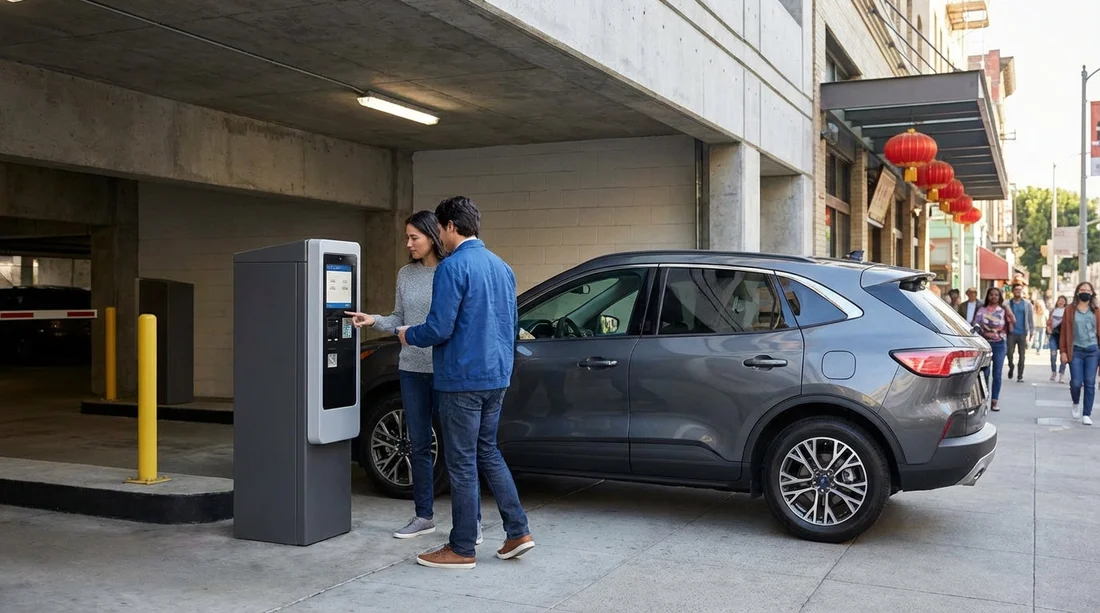
Payment: pay-on-entry ticket systems and pay-by-plate kiosks are both common. Have a credit card ready, and keep your ticket or receipt until you have left the area.
If you are coming from Union Square, approach via Powell, Stockton, or Kearny rather than trying to cut through tiny alleys. If you are coming from the Bay Bridge, your navigation may funnel you into the Financial District first. That is not a problem, it can be an opportunity to use a taller-clearance garage there as your backup.
Step 3: Have a North Beach backup, it is often easier
North Beach is a short walk from Chinatown. Parking can be simpler because garages and lots are sometimes more accessible from wider streets, and the walking route back through Chinatown is pleasant. Your objective is not to park at the closest door, it is to park without scrapes, stress, or a surprise valet rule.
North Beach parking tends to be:
Slightly more flexible on height: though still often under 7'0" for older structures.
Similar pricing: expect comparable hourly rates, sometimes with evening specials in quieter periods.
Better for dinner plans: you can leave your car and avoid repeated re-parking on crowded streets.
A good tactic is to park once for Chinatown and North Beach together. You will do more on foot and reduce the chance of curbside mistakes.
Step 4: Typical rates near Chinatown, and how to keep costs predictable
Parking prices in central San Francisco move with demand, but visitors are usually choosing between three options: street meters, public garages, and private garages attached to hotels or offices. For a first-time Chinatown visit with a car hire, public garages are typically the easiest mix of safety and predictability.
Typical costs you might encounter:
Street meters: often around $3 to $6 per hour, with strict time limits and enforcement. Great if you find a spot, but not ideal if you are staying for a long meal.
Public garages: commonly $4 to $8 per hour, with daily maximums often around $30 to $45. Some garages offer “early bird” or evening rates, but the conditions vary.
Private garages: can be cheaper off-peak, or much pricier at peak times. Some are monthly-focused and may restrict casual parking.
Cost-control tactics that work well:
Choose a daily max garage early: if you will be there more than four hours, the daily cap can protect you.
Avoid re-entry assumptions: many garages treat each entry as a new stay unless your ticket is set up for in-and-out.
Take a photo of your level and row: garages here can be multi-level and tightly signed.
Build a 10-minute buffer: returning late to a meter is an easy way to get a ticket.
Step 5: Payment methods, what to carry, and how to avoid disputes
Most central garages accept credit and debit cards. Some accept cash at staffed booths, but fewer rely on cash-only now. On-street meters and pay stations often support cards and mobile payments, but do not assume mobile signal will be perfect in every spot.
To keep payment smooth:
Carry one physical card: contactless usually works, but chip-and-PIN can be required at some kiosks.
Keep receipts: if a barrier fails to lift or a plate entry is misread, a receipt helps resolve it quickly.
Check your plate entry twice: pay-by-plate systems are unforgiving, a single wrong character can mean a citation.
Watch for “closing” rules: a few smaller garages stop accepting entry late, even if cars inside can exit.
If your car hire uses toll tags or a transponder system, that is separate from parking. Parking charges are almost always paid directly at the garage or meter.
Step 6: Towing and tickets, the Chinatown rules that catch visitors
San Francisco enforces curb regulations aggressively, especially in dense neighbourhoods like Chinatown. The city also has frequent street sweeping, and the sign language can be confusing if you are not used to it. The safest approach is to assume that anything unclear is risky, and choose a garage.
Common towing and ticket triggers near Chinatown:
Red curbs: no stopping, even “just for a minute”.
Bus zones and loading zones: these are actively watched, and you can be cited quickly.
Street sweeping windows: signs show the day and time. Being parked during that window is a ticket, and sometimes a tow depending on location.
Residential permit areas: some blocks limit non-permit parking to one or two hours.
Blocking driveways: even partial obstruction is enough for enforcement.
Also watch for hills. If you do park on a slope, turn your wheels correctly, set the handbrake firmly, and do not leave valuables visible. Break-ins can happen anywhere in the city, and tourist areas are targeted.
Step 7: Avoid valet-only surprises and garage access issues
Hotels and some mixed-use buildings near Chinatown and the Financial District may advertise parking, but it can be valet-only, restricted to guests, or limited to compact vehicles. With a car hire, you want a place that clearly allows self-park and has posted clearance and rates.
Before you turn into an entrance:
Read the board: look for “Self Park”, posted hourly pricing, and a clearance number.
Look for attendants: if there is a valet stand and no self-park lane, assume valet-only.
Confirm operating hours: some lots close and lock, which is a problem if you plan an evening in North Beach.
Check for “no SUVs” language: some older structures restrict wider vehicles regardless of height.
If you are planning a longer San Francisco drive day, it can help to think about where you started your trip. Many visitors arrive via SFO or SJC. If your itinerary includes San Jose, these pages can be useful background for comparing pick-up locations and vehicle categories without changing your Chinatown parking plan: car hire San Jose SJC and car hire airport San Jose SJC. If you collected from SFO, an overview like Enterprise car hire San Francisco SFO can help you identify typical vehicle sizes and policies that affect height and access.
Step 8: A simple, low-stress parking plan you can follow
Use this sequence to park near Chinatown confidently:
1) Check height: confirm your vehicle height and avoid roofs racks if possible.
2) Set a primary garage: aim for a central Chinatown public garage near Portsmouth Square.
3) Choose a backup: pick a North Beach or Financial District garage with a slightly higher clearance.
4) Enter the area deliberately: approach from wider streets, avoid last-minute turns on steep lanes.
5) Pay carefully: card ready, correct plate entry, keep proof of payment.
6) Walk the rest: Chinatown and North Beach are best on foot, and you avoid curb rules.
This approach works because it prioritises clearance and rules over convenience. In Chinatown, a good parking decision is usually the one you make before you see the first “full” sign.
FAQ
What height clearance do I need to park near Chinatown with a hire car? Many nearby garages are around 6'6" to 7'0" clearance. If you have a larger SUV, confirm the posted limit before entering.
How much does parking near Chinatown usually cost? Typical garage pricing is about $4 to $8 per hour, with daily maximums often around $30 to $45. Street meters can be cheaper per hour but have strict limits.
Do garages and meters take card payments? Most garages accept credit or debit cards, and many meters or kiosks do too. Keep a receipt or confirmation, especially with pay-by-plate systems.
Is it safe to park on the street in Chinatown? Street parking is possible, but signage is strict and towing can be fast. A garage is usually lower risk, and always leave nothing visible in the car.
Can I park in a hotel garage if I am not staying there? Sometimes, but many hotel facilities are valet-only or guest-restricted. Look for clearly signed self-park access, posted rates, and a clearance number.




























































































